Migraines and periods: why, and what you can do
Menstrual migraine is a real cycle-linked condition, not a headache to dismiss.
4 min read
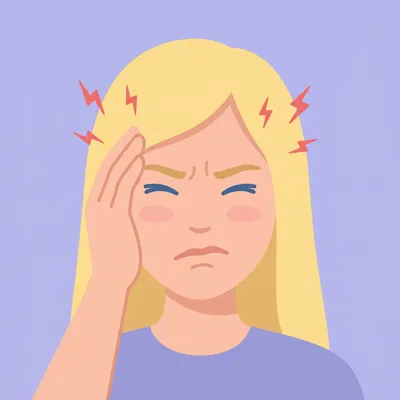
A few days before your period, the pain sets in. Not just a headache, a real migraine that stops you in your tracks. This pain is real and it has a physical cause. It even has a name: menstrual migraine, a recognised condition. If you've been told "it's hormonal, nothing can help," that's not true. Solutions exist.
Menstrual migraine is real, recognised and common
Losing one to three days every month to pain is not a minor thing. You are not exaggerating, and it is not "in your head."
In France, 20 to 25% of adult women get migraines, three times more than men [1]. Among them, 6 in 10 link their attacks directly to their period [2].
Menstrual migraine is a clinical entity in its own right, recognised by the International Classification of Headache Disorders (the medical reference for headaches) [3]. These attacks last about 30% longer, are more intense, and resist standard treatments more [4].
- Pure menstrual migraine: attacks happen only around your period, 2 days before to 3 days after. This affects 7 to 14% of women with migraines [3].
- Period-worsened migraine: attacks at other times too, but clearly worse around your period.
Sources (4)
- [1] INSERM. Dossier Migraine. 2023. Disponible sur : https://www.inserm.fr/dossier/migraine/
- [2] MacGregor EA. Menstrual migraine. Curr Opin Neurol. 2008;21(3):309-315. PMID 18451715. doi:10.1097/WCO.0b013e3282fd184b
- [3] International Headache Society (IHS). The International Classification of Headache Disorders, 3rd edition (ICHD-3). Cephalalgia. 2018;38(1):1-211. doi:10.1177/0333102417738202
- [4] MacGregor EA, Victor TW, Hu X, et al. Characteristics of menstrual vs nonmenstrual migraine: a post hoc analysis of the GEM Study. Headache. 2010;50(4):528-538. PMID: 20236340
Why your brain reacts to the oestrogen drop
Your oestrogens act like a cushion that softens pain signals and steadies the brain's blood vessels. Just before your period, at the end of the luteal phase (the second half of your cycle), their level drops sharply.
It is this rapid drop, not the absolute level, that triggers the attack [5]. That is why the migraine often hits the day before or the first day of your period, not at random.
Hormones are not the only cause. Three other factors add up:
- Prostaglandins: these inflammatory molecules, made to contract the uterus, enter the blood and amplify inflammation, including around the brain's vessels.
- Dehydration: hormonal shifts change your body's water balance, and lack of water is a known trigger.
- Magnesium: up to 1 in 2 people with migraines run low [6], and levels fall further before the period [10].
Each of these links is a lever you can act on.
Sources (3)
- [5] Somerville BW. The role of estradiol withdrawal in the etiology of menstrual migraine. Neurology. 1972;22(4):355-365. doi:10.1212/WNL.22.4.355 ; MacGregor EA. Oestrogen and attacks of migraine with and without aura. Lancet Neurol. 2004;3(6):354-361
- [6] Mauskop A, Varughese J. Why all migraine patients should be treated with magnesium. J Neural Transm. 2012;119(5):575-579. doi:10.1007/s00702-012-0790-2
- [10] Facchinetti F, Sances G, Borella P, et al. Magnesium prophylaxis of menstrual migraine: effects on intracellular magnesium. Headache. 1991;31(5):298-301. doi:10.1111/j.1526-4610.1991.hed3105298.x
Migraine or headache: the right word leads to the right treatment
Telling a tension headache from a migraine is not about ranking suffering, it is about strategy. The right diagnosis leads to the right treatment.
A tension headache squeezes both sides of your head, like a tight band. The pain is diffuse, moderate, with no nausea and no bother from light.
A migraine is often pulsating (throbbing with your heartbeat), on one side, intense. It comes with nausea and hypersensitivity to light, noise, and smells. Some women get an aura before the attack: visual disturbances (bright spots, zigzags) or tingling, lasting a few minutes to an hour [3].
This matters: paracetamol, useful for a mild headache, rarely handles a menstrual migraine [7]. Migraine-specific treatments (targeted anti-inflammatories, triptans) work differently.
If you recognise migraine in what you feel each month, note it down. This will be valuable for your doctor.
Sources (2)
- [3] International Headache Society (IHS). The International Classification of Headache Disorders, 3rd edition (ICHD-3). Cephalalgia. 2018;38(1):1-211. doi:10.1177/0333102417738202
- [7] Société Française d'Études des Migraines et Céphalées (SFEMC). Recommandations pour la prise en charge diagnostique et thérapeutique de la migraine chez l'adulte. 2021 ; European Headache Federation. Guidelines for the management of menstrual migraine. J Headache Pain. 2017
What can bring relief, from daily habits to treatments
No single solution works for everyone. But the range is wide, from daily habits to targeted treatments, to build with your doctor.
For daily life, a few habits ease the load your body absorbs:
- Hydration: aim for 1.5 to 2 litres of water a day, a bit more around your period [8].
- Regular sleep: steady hours and 7 to 8 hours a night, weekends included [8].
- Diet: regular meals rich in omega-3 (oily fish, walnuts, flaxseed), without skipping meals [9].
These are tools, not orders: experiment without guilt.
On the medical side, several options exist, from prevention to the attack itself:
- Magnesium: 300 to 600 mg a day can cut attack frequency, with few side effects [6][10].
- Anti-inflammatories (NSAIDs): started 2 days before your period for 5 to 7 days, as targeted prevention [7].
- Triptans: drugs designed for migraine; frovatriptan is studied for prevention around the period [7].
- Oestrogen gel or patch: applied to "cushion" the oestrogen drop [5]. They are contraindicated if you have migraine with aura, due to an increased vascular risk [7].
Your doctor, a GP, gynaecologist or neurologist, will help you build a tailored strategy.
Sources (6)
- [8] Spigt MG, Kuijper EC, Schayck CP, et al. Increasing the daily water intake for the prophylactic treatment of headache. Eur J Neurol. 2005;12(9):715-718. doi:10.1111/j.1468-1331.2005.01081.x
- [9] Ramsden CE, Zamora D, Faurot KR, et al. Dietary alteration of n-3 and n-6 fatty acids for headache reduction in adults with migraine. BMJ. 2021;374:n1448. doi:10.1136/bmj.n1448
- [6] Mauskop A, Varughese J. Why all migraine patients should be treated with magnesium. J Neural Transm. 2012;119(5):575-579. doi:10.1007/s00702-012-0790-2
- [10] Facchinetti F, Sances G, Borella P, et al. Magnesium prophylaxis of menstrual migraine: effects on intracellular magnesium. Headache. 1991;31(5):298-301. doi:10.1111/j.1526-4610.1991.hed3105298.x
- [7] Société Française d'Études des Migraines et Céphalées (SFEMC). Recommandations pour la prise en charge diagnostique et thérapeutique de la migraine chez l'adulte. 2021 ; European Headache Federation. Guidelines for the management of menstrual migraine. J Headache Pain. 2017
- [5] Somerville BW. The role of estradiol withdrawal in the etiology of menstrual migraine. Neurology. 1972;22(4):355-365. doi:10.1212/WNL.22.4.355 ; MacGregor EA. Oestrogen and attacks of migraine with and without aura. Lancet Neurol. 2004;3(6):354-361
Menstrual migraine is not a whim or a lack of resilience: it is a very real biological reaction. You do not have to "just deal with it." A symptom diary over three cycles gives weight to your words in a consultation and helps you see what brings relief. Log your attacks and periods in Endora, then talk to your doctor.
This article is for information only and does not replace the advice of a health professional. If a symptom worries you, talk to a doctor.