Back pain during your period: why it happens and how to ease it
Your uterus and your lower back share the same nerves. That's what explains the pain, and what calms it.
3 min read

The lower back pain you feel during your period is real, and it has a physical cause. Between 40 and 60% of women with painful periods also get back pain. It's not "all in your head," and it's nobody's fault. Here's why it happens, and what can bring you relief.
Back pain starts in the uterus, not the back
When your period begins, the lining of your uterus releases prostaglandins (molecules that trigger the uterus to contract). The more your body makes, the stronger the cramps [1].
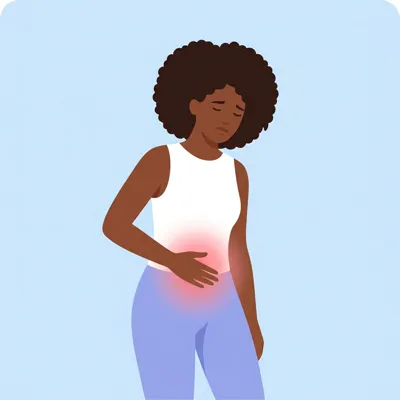
The nerves of your uterus and those of your lower back travel the same pathways in the spinal cord. When the uterus sends a pain signal, the back receives it too. This is called referred pain: it's very real, even though it starts in the uterus [2].
After hurting cycle after cycle, the muscles of your lower back tense up to protect the area. Knots of tension (trigger points) form there and keep the pain going [2].
The result: between 40 and 60% of women with painful periods also get back pain [1][3]. You are far from alone.
Sources (3)
- [1] Dawood MY. Primary Dysmenorrhea: Advances in Pathogenesis and Management. Obstet Gynecol. 2006;108(2):428-441.
- [2] Aredo JV, Heyrana KJ, Karp BI, Shah JP, Stratton P. Relating Chronic Pelvic Pain and Endometriosis to Signs of Sensitization and Myofascial Pain and Dysfunction. Semin Reprod Med. 2017;35(1):88-97.
- [3] Iacovides S, Avidon I, Baker FC. What we know about primary dysmenorrhea today: a critical review. Hum Reprod Update. 2015;21(6):762-778.
A retroverted uterus: a variant, not a disease
In about one woman in four, the uterus tilts backward, toward the spine, rather than forward. This is a retroverted uterus, an anatomical variant, like being left-handed [4].
Most women feel nothing from it. But its closeness to the sacrum (the bone at the base of the spine) can add to back pain when the uterus contracts [4].
A mobile retroverted uterus isn't painful on its own. But if it's fixed backward by adhesions or by endometriosis, the pain is often stronger. The problem then isn't the position, but whatever is holding the uterus in place [4].
Sources (1)
- [4] Retailleau L et al. Utérus rétroversé : mise au point. Gynécologie Obstétrique & Fertilité. 2013;41(9):521-526. Données de prévalence (20-25 %) également confirmées par Williams Gynecology (Hoffman BL et al., 4th ed., McGraw-Hill, 2020).
Heat, stretching, anti-inflammatories: what really helps
Several simple tools act on the mechanism behind the pain. You can combine them and adapt them to your own pace.
- Heat. A hot water bottle or heat patch at 39-40 °C on the lower back, for 20 to 30 minutes, widens blood vessels and relaxes tense muscles [5].
- Gentle stretching. Child's pose, cat-cow and lying twists mobilize the spine and release endorphins, your body's natural painkillers [5].
- Self-massage. A tennis ball rolled against a wall, on each side of the lower back, targets the tension knots [2].
- Anti-inflammatory medicines. Ibuprofen or naproxen block prostaglandin production, so they treat the cause of the contractions, not just the symptom [1][6].
With anti-inflammatories, timing matters: start at the first signs, before the pain sets in [1]. They aren't right for everyone. If you have stomach trouble or a history of ulcers, ask your doctor or pharmacist for advice.
Sources (4)
- [5] Kannan P, Claydon LS. Some physiotherapy treatments may relieve menstrual pain in women with primary dysmenorrhea: a systematic review. J Physiother. 2014;60(1):13-21.
- [2] Aredo JV, Heyrana KJ, Karp BI, Shah JP, Stratton P. Relating Chronic Pelvic Pain and Endometriosis to Signs of Sensitization and Myofascial Pain and Dysfunction. Semin Reprod Med. 2017;35(1):88-97.
- [1] Dawood MY. Primary Dysmenorrhea: Advances in Pathogenesis and Management. Obstet Gynecol. 2006;108(2):428-441.
- [6] Marjoribanks J, Ayeleke RO, Farquhar C, Proctor M. Nonsteroidal anti-inflammatory drugs for dysmenorrhoea. Cochrane Database Syst Rev. 2015;(7):CD001751.
When back pain is a warning sign: think of endometriosis
Sometimes back pain tells a different story. Endometriosis is a condition where tissue similar to the uterine lining grows outside the uterus [8].
When this tissue reaches the uterosacral ligaments (the cords that link the uterus to the sacrum), it causes deep inflammation and intense back pain during periods. This is the most common site of deep endometriosis, up to 69% of cases [7].
Some signs set this pain apart from ordinary period pain:
- pain that worsens from one cycle to the next instead of staying stable;
- pain that no longer responds to your usual anti-inflammatories;
- pain during sex, especially deep penetration;
- pain that radiates to the buttocks or thighs [7][8].
Endometriosis affects about 10% of women of reproductive age, or 1.5 to 2.5 million women in France [8]. The average delay before diagnosis is still 7 years, often because the pain is dismissed [8].
Seeking care isn't panicking, it's respecting yourself. A clinical exam and an expert ultrasound or a pelvic MRI (an imaging scan of the pelvis) help reach a diagnosis [8]. You have every right to insist and to ask for a second opinion.
Sources (2)
- [8] Zondervan KT, Becker CM, Missmer SA. Endometriosis. N Engl J Med. 2020;382(13):1244-1256.
- [7] Chapron C, Fauconnier A, Vieira M, Barakat H, Dousset B, Pansini V, Vacher-Lavenu MC, Dubuisson JB. Anatomical distribution of deeply infiltrating endometriosis: surgical implications and proposition for a classification. Hum Reprod. 2003;18(1):157-161. PMID: 12525459
Your back pain during your period has clear causes: overly zealous molecules, shared nerves, tense muscles. You have concrete tools: heat, stretching, and anti-inflammatories taken at the right time. And if the pain worsens or resists, seeing a doctor isn't an overreaction, it's respecting yourself. Tracking your pain cycle after cycle in Endora helps you talk about it with clear reference points.
This article is for information only and does not replace the advice of a health professional. If a symptom worries you, talk to a doctor.