Why your belly slows down at menopause
The link between your estrogen, your transit and that belly that hardens by evening, plus a simple routine to feel lighter again.
4 min read
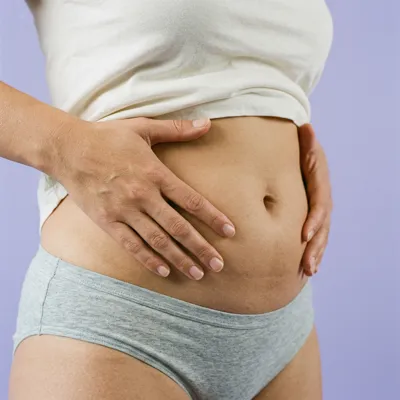
In the morning your belly is flat and soft. By four in the afternoon your waistband is tight, and your stomach feels hard and swollen. That heaviness is real, and it has a precise cause. Constipation already affects women two to three times more than men, and falling estrogen adds to that slowdown at menopause. This isn't a lack of willpower or a badly managed plate: it's physiology.
Falling estrogen genuinely slows your gut
What you feel has a precise mechanism, it's not a vague impression. Picture your intestine as a long muscular tube that pushes its contents along in steady waves. Estrogen helps set the tempo of those contractions.
At menopause, this hormone drops and gut motility slows: the contractions space out and transit takes longer [3]. The longer stool sits in the colon, the more water your body reabsorbs. The result is stool that's harder, drier and tougher to pass [3].
This also explains a well-known gap: constipation affects women two to three times more than men [1]. It's not about willpower, it's mechanical.
There's a second layer. Lower estrogen makes the nerves in your gut more sensitive [2]. The same amount of gas or food that used to pass unnoticed now registers as real discomfort. You're not only making a bit more gas, your body notices it more. That feeling is genuine, not in your head.
Sources (3)
- [3] Yoon K, Kim N. Roles of Sex Hormones and Gender in the Gut Microbiota. J Neurogastroenterol Motil. 2021;27(3):314-325.
- [1] World Gastroenterology Organisation. Constipation: A Global Perspective. 2022.
- [2] Mulak A, Tache Y, Larauche M. Sex hormones in the modulation of irritable bowel syndrome. World J Gastroenterol. 2014;20(10):2433-2448.
Your gut bacteria are in constant conversation with your hormones
A second player joins in: your microbiome, the trillions of bacteria living in your intestine. Some of them talk directly to your hormones.
Scientists call this group the estrobolome (the bacteria that can metabolise estrogen) [4]. Your hormones shape your bacteria, and your bacteria recycle some of your estrogen back into circulation. It's a two-way conversation.
When estrogen falls, the diversity of this microbiome drops and the balance shifts [4]. In practice: more fermentation, so more gas, more bloating, and that belly that hardens by evening. This imbalance also feeds a quiet but real low-grade inflammation [4].
That's why cutting everything to "stop bloating" is a false good idea. Over-restricting only thins the microbiome further. You end up with a joyless plate and a belly that's just as sensitive.
The logic runs the other way: feed this microbiome to help it rebalance. Fibre to nourish it, ferments to repopulate it. You're not fighting your bacteria, you're rebuilding their diversity.
Sources (1)
- [4] Baker JM, Al-Nakkash L, Herbst-Kralovetz MM. Estrogen-gut microbiome axis: Physiological and clinical implications. Maturitas. 2017;103:45-53.
Gradual fibre, water, walking and ferments relaunch the engine
Now the practical part. Four simple levers, none of which forbid you anything.
Fibre, added gradually. Soluble fibre (oats, psyllium, legumes, ripe fruit) holds water and makes stool softer and easier to pass [5]. The classic trap is eating a lot all at once, which triggers exactly the bloating you want to avoid. Build up over two to three weeks, not in a day [5]. Most adults never reach the recommended 25 to 30 g a day [6].
Water, the essential partner. Without enough fluid, fibre can neither swell nor soften stool [7]. Drink regularly through the day, before you feel thirsty.
A walk, starting tonight. Moving, even ten minutes after a meal, stimulates the contractions of your gut [8]. Prolonged inactivity, by contrast, lulls transit to sleep [8].
Ferments, to repopulate. Specific strains like Bifidobacterium lactis shorten transit time and improve regularity [9]. Yogurt, kefir and fermented vegetables supply them daily.
One last thing: no universal banned-foods list works. What bloats another woman may suit you perfectly. Watch what flows easily for you.
Sources (5)
- [5] van der Schoot A, Drysdale C, Whelan K, Dimidi E. The Effect of Fiber Supplementation on Chronic Constipation in Adults: An Updated Systematic Review and Meta-Analysis of Randomized Controlled Trials. Am J Clin Nutr. 2022;116(4):953-969.
- [6] ANSES. Étude individuelle nationale des consommations alimentaires (INCA 3). 2017.
- [7] Boilesen SN, Tahan S, Dias FC, et al. Water and fluid intake in the prevention and treatment of functional constipation. J Pediatr (Rio J). 2017;93(4):320-327. (étude en population pédiatrique)
- [8] Iovino P, Chiarioni G, Bilancio G, et al. New onset of constipation during long-term physical inactivity. PLoS One. 2013;8(8):e72608.
- [9] Dimidi E, Christodoulides S, Scott SM, Whelan K. Mechanisms of Action of Probiotics and the Gastrointestinal Microbiota on Gut Motility and Constipation. Adv Nutr. 2017;8(3):484-494.
When slow digestion needs a doctor, not a routine
The routine fits a transit that slows gradually, in step with hormonal change. But some signals fall outside that pattern and deserve a prompt appointment.
One myth to drop: "a sudden change in transit is normal at menopause." It isn't. New, persistent constipation should always be evaluated [1].
See a doctor without waiting, especially after 50, if you notice:
- Blood in your stool, bright red or dark.
- Abdominal pain that's unusual or keeps coming back.
- A sudden alternation between constipation and diarrhoea.
- Unexplained weight loss or marked fatigue.
These signs don't mean something serious is certain. But they call for ruling out an organic cause [10]. You have the right to be taken seriously, and a second opinion is always an option.
Worth noting: in some women, restoring estrogen can indirectly ease digestive comfort [3]. MHT isn't prescribed for that alone, but if you're considering it for other menopause symptoms, raise it with your doctor.
Sources (3)
- [1] World Gastroenterology Organisation. Constipation: A Global Perspective. 2022.
- [10] National Institute for Health and Care Excellence (NICE). Constipation: Clinical Knowledge Summary, Red flags and when to refer. 2023.
- [3] Yoon K, Kim N. Roles of Sex Hormones and Gender in the Gut Microbiota. J Neurogastroenterol Motil. 2021;27(3):314-325.
Your digestion didn't break: it changed pace because your hormones changed the tempo. That slowdown is real, hormonal and adjustable, neither your fault nor a life sentence. Start gently: build up fibre over two to three weeks, drink enough, walk ten minutes after meals, add a little ferment to your days. Then watch what flows easily for you. Daily tracking turns your sensations into useful information, at your own pace. Your belly can become an ally again, not an opponent.
This article is for information only and does not replace the advice of a health professional. If a symptom worries you, talk to a doctor.