You're gaining weight and nothing changed? What your body never explained
The kilos that arrived in a few months follow a precise logic, and you can take charge of it.
3 min read
One morning your jeans button with a fight, the scale shows two or three kilos more, and your plate never changed. You're not imagining it: this weight gain is real and well documented. Over a few months, 2 to 5 kg can settle in without you "letting go." Your body changed the rules, and those rules can be relearned.
Menopause adds 2 to 5 kg, and the fat heads for your belly
No, you don't "automatically gain 10 kilos" at menopause. The gain truly tied to this transition runs around 2 to 5 kg over several years, roughly 0.5 to 1 kg a year [1][2]. A good share comes from plain aging, men included, not from hormones alone.
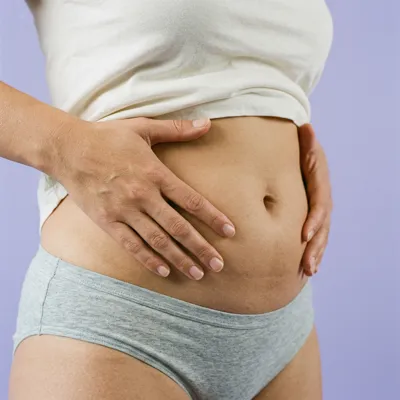
So why do so many women describe an "explosion"? Because the number on the scale hides the real story: where the fat lands. As estrogen drops, it leaves the hips and moves to the belly, deep around your organs. This visceral fat can rise by about 44% across the transition [3].
So your waist grows even when weight barely moves [5]. If your waistband tightens while the scale stalls, you're seeing exactly what science describes. This deep fat is also more metabolically active: reining it in is about your health, not just your shape [3]. So the quiet question in the back of your mind, whether you're secretly doing something wrong, has an answer. You aren't.
Sources (4)
- [1] Davis SR, Castelo-Branco C, Chedraui P, et al. Understanding weight gain at menopause. Climacteric. 2012;15(5):419-429. doi:10.3109/13697137.2012.707385
- [2] Greendale GA, Sternfeld B, Huang M, et al. Changes in body composition and weight during the menopause transition. JCI Insight. 2019;4(5):e124865. doi:10.1172/jci.insight.124865
- [3] Lovejoy JC, Champagne CM, de Jonge L, et al. Increased visceral fat and decreased energy expenditure during the menopausal transition. Int J Obes (Lond). 2008;32(6):949-958. doi:10.1038/ijo.2008.25
- [5] Mishra GD, Kuh D. Waist circumference and body composition changes during the menopausal transition. BMJ. 2012;344:e402.
The real culprit isn't your metabolism, it's shrinking muscle
We keep hearing that "metabolism collapses" at 50. It doesn't. A large study measured energy use across the whole lifespan: adjusted for muscle mass, it stays stable between ages 20 and 60 [4]. Your cells didn't "break."
What changes is muscle. At menopause, falling estrogen speeds up its loss [6]. This is sarcopenia (the gradual loss of muscle): about 0.5 to 1% per year after 50 [7].
And muscle is an engine that burns fuel even at rest. Less muscle means your resting burn drops by a few dozen calories a day [4]. On identical meals, that small gap ends up in storage over months. That is the honest answer to "I changed nothing but I'm gaining." The good news: an engine can be rebuilt.
Sources (3)
- [4] Pontzer H, Yamada Y, Sagayama H, et al. Daily energy expenditure through the human life course. Science. 2021;373(6556):808-812. doi:10.1126/science.abe5017
- [6] Maltais ML, Desroches J, Dionne IJ. Changes in muscle mass and strength after menopause. J Musculoskelet Neuronal Interact. 2009;9(4):186-197.
- [7] Volpi E, Nazemi R, Fujita S. Muscle tissue changes with aging. Curr Opin Clin Nutr Metab Care. 2004;7(4):405-410.
Why eating less and less works against you instead of helping
If "eat less, move more" hasn't worked for you, the problem isn't you, it's the advice. When you slash calories hard, your body doesn't draw only on fat: up to a quarter of the weight you lose can be muscle [8].
You've just sabotaged your own engine. Less muscle means an even lower resting burn [6]. When normal eating resumes, the weight returns, often as fat. That's the vicious cycle of severe restriction.
The data are clear: a moderate deficit with enough protein protects lean mass while you lose [9]. The answer to a plateau is never "deprive yourself more." Eating too little is what keeps the plateau going.
Sources (3)
- [8] Cava E, Yeat NC, Mittendorfer B. Preserving Healthy Muscle during Weight Loss. Adv Nutr. 2017;8(3):511-519. doi:10.3945/an.116.014506
- [6] Maltais ML, Desroches J, Dionne IJ. Changes in muscle mass and strength after menopause. J Musculoskelet Neuronal Interact. 2009;9(4):186-197.
- [9] Leidy HJ, Clifton PM, Astrup A, et al. The role of protein in weight loss and maintenance. Am J Clin Nutr. 2015;101(6):1320S-1329S.
What actually works: protein, muscle, and a bit of patience
The strategy follows the mechanism: feed and rebuild muscle, don't starve it. Three levers, all evidence-backed.
- Protein. Aim for about 1.2 to 1.6 g per kilo per day, spread across three meals, starting at breakfast [9][12]. If you have a kidney condition, confirm these amounts with your doctor.
- Strength training. Two to three sessions a week rebuild lean mass and slow fat gain over years [10][12]. Bands or light weights are enough to start.
- Endurance, as a complement. About 150 minutes a week of brisk walking or cycling mainly targets belly fat [11].
Then comes patience. Expect 8 to 12 weeks of consistency before clear results, around 0.25 to 0.5 kg a week [13]. Be wary of quick fixes: detoxes and extreme fasts aren't validated after menopause and set up the rebound [14]. For some women, menopausal hormone therapy (MHT), discussed with a doctor, can limit fat moving to the belly, without being a weight-loss treatment [1].
Sources (7)
- [9] Leidy HJ, Clifton PM, Astrup A, et al. The role of protein in weight loss and maintenance. Am J Clin Nutr. 2015;101(6):1320S-1329S.
- [12] Morton RW, Murphy KT, McKellar SR, et al. Effect of protein supplementation on resistance training-induced gains in muscle mass and strength in healthy adults. Br J Sports Med. 2018;52(6):376-384. doi:10.1136/bjsports-2017-097608
- [10] Bea JW, Going SB, Wertheim BC, et al. Resistance training predicts 6-yr body composition change in postmenopausal women. Med Sci Sports Exerc. 2010;42(7):1286-1295.
- [11] Sternfeld B, Wang H, Quesenberry CP, et al. Physical activity and changes in weight and waist circumference in midlife women. Am J Epidemiol. 2004;160(9):912-922.
- [13] American College of Sports Medicine. ACSM Position Stand: Physical Activity Intervention Strategies for Weight Loss and Prevention of Weight Regain for Adults. Med Sci Sports Exerc. 2009;41(2):459-471.
- [14] National Institute for Health and Care Excellence (NICE). Menopause: diagnosis and management (NG7). 2014, updated 2019.
- [1] Davis SR, Castelo-Branco C, Chedraui P, et al. Understanding weight gain at menopause. Climacteric. 2012;15(5):419-429. doi:10.3109/13697137.2012.707385
These kilos don't prove you "let go." Fat migrated to your belly, your muscle engine shrank, and on identical meals you burn a little less. None of it is irreversible. Your first move, starting tomorrow: add a real portion of protein at breakfast, then measure your waist, your true marker. The scale confuses muscle and fat; your waistband tells the truth. Tracking these markers over eight weeks turns a vague feeling into visible progress.
This article is for information only and does not replace the advice of a health professional. If a symptom worries you, talk to a doctor.