Your belly changed and you did nothing different. What's really going on?
At menopause, fat moves to your belly. Here's why, and the one lever that actually matters.
3 min read
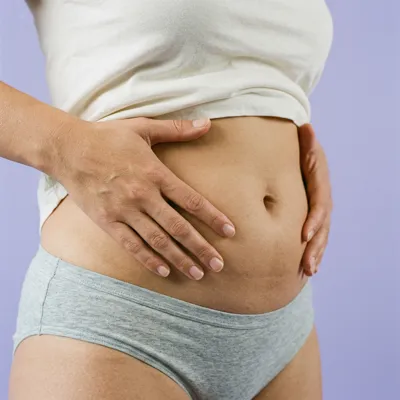
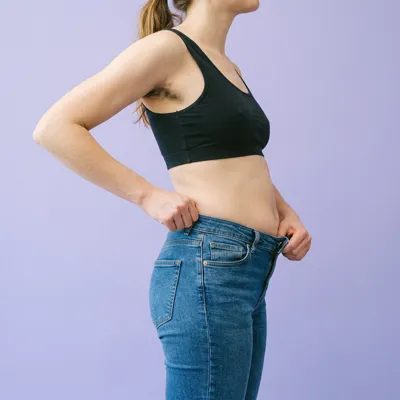
You button the jeans that fit six months ago, and they won't close. Yet you've changed nothing: same meals, same habits, same effort. That sense of not quite recognizing your body is real and valid. Here's the truth: you didn't fail, and you didn't get lazy. The rules of the game changed, and nobody warned you.
Fat moves house: age sets the amount, menopause sets the spot
"Is it menopause or just age?" The honest answer: a bit of both, but not how you think.
The midlife weight gain, those 2 to 5 kilos that creep in, is driven mainly by aging and lifestyle, not by menopause itself [1]. Women gain about 0.7 kg per year in these years, and so do men the same age [3].
Menopause does something else: it stores fat differently. Before, your body parked it on your hips and thighs. At the transition, it moves it around your middle, deep around your organs (visceral fat) [2][4].
That's why your silhouette shifts while the scale barely moves [5]. The gap between the scale and the mirror is confusing, but it is not in your head. Age sets the amount, menopause sets the spot.
Sources (5)
- [1] Davis SR, Castelo-Branco C, Chedraui P, Lumsden MA, Nappi RE, Shah D, Villaseca P; Writing Group of the International Menopause Society. Understanding weight gain at menopause. Climacteric. 2012;15(5):419-429. doi:10.3109/13697137.2012.707385
- [3] Greendale GA, Sternfeld B, Huang M, Han W, Karvonen-Gutierrez C, Ruppert K, Cauley JA, Finkelstein JS, Jiang SF, Karlamangla AS. Changes in body composition and weight during the menopause transition. JCI Insight. 2019;4(5):e124865. doi:10.1172/jci.insight.124865
- [2] Lovejoy JC, Champagne CM, de Jonge L, Xie H, Smith SR. Increased visceral fat and decreased energy expenditure during the menopausal transition. Int J Obes (Lond). 2008;32(6):949-958. doi:10.1038/ijo.2008.25
- [4] Mauvais-Jarvis F, Clegg DJ, Hevener AL. The role of estrogens in control of energy balance and glucose homeostasis. Endocr Rev. 2013;34(3):309-338. doi:10.1210/er.2012-1055
- [5] Karvonen-Gutierrez C, Kim C. Association of Mid-Life Changes in Body Size, Body Composition and Obesity Status with the Menopausal Transition. Healthcare (Basel). 2016;4(3):42. doi:10.3390/healthcare4030042
Your real lever is muscle, not just hormones
You were told it's all "hormonal." That's bad news in disguise, because you can't command your hormones. But three players are involved, and one is a real lever.
Three players:
- Estrogen: as it falls, it stops sending fat to your hips; fat heads for your belly instead [4].
- Age: your resting energy use drifts down slowly [2].
- Muscle: you lose 3 to 8% per decade after 30, speeding up after 50 [6].
Picture muscle as a furnace: while it burns, it spends energy even at rest. Less muscle means a smaller furnace, so your body spends less without you changing a thing. Two of the three, aging and hormones, you can't negotiate with. The third, muscle, you can protect and even rebuild. That is the one that truly responds to your effort.
Sources (4)
- [4] Mauvais-Jarvis F, Clegg DJ, Hevener AL. The role of estrogens in control of energy balance and glucose homeostasis. Endocr Rev. 2013;34(3):309-338. doi:10.1210/er.2012-1055
- [2] Lovejoy JC, Champagne CM, de Jonge L, Xie H, Smith SR. Increased visceral fat and decreased energy expenditure during the menopausal transition. Int J Obes (Lond). 2008;32(6):949-958. doi:10.1038/ijo.2008.25
- [6] Volpi E, Nazemi R, Fujita S. Muscle tissue changes with aging. Curr Opin Clin Nutr Metab Care. 2004;7(4):405-410. doi:10.1097/01.mco.0000134362.76653.b2
- [14] Pontzer H, Yamada Y, Sagayama H, et al. Daily energy expenditure through the human life course. Science. 2021;373(6556):808-812. doi:10.1126/science.abe5017
What actually works (and why starving backfires)
Your instinct is to eat far less. Today, that instinct works against you. When you cut hard, your body doesn't only burn fat: it burns muscle too [7]. You put out your own furnace, your metabolism slows, and the fat returns the moment you eat normally again.
The real shift: fuel your muscle instead of starving it. With age, your body uses protein less efficiently, so you need a little more [7].
- Protein: about 1 to 1.2 grams per kilo per day, spread across meals (eggs, Greek yogurt, fish, legumes, poultry) [7].
- Strength training: 2 to 3 times a week; it rebuilds the furnace and trims belly fat [8].
- Aerobic activity: 150 to 300 minutes a week at moderate intensity, linked to less visceral fat [9][10].
- Sleep and stress: poor sleep raises cortisol, a hormone that favors belly storage [11].
If your symptoms are heavy, menopause hormone therapy (MHT) can modestly limit this shift toward the belly in some women [1]. It's prescribed for symptoms, not weight, and decided case by case with your doctor.
Sources (6)
- [7] Bauer J, Biolo G, Cederholm T, et al. Evidence-based recommendations for optimal dietary protein intake in older people: a position paper from the PROT-AGE Study Group. J Am Med Dir Assoc. 2013;14(8):542-559. doi:10.1016/j.jamda.2013.05.021
- [8] Wewege MA, Desai I, Honey C, et al. The effect of resistance training in healthy adults on body fat percentage, fat mass and visceral fat: a systematic review and meta-analysis. Sports Med. 2022;52(2):287-300. doi:10.1007/s40279-021-01562-2
- [9] World Health Organization. WHO Guidelines on Physical Activity and Sedentary Behaviour. Geneva: WHO; 2020.
- [10] Vissers D, Hens W, Taeymans J, Baeyens JP, Poortmans J, Van Gaal L. The effect of exercise on visceral adipose tissue in overweight adults: a systematic review and meta-analysis. PLoS One. 2013;8(2):e56415. doi:10.1371/journal.pone.0056415
- [11] van der Valk ES, Savas M, van Rossum EFC. Stress and Obesity: Are There More Susceptible Individuals? Curr Obes Rep. 2018;7(2):193-203. doi:10.1007/s13679-018-0306-y
- [1] Davis SR, Castelo-Branco C, Chedraui P, Lumsden MA, Nappi RE, Shah D, Villaseca P; Writing Group of the International Menopause Society. Understanding weight gain at menopause. Climacteric. 2012;15(5):419-429. doi:10.3109/13697137.2012.707385
Before you blame menopause: the check to run
Not every midlife body change is "menopause's fault." Slow gain with a shift toward the belly fits the pattern. Rapid, dramatic, unexplained gain over a few weeks deserves a medical opinion [12].
The first cause to rule out is your thyroid. An underactive thyroid (hypothyroidism) is common in women this age and can cause weight gain [12]. It can mimic menopause: fatigue, feeling cold, low mood, so the two are easy to confuse. These other causes have their own treatments, and you don't want to spend months doing squats for a problem a blood test could catch.
The right move: a simple blood test to check your thyroid and rule out other causes [13]. Asking for it isn't dramatizing, it's acting on the right problem. You deserve to be taken seriously, and an "it's your age" that waves off your request is worth pushing back on.
Sources (2)
- [12] Biondi B. Thyroid and obesity: an intriguing relationship. J Clin Endocrinol Metab. 2010;95(8):3614-3617. doi:10.1210/jc.2010-1245
- [13] Haute Autorité de Santé (HAS). Hypothyroïdie de l'adulte : prise en charge. 2019.
Your body didn't betray you: it changed its rules, with no manual. The amount is about age, the spot is about hormones, but your real lever is muscle. This week, pick one action: add real protein to your breakfast. Next week, add a walk or a strength session. In the app, you can track your meals and activity to see what actually moves, at your own pace, without blaming yourself.
This article is for information only and does not replace the advice of a health professional. If a symptom worries you, talk to a doctor.