Why is my belly flat in the morning and bloated by night?
How to tell reversible bloating and water retention from real fat, and the daily levers that deflate the evening balloon.
3 min read

By evening you're unbuttoning your jeans, though your belly was flat this morning. That feeling is real, and up to one in three women knows it. The good news: if your belly deflates overnight, it's usually gas and water, not fat. And that is reversible.
A belly that deflates overnight is rarely fat
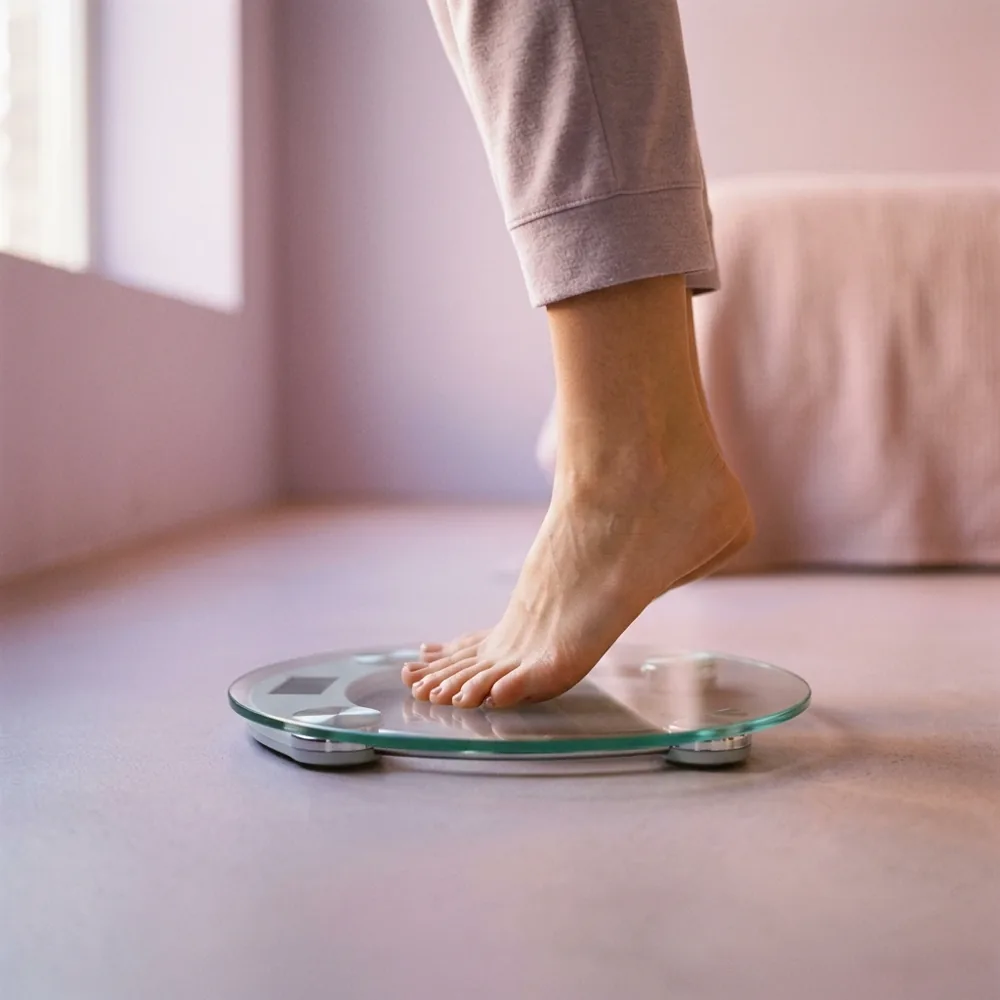
One simple fact calms many women: fat does not vanish overnight. It settles slowly, over weeks, and it's there in the morning and the evening alike. A belly that's flat at dawn and round by night is signalling something else. A common-sense calculation confirms it: storing a kilo of fat takes several thousand extra calories, on the order of 7,000, so gaining three kilos of fat in a single day is physically impossible.
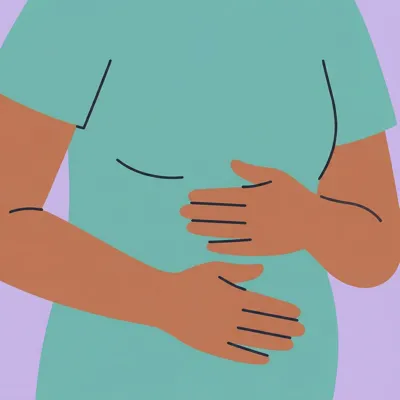
Doctors separate two things people often confuse: bloating (the feeling of pressure) and abdominal distension (the visible rise in your waistline) [1]. That distension builds through the day, then resolves overnight [1].
This is what's called the morning test. If your belly is soft when you wake, your evening swelling comes from gut contents and water, not stored fat. Your waistline can shift by several centimetres in a few hours [2]. This is common: women report it nearly twice as often as men [2]. Visible, yes. Permanent, no.
Sources (2)
- [1] Mari A, Abu Backer F, Mahamid M, et al. Bloating and Abdominal Distension: Clinical Approach and Management. Adv Ther. 2019;36(5):1075-1084. doi:10.1007/s12325-019-00924-7
- [2] Ballou S, Singh P, Nee J, et al. Prevalence and associated factors of bloating. Am J Gastroenterol. 2019.
At menopause, hormones slow your gut and hold water
You haven't become lazy or careless. Your estrogen and progesterone, which swing then fall, directly influence your digestion [3]. Many women report more bloating during this transition. This isn't about willpower: your body simply changed the rules, without handing you the manual.
Progesterone relaxes the muscles of your gut. It slows transit, like a conveyor belt on low speed. Food sits longer, ferments more, and produces more gas [3]. Hence the constipation and the evening swelling.
Hormones also change water retention and your microbiome (the bacteria that digest for you) [3]. One last, quieter mechanism: visceral hypersensitivity. The gut feels the smallest amount of gas intensely, and the belly wall pushes forward instead of contracting [1]. The stomach looks huge for very little gas. It's a real physical reflex, not a feeling.
A slower change also exists: falling estrogen gradually shifts fat storage toward the belly [10]. But that change is gradual, it doesn't come and go within a day. A belly that inflates and deflates is still gas and water.
Sources (3)
- [3] Mulak A, Taché Y, Larauche M. Sex hormones in the modulation of irritable bowel syndrome. World J Gastroenterol. 2014;20(10):2433-2448. doi:10.3748/wjg.v20.i10.2433
- [1] Mari A, Abu Backer F, Mahamid M, et al. Bloating and Abdominal Distension: Clinical Approach and Management. Adv Ther. 2019;36(5):1075-1084. doi:10.1007/s12325-019-00924-7
- [10] Hill DA, Hill SR. Counseling patients about hormone therapy and alternatives for menopausal symptoms. Am Fam Physician. 2010;82(7):801-807.
Your triggers are personal, and tracking reveals them
Some foods swell you more than others. The big family to know is FODMAPs: sugars your bacteria ferment, which produces gas and draws water into the gut [4][5]. The most common:
- Onions, garlic and legumes (lentils, chickpeas).
- Cabbage, some fruits and sweeteners.
- Milk, if you're lactose intolerant.
Cutting these back eases bloating in a good share of the people affected [5]. But tolerance is personal: onions floor you while your colleague digests them fine. That's why ready-made diets disappoint. A low-FODMAP approach works best when you reduce these foods for a while, then reintroduce them one at a time to see which ones affect you [5].
Two other triggers matter: fizzy drinks and salt. Beyond the recommended 5 g of salt a day, excess sodium drives water retention [6]. Drinking less doesn't help, quite the opposite. To spot YOUR culprits, track your meals and bloating for two to three weeks: patterns emerge, because the peak often arrives hours after the meal.
Sources (3)
- [4] Lacy BE, Cangemi D, Vazquez-Roque M. Management of Chronic Abdominal Distension and Bloating. Clin Gastroenterol Hepatol. 2021;19(2):219-231. doi:10.1016/j.cgh.2020.03.056
- [5] Peters SL, Yao CK, Philpott H, et al. Randomised clinical trial: gut-directed hypnotherapy vs low FODMAP diet for IBS. Aliment Pharmacol Ther. 2016;44(5):447-459. doi:10.1111/apt.13706
- [6] Organisation mondiale de la Santé (OMS). Recommandations sur l'apport en sodium chez l'adulte.
Anti-bloat moves to try tonight
These moves won't promise a flat belly in three days, but they're real levers. You can try one tonight.
- A walk after dinner. Ten to fifteen minutes speeds transit and gas release [4].
- Fennel tea. This carminative plant helps the gut move gas along [8].
- Peppermint relaxes the gut muscle and calms spasms, per a meta-analysis of 12 trials [7].
- Fibre, gently. Increased gradually, it feeds good bacteria; some probiotics reduce bloating, with effects that vary by strain [9].
- Less salt and soda. Limit ready meals, cured meats and salty snacks, the hidden sources of sodium [6].
Staying well hydrated, alongside less salt, also helps your body release the water it's holding.
Sources (5)
- [4] Lacy BE, Cangemi D, Vazquez-Roque M. Management of Chronic Abdominal Distension and Bloating. Clin Gastroenterol Hepatol. 2021;19(2):219-231. doi:10.1016/j.cgh.2020.03.056
- [8] Ghazanfarpour M, Mohammadzadeh F, Shokrollahi P, et al. Effect of Foeniculum vulgare (fennel) on symptoms of menopause: a systematic review and meta-analysis. Post Reprod Health. 2018.
- [7] Alammar N, Wang L, Saberi B, et al. The impact of peppermint oil on the irritable bowel syndrome: a meta-analysis. BMC Complement Altern Med. 2019;19(1):21. doi:10.1186/s12906-018-2409-0
- [9] Ford AC, Quigley EMM, Lacy BE, et al. American College of Gastroenterology monograph on the management of irritable bowel syndrome and chronic idiopathic constipation. Am J Gastroenterol. 2014;109 Suppl 1:S2-S26. doi:10.1038/ajg.2014.187
- [6] Organisation mondiale de la Santé (OMS). Recommandations sur l'apport en sodium chez l'adulte.
Your belly isn't your enemy, it's a messenger. If it deflates overnight, it's reminding you that the evening swelling is mostly gas and water, so reversible. You may not fix everything in a week, and that's okay. Your first step tonight: note what you ate and how you feel, without judging yourself.
This article is for information only and does not replace the advice of a health professional. If a symptom worries you, talk to a doctor.