Will MHT make me gain weight?
Menopausal hormone therapy doesn't cause weight gain, and it may even help with the fat that settles around your belly.
4 min read
Your jeans pinch at the waist even though nothing changed in your meals or your activity. You're not imagining it: your shape really does shift at menopause. And when someone mentions MHT (menopausal hormone therapy), a familiar worry shows up: "what if it makes me gain even more?" Fewer than 6% of postmenopausal women in France use MHT, and this fear is part of why [8]. Yet it isn't the treatment rounding out your belly.
Your waist is changing, and it's not because you let yourself go
Your rounding waist is not a sign of letting yourself go. It's a hormonal shift happening inside your body, on a timeline you didn't choose.
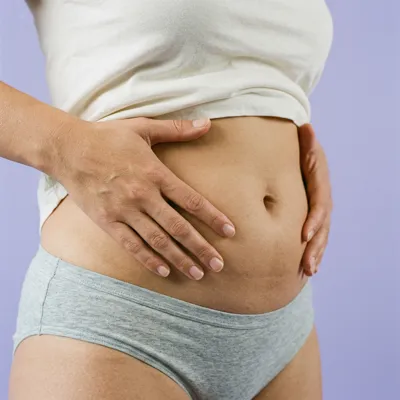
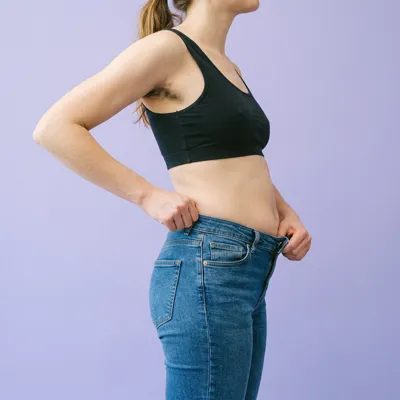
Before menopause, your estrogen sent fat toward your hips and thighs. When it drops, that fat relocates: it leaves the hips and settles around your waist and organs, the deep belly fat called visceral fat [1]. Often it isn't more fat, it's the same fat moving to a new address.
In the large SWAN study, deep abdominal fat rose by about 44% across the transition, driven by falling estrogen, not by any treatment [2].
A second thing happens with age: we lose muscle and the metabolism slows. You burn fewer calories at rest, and weight creeps up by roughly half a kilo a year, whatever treatment you take [2]. Neither menopause nor aging is your fault.
Sources (2)
- [1] Davis SR, Castelo-Branco C, Chedraui P, et al. Understanding weight gain at menopause. Climacteric. 2012;15(5):419-429. doi:10.3109/13697137.2012.707385
- [2] Greendale GA, Sternfeld B, Huang M, et al. Changes in body composition and weight during the menopause transition (SWAN). JCI Insight. 2019;4(5):e124865. doi:10.1172/jci.insight.124865
MHT doesn't cause weight gain: the trials are clear
Here's what may surprise you: put to the test, MHT doesn't add kilos.
A Cochrane review, the most rigorous kind of analysis in medicine, compared women on MHT with women on a placebo. The verdict: no weight difference between the groups [3]. Taking MHT or a hormone-free pill gives the same result on the scale.
The major menopause societies agree. In 2022, the North American Menopause Society concluded that MHT is not associated with weight gain, and may even act favourably on body composition [4].
One useful detail: in the first few weeks, some women notice mild bloating or fluid retention, and the scale nudges up a little [1]. That's water, not fat, and it settles as your body adjusts.
Sources (3)
- [3] Norman RJ, Flight IH, Rees MC. Oestrogen and progestogen hormone replacement therapy for peri-menopausal and post-menopausal women: weight and body fat distribution. Cochrane Database Syst Rev. 2000;(2):CD001018 (mise à jour Marjoribanks et al., 2017)
- [4] The 2022 hormone therapy position statement of The North American Menopause Society. Menopause. 2022;29(7):767-794. doi:10.1097/GME.0000000000002028
- [1] Davis SR, Castelo-Branco C, Chedraui P, et al. Understanding weight gain at menopause. Climacteric. 2012;15(5):419-429. doi:10.3109/13697137.2012.707385
MHT may even help, without being a fat-burner
The data goes further, and this is the part almost nobody tells you.
A meta-analysis pooling over a hundred trials found less abdominal fat and a smaller waist in women on treatment, with better blood-sugar control and a lower diabetes risk [5]. The OsteoLaus study, which measures body composition with detailed imaging, found less visceral fat in users [6]. In the PEPI trial, over three years, the placebo group actually gained more weight and waist size than the treated group [7].
Let's be honest the other way too: MHT is not a weight-loss treatment. It's neutral on weight and rather favourable on fat distribution, but it won't melt your belly.
The real lever stays in your hands: physical activity. Strength training preserves the muscle you'd otherwise lose, and moving reduces visceral fat [1]. On the plate, more protein and fibre helps, with no logic of deprivation. In France, transdermal estradiol, gel or patch, is now preferred for its better metabolic profile [8][9].
Sources (6)
- [5] Salpeter SR, Walsh JM, Ormiston TM, et al. Meta-analysis: effect of hormone-replacement therapy on components of the metabolic syndrome in postmenopausal women. Diabetes Obes Metab. 2006;8(5):538-554
- [6] Papadakis GE, Hans D, Gonzalez-Rodriguez E, et al. Menopausal Hormone Therapy Is Associated With Reduced Total and Visceral Adiposity (OsteoLaus). J Clin Endocrinol Metab. 2018;103(5):1948-1957
- [7] Espeland MA, Stefanick ML, Kritz-Silverstein D, et al. (PEPI Trial). Effect of postmenopausal hormone therapy on body weight and waist and hip girths. J Clin Endocrinol Metab. 1997;82(5):1549-1556
- [1] Davis SR, Castelo-Branco C, Chedraui P, et al. Understanding weight gain at menopause. Climacteric. 2012;15(5):419-429. doi:10.3109/13697137.2012.707385
- [8] Haute Autorité de Santé / CNGOF / GEMVi. Traitements hormonaux de la ménopause : état des lieux et recommandations. 2021
- [9] National Institute for Health and Care Excellence (NICE). Menopause: identification and management (NG23). 2024
A decision to build with your doctor
Understanding that MHT doesn't cause weight gain frees the decision from a false constraint. But MHT isn't right for everyone, and it isn't started lightly.
It's prescribed after an individual benefit-risk assessment: your age, your history, your symptoms, your preferences [4][8]. Its main goal is to ease menopause symptoms and improve your quality of life [8]. Two women the same age can get different advice, and that's normal.
Three safety points to keep in mind:
- MHT is not contraception: in perimenopause, pregnancy is still possible [9].
- Any bleeding after menopause needs medical assessment, no exceptions [9].
- MHT is reviewed regularly: the dose, form and duration can be adjusted.
To prepare for your appointment, track your symptoms over a few weeks and write your questions down. A clear log turns a vague feeling into useful information, and lets you raise the weight question with the facts in hand.
Sources (3)
- [4] The 2022 hormone therapy position statement of The North American Menopause Society. Menopause. 2022;29(7):767-794. doi:10.1097/GME.0000000000002028
- [8] Haute Autorité de Santé / CNGOF / GEMVi. Traitements hormonaux de la ménopause : état des lieux et recommandations. 2021
- [9] National Institute for Health and Care Excellence (NICE). Menopause: identification and management (NG23). 2024
You no longer have to choose between easing your symptoms and staying in control of your body. The fear of gaining weight rested on a shortcut: MHT was blamed for a change in shape already under way, caused by falling estrogen and the passing years. The data is clear: MHT doesn't cause weight gain, and may even limit storage around your belly. It's not a fat-burner, it's a medical treatment, to decide with your doctor, with your eyes open.
This article is for information only and does not replace the advice of a health professional. If a symptom worries you, talk to a doctor.