Eight hours of sleep and still exhausted: what breaks in your nights
In perimenopause, the problem isn't how much you sleep, but how. And nobody explained that to you.
4 min read
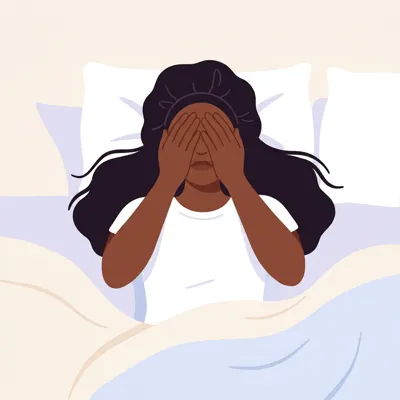
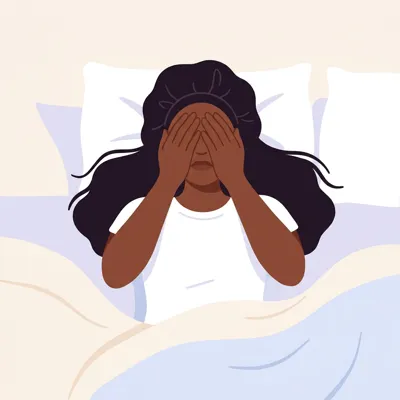
You slept your eight hours and you wake up wrecked, head heavy, already running on empty. That fatigue is real and measurable, and it has a physiological cause. In perimenopause, the problem isn't how many hours you get, it's how deep they are. Here's why your nights stopped recharging you, how to rule out another cause, and the levers you can pull starting tonight. If this fatigue persists despite the adjustments, talk to your doctor.
It's not how long you slept, it's how deep
Sleep quantity and sleep quality are two different things. You can spend eight hours in bed and still wake up flat, because those hours were shallow.
Sleep isn't one uniform block. Each cycle holds a precious phase, deep sleep (the N3 stage, the one that truly repairs your body). It consolidates memory and recharges the battery. This is the phase that collapses during the menopause transition.
The numbers are striking: 39 to 47% of perimenopausal women report sleep problems, and up to 60% of menopausal women have insomnia symptoms [1][2]. More telling still, daytime fatigue is tied more to sleep quality and hot flashes than to total time in bed [3].
This isn't a feeling. In a sleep lab (polysomnography, the test that measures sleep), women objectively show more micro-awakenings and less deep sleep [4]. Your sleep got light as paper, shredded by tiny wake-ups you don't even remember.
Sources (4)
- [1] Baker FC, de Zambotti M, Colrain IM, Bei B. Sleep problems during the menopausal transition: prevalence, impact, and management challenges. Nat Sci Sleep. 2018;10:73-95. doi:10.2147/NSS.S125807
- [2] The North American Menopause Society (NAMS). Position Statement on Menopause and Sleep. 2022.
- [3] Lampio L, Polo-Kantola P, Polo O, et al. Sleep in midlife women: effects of menopause, vasomotor symptoms, and depressive symptoms. Menopause. 2014;21(11):1217-1224. doi:10.1097/GME.0000000000000239
- [4] de Zambotti M, Colrain IM, Javitz HS, Baker FC. Magnitude of the impact of hot flashes on sleep in perimenopausal women. Menopause. 2014;21(7):742-748. doi:10.1097/GME.0000000000000123
It's not your fault: progesterone took the brakes off
To understand why your deep sleep collapses, meet a quiet hormone: progesterone. For years it worked like a natural sleep aid.
Progesterone converts into a calming compound, allopregnanolone. This compound switches on your brain's GABA receptors, the nervous system's brake, the same ones targeted by certain sleep medications [5]. In perimenopause, progesterone drops and the brake loosens: your brain sinks less easily into the deep stages.
There's a second, thermal saboteur. To reach deep sleep, your body has to lower its core temperature [7]. Night-time hot flashes do the opposite: a wave of heat warms you and restarts arousal. They affect 75 to 80% of women in the menopause transition [6] and fragment the night with micro-awakenings that last seconds.
This mechanism is physiological and hormonal, not psychological. It isn't you failing: it's a precise system going off-balance because a hormone is missing.
Sources (3)
- [5] Schussler P, Kluge M, Yassouridis A, et al. Progesterone reduces wakefulness in sleep EEG and has no effect on cognition in healthy postmenopausal women. Psychoneuroendocrinology. 2008;33(8):1124-1131. doi:10.1016/j.psyneuen.2008.05.013
- [7] Harding EC, Franks NP, Wisden W. The temperature dependence of sleep. Front Neurosci. 2019;13:336. doi:10.3389/fnins.2019.00336
- [6] Avis NE, Crawford SL, Greendale G, et al. Duration of menopausal vasomotor symptoms over the menopause transition (SWAN Study). JAMA Intern Med. 2015;175(4):531-539. doi:10.1001/jamainternmed.2014.8063
'What if it's something else?' The blood test that clears the doubt
Let's face that background fear head-on: 'what if it isn't just menopause?' You're right to ask.
Crushing fatigue that persists despite decent sleep isn't always hormonal. Several very different causes produce the same symptoms, and only a blood test ordered by your doctor can tell them apart [9]. Three tests matter:
- Ferritin: the level of your iron stores. When it's low, you're exhausted even after sleeping. Up to 20 to 25% of perimenopausal women are iron-deficient, often from periods that turned heavy [8].
- A full blood count (CBC): it screens for anaemia, a shortage of the red cells that carry oxygen.
- TSH: your thyroid marker. An underactive thyroid causes deep fatigue, close to that of menopause.
This fatigue can also mask a mood disorder, which deserves to be taken seriously and supported too [9]. Instead of staying in an anxious fog, you turn a vague fear into a precise list of tests.
Sources (2)
- [9] Soares CN. Mood disorders in midlife women: understanding the critical window and its clinical implications. Menopause. 2014;21(2):198-206. doi:10.1097/GME.0000000000000193
- [8] Percy L, Mansour D, Fraser I. Iron deficiency and iron deficiency anaemia in women. Best Pract Res Clin Obstet Gynaecol. 2017;40:55-67. doi:10.1016/j.bpobgyn.2016.09.007
What you can try tonight, and the medical option
Three simple levers lay the groundwork, starting tonight:
- A bedroom at 18 to 19°C. The cool helps your body lower its temperature, a condition for deep sleep, and blunts night-time hot flashes [7].
- Caffeine before 4 p.m. Taken up to six hours before bed, it cuts sleep time even when you feel no disruption [11]. Your body takes hours to clear it.
- Magnesium glycinate in the evening. It helps calm the nervous system; supplementation may improve sleep efficiency [10]. The evidence is modest, so check with your doctor or pharmacist, especially if you have kidney problems.
If the root cause is the progesterone drop, one option targets it directly. Micronised progesterone taken at night has a sedative effect and increases deep sleep [5]. MHT (menopause hormone therapy) combines estrogen and progesterone. Estrogen reduces hot flashes and improves sleep quality, especially when night-time awakenings dominate [12]. Whether it suits you is assessed with your doctor.
To avoid: standard sleeping pills (benzodiazepines, Z-drugs) don't fix the hormonal cause and carry risks of tolerance, dependence, and falls [2]. Cognitive behavioural therapy for insomnia (CBT-I) has lasting effects without those risks [13].
Sources (7)
- [7] Harding EC, Franks NP, Wisden W. The temperature dependence of sleep. Front Neurosci. 2019;13:336. doi:10.3389/fnins.2019.00336
- [11] Drake C, Roehrs T, Shambroom J, Roth T. Caffeine effects on sleep taken 0, 3, or 6 hours before going to bed. J Clin Sleep Med. 2013;9(11):1195-1200. doi:10.5664/jcsm.3170
- [10] Abbasi B, Kimiagar M, Sadeghniiat K, et al. The effect of magnesium supplementation on primary insomnia in elderly: a double-blind placebo-controlled clinical trial. J Res Med Sci. 2012;17(12):1161-1169.
- [5] Schussler P, Kluge M, Yassouridis A, et al. Progesterone reduces wakefulness in sleep EEG and has no effect on cognition in healthy postmenopausal women. Psychoneuroendocrinology. 2008;33(8):1124-1131. doi:10.1016/j.psyneuen.2008.05.013
- [12] Cintron D, Lipford M, Larrea-Mantilla L, et al. Efficacy of menopausal hormone therapy on sleep quality: systematic review and meta-analysis. Endocrine. 2017;55(3):702-711. doi:10.1007/s12020-016-1072-9
- [2] The North American Menopause Society (NAMS). Position Statement on Menopause and Sleep. 2022.
- [13] McCurry SM, Guthrie KA, Morin CM, et al. Telephone-based cognitive behavioral therapy for insomnia in perimenopausal and postmenopausal women with vasomotor symptoms. JAMA Intern Med. 2016;176(7):913-920. doi:10.1001/jamainternmed.2016.1795
You're not doomed to this leaden fatigue. What breaks in your nights has a name, a mechanism, and causes that can be worked on. It isn't you failing: it's a precise hormonal system going off-balance. Tonight, drop your bedroom to 18 or 19°C and log your night. Tomorrow, rate your morning energy. Within two to three weeks, the app surfaces your patterns (hot flashes, caffeine, energy), so you walk into your doctor's office with data, not impressions.
This article is for information only and does not replace the advice of a health professional. If a symptom worries you, talk to a doctor.