And what if it's your thyroid, not just menopause?
Menopausal fatigue, or a thyroid slowing down? How to tell them apart, and the trap almost nobody warns you about.
4 min read
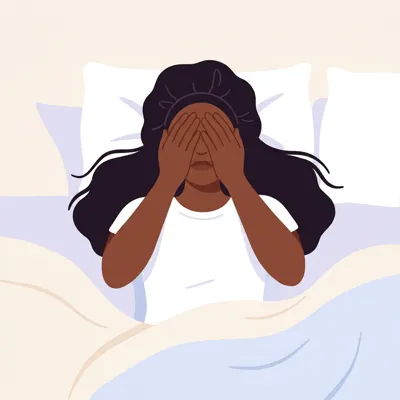
3 a.m., awake again, body heavy and mind wrapped in fog. That tiredness sleep no longer fixes is real. You mentioned it, and the answer came quickly: it's menopause. But what if it isn't only that? Your symptoms look almost exactly like a thyroid that's slowing down, a problem that affects about 1 woman in 8.
Your fatigue is real, and it's worth investigating
Let's say it plainly: your fatigue is real. The fog when you hunt for a word, when you reread the same email three times, is not in your head. You're listening to your body, which is exactly the right instinct.
What wears you down isn't only the tired body. It's having to justify it, feeling a door close the moment someone says "menopause." You're allowed to ask for a closer look.
There's a real reason to dig. Thyroid disorders are heavily female, 5 to 8 times more common in women than in men [1]. Over a lifetime, about 1 woman in 8 develops one, and nearly 6 in 10 don't know they have it [1].
The stage you're in, peri or postmenopause, is exactly when the risk climbs. Hypothyroidism (an underactive thyroid, running slow) peaks in peri and postmenopausal women [3]. Symptoms showing up now are no coincidence.
Sources (2)
- [1] American Thyroid Association. General Information / Thyroid Statistics. 2021-2022. www.thyroid.org
- [3] Uygur MM, Yoldemir T, Yavuz DG. Thyroid disease in the perimenopause and postmenopause period. Climacteric. 2018;21(1):60-67. doi:10.1080/13697137.2017.1406911
Menopause and a slow thyroid share almost the same signs
If no one settles it quickly, it isn't carelessness. The two states look almost identical.
On one side, menopause: fatigue, weight gain, mood swings, broken sleep, poor focus. On the other, hypothyroidism: fatigue, weight gain, feeling cold, brain fog, slowing down, hair loss. The lists overlap almost word for word [2][3].
Picture the thyroid as the body's thermostat. This small butterfly-shaped gland at the base of your neck sets your energy, your temperature, the speed of your metabolism. Set too low, everything slows: you feel cold, heavy, your thinking drags.
The most common cause is an autoimmune condition, Hashimoto's thyroiditis (the immune system attacks the thyroid). It peaks during the perimenopausal years [4][3]. The two clocks often start ticking together.
So symptoms alone can't tell them apart. Guidelines are clear: labelling it "menopause" doesn't remove the need to look for other causes, especially when symptoms are marked [10]. The label shouldn't close the search, it should open it.
Sources (4)
- [2] Del Ghianda S, Tonacchera M, Vitti P. Thyroid and menopause. Climacteric. 2014;17(3):225-234. doi:10.3109/13697137.2013.838554
- [3] Uygur MM, Yoldemir T, Yavuz DG. Thyroid disease in the perimenopause and postmenopause period. Climacteric. 2018;21(1):60-67. doi:10.1080/13697137.2017.1406911
- [4] Caturegli P, De Remigis A, Rose NR. Hashimoto thyroiditis: clinical and diagnostic criteria. Autoimmun Rev. 2014;13(4-5):391-397. doi:10.1016/j.autrev.2014.01.007
- [10] National Institute for Health and Care Excellence. Menopause: diagnosis and management (NG23). 2015, updated 2024.
The trap: menopause can make a thyroid test read 'normal'
Here's the heart of it, the piece that can save you time. Menopause can skew a thyroid test and make it look fine when it isn't.
Your thyroid hormones don't travel alone. Most ride attached to a carrier protein, a sort of taxi. Only the ones that get out, the "free" hormones, are active and useful to your cells [5].
Oestrogen controls how many taxis your body makes [5]. When it drops or swings during menopause, the balance shifts: a number can look normal on paper while your body is short on the hormone actually available.
That's why relying on TSH alone (the first-line test) can send you home with a misleading "all clear." It's better to also measure free T4, and free T3 when symptoms persist.
Watch the grey zone too: subclinical hypothyroidism, a slightly raised TSH with a still-normal free T4. It affects up to 1 woman in 10 after 50, causes real symptoms, and deserves monitoring rather than a quick dismissal [7][8]. One concrete point: oral oestrogen in MHT raises that carrier protein, and sometimes your thyroid hormone needs; patch or gel has less of this effect [6].
Sources (4)
- [5] Santin AP, Furlanetto TW. Role of estrogen in thyroid function and growth regulation. J Thyroid Res. 2011;2011:875125. doi:10.4061/2011/875125
- [7] Biondi B, Cappola AR, Cooper DS. Subclinical hypothyroidism: a review. JAMA. 2019;322(2):153-160. doi:10.1001/jama.2019.9052
- [8] Vanderpump MPJ. The epidemiology of thyroid disease (Whickham Survey follow-up). Clin Endocrinol (Oxf). 2011;75(2):141-147.
- [6] Mazer NA. Interaction of estrogen therapy and thyroid hormone replacement in postmenopausal women. Thyroid. 2004;14(Suppl 1):S27-S34. doi:10.1089/105072504323024561
The full panel to ask for, and how to raise it
Now the practical tools. You can ask for a genuinely complete panel, not a single number.
A checklist to bring to your appointment:
- TSH: the starting point, never the finish line.
- Free T4: the hormone actually available, essential if you have symptoms or a borderline TSH.
- Free T3: worth asking for when symptoms persist.
- Anti-TPO antibodies: to catch early autoimmune thyroiditis, even when the rest looks normal.
These are exactly what guidelines recommend when symptoms or a borderline TSH are present [9][11].
How to say it without over-explaining: "I know I'm in menopause, but I'd like my thyroid checked too, because my symptoms overlap." And if the result is borderline: "I'd like it monitored closely rather than filed as normal."
A borderline result shouldn't be waved through: it warrants repeat testing and sometimes a second opinion [7]. If hypothyroidism is confirmed, the standard treatment is levothyroxine, with a TSH recheck 6 to 8 weeks later to adjust the dose [9]. Asking for a second opinion is neither pushy nor rude.
Sources (3)
- [9] Garber JR, Cobin RH, Gharib H, et al. Clinical practice guidelines for hypothyroidism in adults: ATA/AACE. Thyroid. 2012;22(12):1200-1235. doi:10.1089/thy.2012.0205
- [11] National Institute for Health and Care Excellence. Thyroid disease: assessment and management (NG145). 2019.
- [7] Biondi B, Cappola AR, Cooper DS. Subclinical hypothyroidism: a review. JAMA. 2019;322(2):153-160. doi:10.1001/jama.2019.9052
Menopause, thyroid, or both together: you deserve a proper workup and clear answers. The fatigue, the cold, the fog and the weight all have a cause, and that cause is found with a complete blood test. If it's your thyroid, it can be diagnosed and treated, often with a single dose-adjusted tablet. Note your symptoms and how long you've had them, bring the checklist, ask for the full panel. You're no longer the one who leaves with "it's just your age." You're the one asking the right questions.
This article is for information only and does not replace the advice of a health professional. If a symptom worries you, talk to a doctor.