Night sweats and insomnia: how to break the loop that wakes you at 3am
Why the less you sleep the more you sweat, and how to attack this vicious circle from both ends, starting tonight.
4 min read
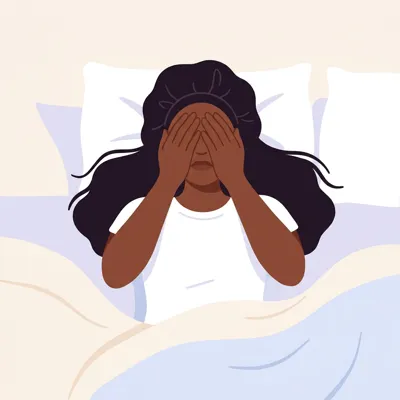
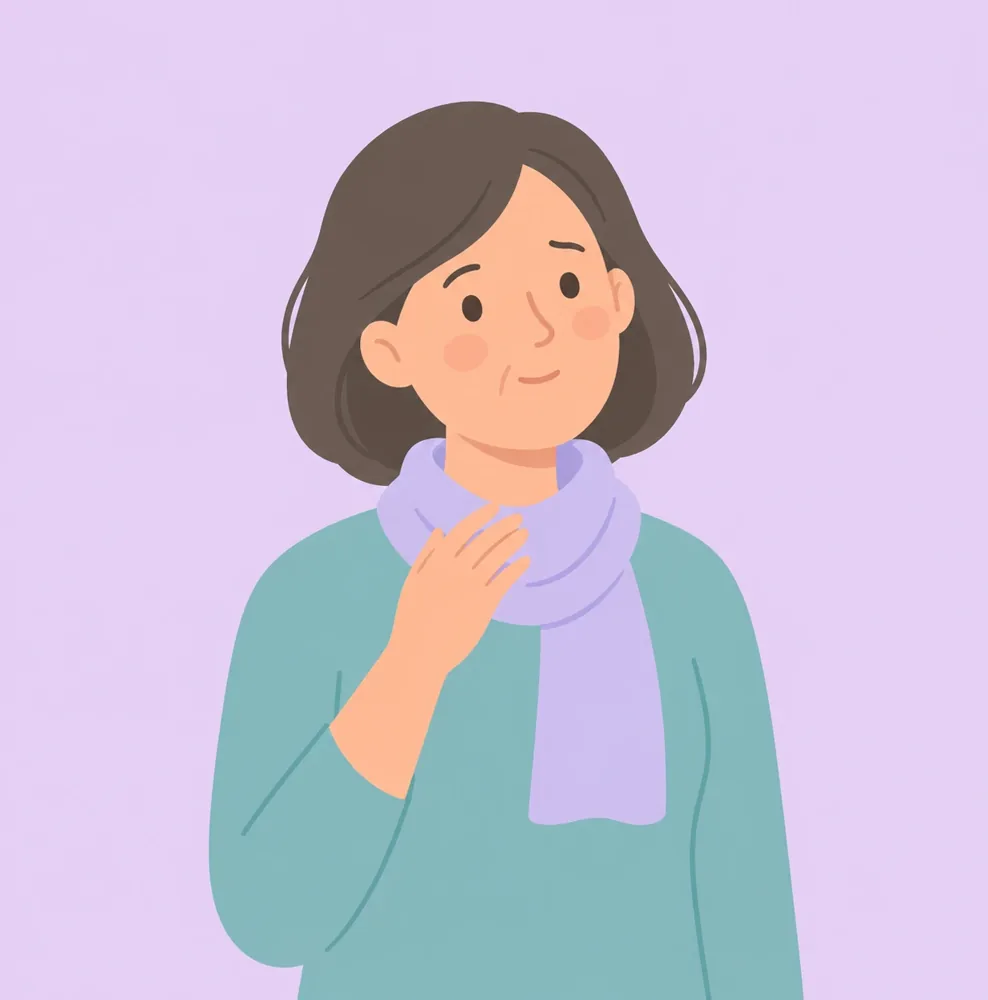
It's 3am, your pyjama is soaked, your eyes are wide open, and sleep won't come back. What you're feeling is real and measurable: the hot flash genuinely wakes you [4]. Night sweats and insomnia form a loop that feeds itself. The good news: a loop has two ends, and you can start breaking it tonight.
Why the sweat-sleep loop feeds itself
What you feel at night is not imaginary, and it's not about willpower. It starts with your inner thermostat, a small brain centre that keeps you in a comfort zone. At menopause, as estrogen drops, that zone shrinks sharply [6]. A tiny rise in temperature now crosses the threshold, and your body triggers a sweat to cool you down.
At night, that sweat wakes you, and the loop closes. Lost sleep switches your nervous system to high alert, releasing more stress hormones and making the thermostat even less stable [6]. The less you sleep, the more you sweat. The more you sweat, the more you wake [4].
The numbers show the scale. Up to 80% of women get hot flashes or night sweats at menopause [1]. Between 39 and 47% of women in perimenopause report real sleep problems [2]. And you can't always just wait it out: these sweats last a median of 7.4 years, sometimes over 10 [5]. That fatigue has a physical cause, and it weighs on your mood on its own [3]. A vicious circle is a mechanism, not a sentence.
Sources (6)
- [6] Freedman RR. Menopausal hot flashes: mechanisms, endocrinology, treatment. J Steroid Biochem Mol Biol. 2014;142:115-120. doi:10.1016/j.jsbmb.2013.08.010
- [4] Thurston RC, Chang Y, Buysse DJ, Hall MH, Matthews KA. Hot flashes and awakenings among midlife women. Sleep. 2019;42(9):zsz131. doi:10.1093/sleep/zsz131
- [1] National Institute for Health and Care Excellence (NICE). Menopause: diagnosis and management. NICE Guideline NG23. 2015.
- [2] Baker FC, de Zambotti M, Colrain IM, Bei B. Sleep problems during the menopausal transition: prevalence, impact, and management challenges. Nat Sci Sleep. 2018;10:73-95. doi:10.2147/NSS.S125807
- [5] Avis NE, Crawford SL, Greendale G, et al. Duration of menopausal vasomotor symptoms over the menopause transition (SWAN). JAMA Intern Med. 2015;175(4):531-539. doi:10.1001/jamainternmed.2014.8063
- [3] Joffe H, Crawford SL, Freeman MP, et al. Independent contributions of nocturnal hot flashes and sleep disturbance to depression in estrogen-deprived women. J Clin Endocrinol Metab. 2016;101(10):3847-3855. doi:10.1210/jc.2016-2348
Your bedroom: 18-19°C and no single duvet
Your first lever is the most immediate: your sleep environment. These moves don't cure menopause, but they ease the discomfort of sweats and cut the awakenings [7]. And they're free, available tonight.
Aim for a bedroom at 18 to 19°C, precisely. Your inner thermostat has turned hypersensitive: the cooler the room, the more margin you keep before crossing the sweating threshold [6].
Then a few simple tweaks:
- Layered sheets over one heavy duvet: peel off a layer without getting up or turning on the light.
- Cotton or linen, breathable fabrics; avoid synthetics that trap moisture against your skin.
- A towel and a dry spare top by the bed, to shorten the time you spend standing up.
The less you switch your brain on at 3am, the better your odds of drifting back to sleep. Every move that shortens the waking helps calm the mechanism.
Sources (2)
- [7] The 2023 nonhormone therapy position statement of The Menopause Society Advisory Panel. Menopause. 2023;30(6):573-590. doi:10.1097/GME.0000000000002200
- [6] Freedman RR. Menopausal hot flashes: mechanisms, endocrinology, treatment. J Steroid Biochem Mol Biol. 2014;142:115-120. doi:10.1016/j.jsbmb.2013.08.010
Your body: a calmer evening, and plants that can help
Your second lever: easing the nervous-system arousal that keeps the loop going. Two paths work together, your evening and plants.
To bring the pressure down before bed:
- Skip alcohol and intense exercise late in the day, two classic triggers for sweats.
- Limit screens and bright light in the hour before bed.
- Build a calming ritual: reading, slow breathing, a warm shower rather than a hot one.
For plants, some contain compounds that partly mimic estrogen. Sage showed, in one trial, a drop in flash frequency of about 50% over 4 weeks [8]. Hops also eases the rise in skin temperature linked to low estrogen [9]. But the evidence stays limited and the effect modest [7]. Always tell your doctor or pharmacist which plants you take: natural doesn't mean free of interactions.
One approach is solidly backed: cognitive behavioural therapy for insomnia (a short course of sessions with a psychologist). It reduces menopause insomnia and works directly on the vicious circle [7].
Sources (3)
- [8] Bommer S, Klein P, Suter A. First time proof of sage's tolerability and efficacy in menopausal women with hot flushes. Adv Ther. 2011;28(6):490-500. doi:10.1007/s12325-011-0027-z
- [9] Bowe J, Li XF, Kinsey-Jones J, et al. The hop phytoestrogen, 8-prenylnaringenin, reverses the ovariectomy-induced rise in skin temperature in an animal model of menopausal hot flushes. J Endocrinol. 2006;191(2):399-405. doi:10.1677/joe.1.06919
- [7] The 2023 nonhormone therapy position statement of The Menopause Society Advisory Panel. Menopause. 2023;30(6):573-590. doi:10.1097/GME.0000000000002200
The most effective route: estrogen through the skin
If the tweaks aren't enough, and that's common when sweats are moderate to severe, there's a far more effective option: menopause hormone therapy (MHT). It's the single most effective treatment for night sweats and hot flashes [10].
The form matters. Through the skin (an estradiol gel or patch), estrogen reaches your blood without passing through the liver. The result: a lower clot risk than with pills [11]. This is now the preferred first-line route.
Let's name the fear, because it's understandable. The current data are clear: for most women under 60, or within 10 years of menopause, the benefits of MHT outweigh the risks [11]. The decision is never automatic: you make it with your doctor, based on your history.
And if MHT isn't right for you? Non-hormonal options exist. Certain low-dose antidepressants (such as paroxetine or venlafaxine) reduce flash frequency [7]. Come to your appointment with questions ready: is skin MHT right for my profile? What are my personal risks? You have the right to be an active part of this decision.
Sources (3)
- [10] Marjoribanks J, Farquhar C, Roberts H, Lethaby A, Lee J. Long-term hormone therapy for perimenopausal and postmenopausal women. Cochrane Database Syst Rev. 2017;1(1):CD004143. doi:10.1002/14651858.CD004143.pub5
- [11] The 2022 hormone therapy position statement of The North American Menopause Society Advisory Panel. Menopause. 2022;29(7):767-794. doi:10.1097/GME.0000000000002028
- [7] The 2023 nonhormone therapy position statement of The Menopause Society Advisory Panel. Menopause. 2023;30(6):573-590. doi:10.1097/GME.0000000000002200
The sweat-sleep combo isn't a curse: it's a loop, and it breaks at both ends. In the bedroom: 18 to 19°C, layered sheets, cotton on your skin. In your body: a calming evening, sage, CBT for insomnia. In medicine: transdermal MHT, worth exploring with your doctor. Start tonight with one thing: turn down your bedroom temperature. Then log your nights in the app to see, in black and white, what actually quiets the loop.
This article is for information only and does not replace the advice of a health professional. If a symptom worries you, talk to a doctor.