Why do you wake at 3 a.m. on the dot in menopause?
The wake-up that returns at the same hour every night is no mystery. It's biochemistry, and it can be explained.
4 min read

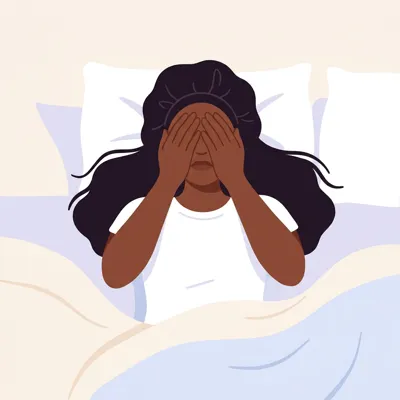
It's 3 a.m. on the dot. Your body is wrecked, and yet your brain has just switched on at full speed. That 'wired but tired' paradox is real and common: in menopause, up to 6 in 10 women report disrupted sleep. This same-hour wake-up follows a precise hormonal logic, not a personal flaw. Here's why it happens, and what you can do about it, tonight.
Exhausted but wide awake: this paradox is real and common
Your body is begging for sleep; your mind refuses to switch off. This isn't weak willpower or poor stress management. It's a documented physiological shift in women going through the menopause transition.
Waking in the night, what specialists call sleep-maintenance trouble, is the most common complaint at this stage, well ahead of trouble falling asleep [1]. The numbers back it up:
- 40 to 60% of women report sleep problems around menopause [2].
- In perimenopause, chronic insomnia climbs to 56%, up from 31% before [3].
- For nearly half of affected women, the issue is staying asleep, not falling asleep [4].
In other words, drifting off at bedtime is usually fine. The trap is that second-half-of-the-night wake-up that leaves you staring into the dark. This pattern is so typical that it has a precise biological explanation.
Sources (4)
- [1] Baker FC, Lampio L, Saaresranta T, Polo-Kantola P. Sleep and Sleep Disorders in the Menopausal Transition. Sleep Med Clin. 2018;13(3):443-456. doi:10.1016/j.jsmc.2018.04.011
- [2] Baker FC, de Zambotti M, Colrain IM, Bei B. Sleep problems during the menopausal transition: prevalence, impact, and management challenges. Nat Sci Sleep. 2018;10:73-95. doi:10.2147/NSS.S125807
- [3] Kravitz HM, Joffe H. Sleep during the perimenopause: a SWAN story. Obstet Gynecol Clin North Am. 2011;38(3):567-586.
- [4] Ohayon MM. Severe hot flashes are associated with chronic insomnia. Arch Intern Med. 2006;166(12):1262-1268. doi:10.1001/archinte.166.12.1262
Why 3 a.m. and not 5: cortisol too early, progesterone too low
Two hormones cross paths at the worst moment, around the middle of the night.
The first, cortisol, is your wake-up hormone, a kind of internal alarm clock. Normally low early in the night, it climbs gently toward dawn to prepare you to open your eyes. In the menopause transition, this system is disrupted: levels rise and the curve shifts earlier [5]. Your internal alarm fires too soon, around 2 to 4 a.m., and switches your brain back on.
The second, progesterone, works like a calming blanket over the brain. It converts into a molecule (allopregnanolone) that quiets nervous activity, acting on the same receptors as anti-anxiety medicines [6]. In perimenopause, progesterone drops. The blanket thins, and the smallest signal is enough to pull you out of sleep.
Then add temperature. Falling estrogen disrupts your internal thermostat (in the hypothalamus, a brain region). It triggers tiny heat surges, sometimes too faint to feel, that are enough to spark a micro-awakening [2]. Three changes, one hour. That's why it's 3 a.m.
Sources (3)
- [5] Woods NF, Mitchell ES, Smith-Dijulio K. Cortisol Levels During the Menopausal Transition and Early Postmenopause. Menopause. 2009;16(4):708-718.
- [6] Nolan BJ, Liang B, Cheung AS. Efficacy of Micronized Progesterone for Sleep: A Systematic Review and Meta-analysis of Randomized Controlled Trials. J Clin Endocrinol Metab. 2021;106(4):942-951. doi:10.1210/clinem/dgaa873
- [2] Baker FC, de Zambotti M, Colrain IM, Bei B. Sleep problems during the menopausal transition: prevalence, impact, and management challenges. Nat Sci Sleep. 2018;10:73-95. doi:10.2147/NSS.S125807
This wake-up isn't permanent, and the fear feeds the loop
Good news first: this isn't your new normal. Sleep trouble in the menopause transition is often temporary and tends to improve once menopause settles and hormones stop swinging [2].
But there's a trap. Once you're awake, the thought 'I have to get back to sleep or tomorrow's ruined' fires up your stress system. And that system releases cortisol, the very hormone keeping you alert. The harder you fight for sleep, the more you make the molecule that blocks it.
The loop closes when the dread becomes anticipatory: you start fearing the bed, and your brain links the bedroom to struggle rather than rest. This learned association keeps insomnia going long after the original hormonal trigger.
This anxious arousal is a normal reaction to a wake-up you didn't choose. You didn't 'handle your stress badly'. This is exactly the loop that a proven method, cognitive behavioral therapy for insomnia, teaches you to break [7].
Sources (2)
- [2] Baker FC, de Zambotti M, Colrain IM, Bei B. Sleep problems during the menopausal transition: prevalence, impact, and management challenges. Nat Sci Sleep. 2018;10:73-95. doi:10.2147/NSS.S125807
- [7] Trauer JM, Qian MY, Doyle JS, Rajaratnam SMW, Cunnington D. Cognitive Behavioral Therapy for Chronic Insomnia: A Systematic Review and Meta-analysis. Ann Intern Med. 2015;163(3):191-204. doi:10.7326/M14-2841
What you can do: tonight, and for the long game
Concrete steps you can test tonight:
- No screens. Light suppresses melatonin, your sleep hormone, and boosts alertness [10]. Stay in the dark.
- Slow breathing, with a longer exhale: the simplest signal to calm your stress system.
- The 20-minute rule. If you can't fall back asleep, get up, go to a dimly lit room, do something boring, and return when sleepiness comes. Don't let the bed become the arena for the fight [11].
- Keep the room cool and dark, to limit the temperature-driven micro-awakenings [11].
Magnesium (as bisglycinate, in the evening) can be an add-on: the evidence is modest, but an effect on perceived sleep is seen, especially with a deficiency [12]. Check with your doctor or pharmacist first.
For the long game, international guidelines are clear: cognitive behavioral therapy for insomnia is the first-line treatment, before any sleeping pill [8]. Tested in menopausal women, it markedly reduced insomnia severity in around 70% of participants [9]. Sleeping pills only help short-term, with a dependence risk [8]. Menopausal hormone therapy is another option to discuss with your doctor, especially if night sweats dominate your nights [6].
Sources (6)
- [10] Chang AM, Aeschbach D, Duffy JF, Czeisler CA. Evening use of light-emitting eReaders negatively affects sleep, circadian timing, and next-morning alertness. Proc Natl Acad Sci USA. 2015;112(4):1232-1237.
- [11] Riemann D, Espie CA, Altena E, Arnardottir ES, Baglioni C, et al. The European Insomnia Guideline: An Update on the Diagnosis and Treatment of Insomnia 2023. J Sleep Res. 2023;32(6):e14035.
- [12] Abbasi B, Kimiagar M, Sadeghniiat K, Shirazi MM, Hedayati M, Rashidkhani B. The Effect of Magnesium Supplementation on Primary Insomnia in Elderly: A Double-blind Placebo-controlled Clinical Trial. J Res Med Sci. 2012;17(12):1161-1169.
- [8] Qaseem A, Kansagara D, Forciea MA, Cooke M, Denberg TD. Management of Chronic Insomnia Disorder in Adults: A Clinical Practice Guideline From the American College of Physicians. Ann Intern Med. 2016;165(2):125-133.
- [9] McCurry SM, Guthrie KA, Morin CM, Woods NF, Landis CA, Ensrud KE, et al. Telephone-Based Cognitive Behavioral Therapy for Insomnia in Perimenopausal and Postmenopausal Women With Vasomotor Symptoms (MsFLASH). JAMA Intern Med. 2016;176(7):913-920.
- [6] Nolan BJ, Liang B, Cheung AS. Efficacy of Micronized Progesterone for Sleep: A Systematic Review and Meta-analysis of Randomized Controlled Trials. J Clin Endocrinol Metab. 2021;106(4):942-951. doi:10.1210/clinem/dgaa873
You didn't choose this 3 a.m. wake-up. But now you can read its mechanics: cortisol firing too early, calming progesterone running low, lighter sleep late in the night. It's biochemistry, not fate. Tonight, try just one thing from the list. And for two weeks, log your wake times in Endora: that record makes the pattern visible, and gives real weight to what you tell your doctor.
This article is for information only and does not replace the advice of a health professional. If a symptom worries you, talk to a doctor.