Anxiety out of nowhere in your 40s? Your hormones might be behind it
You can be deep in perimenopause with anxiety alone, and not a single hot flush in sight.
3 min read
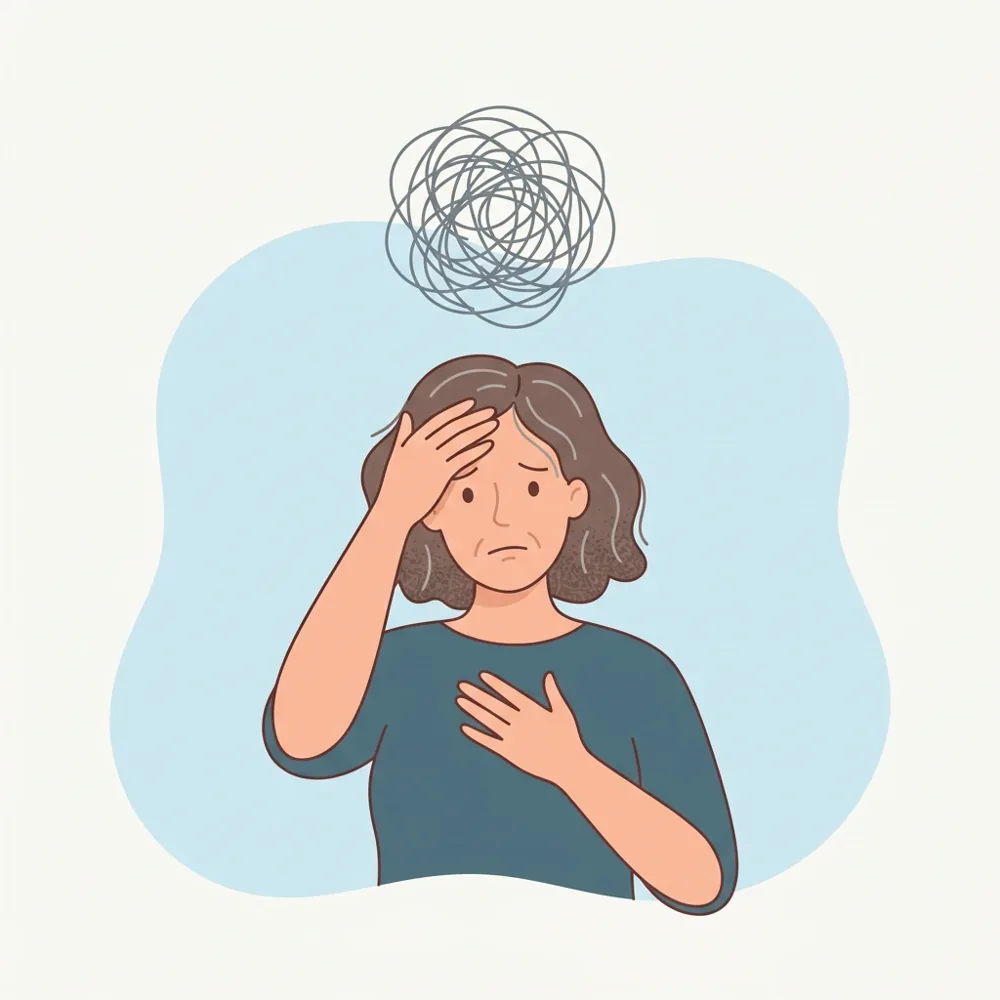
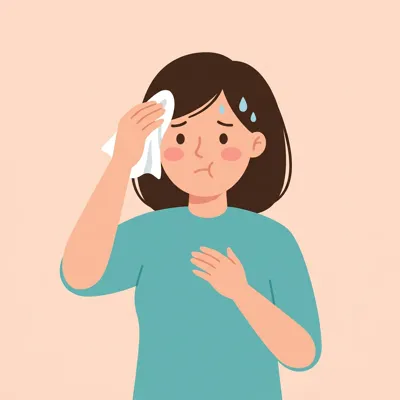
That anxiety that arrives for no reason, the heart pounding at 3am: these sensations are real, and often hormonal. During the menopause transition, the risk of high anxiety rises sharply [1]. And you can move through it with anxiety alone, not a single hot flush. Here's why, and what you can actually do about it.
Anxiety without hot flushes can still be hormonal
The fear of 'losing your grip', of no longer recognising the woman who handled everything, is understandable. But for many women, the brain is reacting to a very real chemical shift, one that medicine recognises.
The myth is that menopause means hot flushes. It doesn't. Hormonal changes act on the brain first: anxiety, palpitations or broken sleep can appear before the flushes, or instead of them [1]. International guidelines now recognise anxiety and mood changes as symptoms of perimenopause [7].
The numbers back this up. In the large SWAN study, women with low anxiety before menopause were far more likely to develop high anxiety during the transition [1]. You're not an odd case.
Moving from 'something is wrong with me' to 'a real process is under way, and there are options' is often what starts to loosen the grip of fear.
Sources (2)
- [1] Bromberger JT, Kravitz HM, Chang Y, et al. Does risk for anxiety increase during the menopausal transition? Study of Women's Health Across the Nation (SWAN). Menopause. 2013;20(5):488-495. doi:10.1097/GME.0b013e3182730599
- [7] National Institute for Health and Care Excellence. Menopause: identification and management (NG23). NICE Guideline. Updated 2024.
It's oestrogen's swings that unsettle your calm
Oestrogen isn't only the 'period hormone'. It's also a master regulator of mood: it helps your brain make and use serotonin, your mood stabiliser [2]. While it stays steady, you tend to feel like yourself.
In perimenopause, oestrogen doesn't glide down in a smooth line. It swings up and down, sometimes within the same week. And the brain hates that instability.
It's the fluctuation, more than the low level, that's linked to mood disturbance [2][3]. A study of women with no history of depression tied these rapid swings in oestradiol (the active form of oestrogen) to anxious mood [2].
That's why anxiety hits 'for no reason'. There's no outside trigger because the trigger is internal and chemical. It's not a lack of willpower or a hidden weakness: it's biology.
Sources (2)
- [2] Freeman EW, Sammel MD, Lin H, Nelson DB. Associations of hormones and menopausal status with depressed mood in women with no history of depression. Arch Gen Psychiatry. 2006;63(4):375-382. doi:10.1001/archpsyc.63.4.375
- [3] Joffe H, de Wit A, Coborn J, et al. Impact of Estradiol Variability and Progesterone on Mood in Perimenopausal Women With Depressive Symptoms. J Clin Endocrinol Metab. 2020;105(3):e642-e650. doi:10.1210/clinem/dgz181
Racing heart, sleep, cortisol: the loop that feeds itself
A hot flush isn't only about heat. It's a burst from your autonomic nervous system (the body's automatic alarm): your heart rate rises, sometimes into full palpitations [4].
Here's the catch. Those sensations, a pounding heart and sudden heat, feel almost identical to a panic surge. Your brain reads them as danger and triggers fear, which speeds the heart up further.
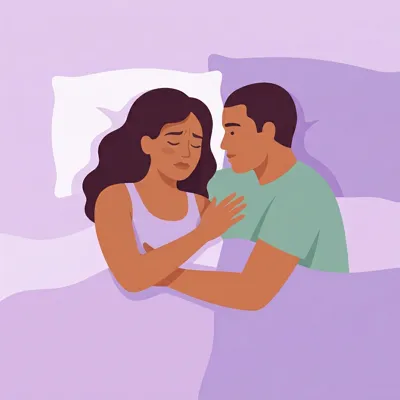
Now add sleep. Night sweats fragment your nights, often without fully waking you. And broken sleep makes the brain more reactive and less able to calm anxiety the next day [5]. Your cortisol rhythm, the stress hormone, drifts too.
The result is a loop where each part quietly feeds the next. The good news: a loop has exit points, and you don't have to break all of them at once. One caveat: a racing heart during a flush is usually benign, but any new heart symptom deserves a check-up [4].
Sources (2)
- [4] Thurston RC, Christie IC, Matthews KA. Hot flashes and cardiac vagal control: a link to cardiovascular risk. Menopause. 2010;17(3):456-461.
- [5] Joffe H, Crawford SL, Freeman MP, et al. Independent contributions of nocturnal hot flashes and sleep disturbance to depression in estrogen-deprived women. J Clin Endocrinol Metab. 2016;101(10):3847-3855.
'It's just stress': the label you may have been given wrongly
If a doctor sent you home with 'it's the stress of life', you weren't being dramatic. Your symptoms were simply misattributed, sometimes for years.
Exhaustion, irritability, dread, insomnia: burnout and hormonal anxiety share the same face. Without weighing your age and hormonal status, the diagnosis slides to the most common explanation [6]. Worth remembering: perimenopause and an anxiety disorder can coexist, and both deserve a proper assessment [6][7].
There are effective options to discuss with your doctor:
- Menopausal hormone therapy (HRT) reduces hot flushes and can improve mood driven by fluctuation, especially in early perimenopause; it does have contraindications and needs to be weighed individually with your doctor, based on your own history [7].
- Cognitive behavioural therapy (CBT), which works on your thoughts and reactions, is a proven non-hormonal option [7][8].
- Certain antidepressants can help when HRT isn't suitable, weighed case by case.
In the meantime, one simple move: breathing slowly, about six times a minute (inhale 5 seconds, exhale 5 seconds), switches on the nervous system's natural brake and steadies the heart in the moment.
Sources (3)
- [6] Maki PM, Kornstein SG, Joffe H, et al. Guidelines for the Evaluation and Treatment of Perimenopausal Depression: Summary and Recommendations. Menopause. 2018;25(10):1069-1085.
- [7] National Institute for Health and Care Excellence. Menopause: identification and management (NG23). NICE Guideline. Updated 2024.
- [8] Hunter MS. Cognitive behavioral therapy for menopausal symptoms. Climacteric. 2021;24(1):51-56. doi:10.1080/13697137.2020.1777965
You're not broken. Your body is moving through a real transition that touches the brain before the thermostat. This anxiety has a name, a mechanism and levers you can pull. Tonight, try the six-breaths-a-minute rhythm once. This week, track your mood, sleep and any flushes side by side: that picture, shown to your doctor, beats a vague complaint every time.
This article is for information only and does not replace the advice of a health professional. If a symptom worries you, talk to a doctor.