My heart's racing out of nowhere. Is it serious, or is it my hormones?
Palpitations, the menopause symptom that scares you most and that almost no one links to your estrogen.
3 min read
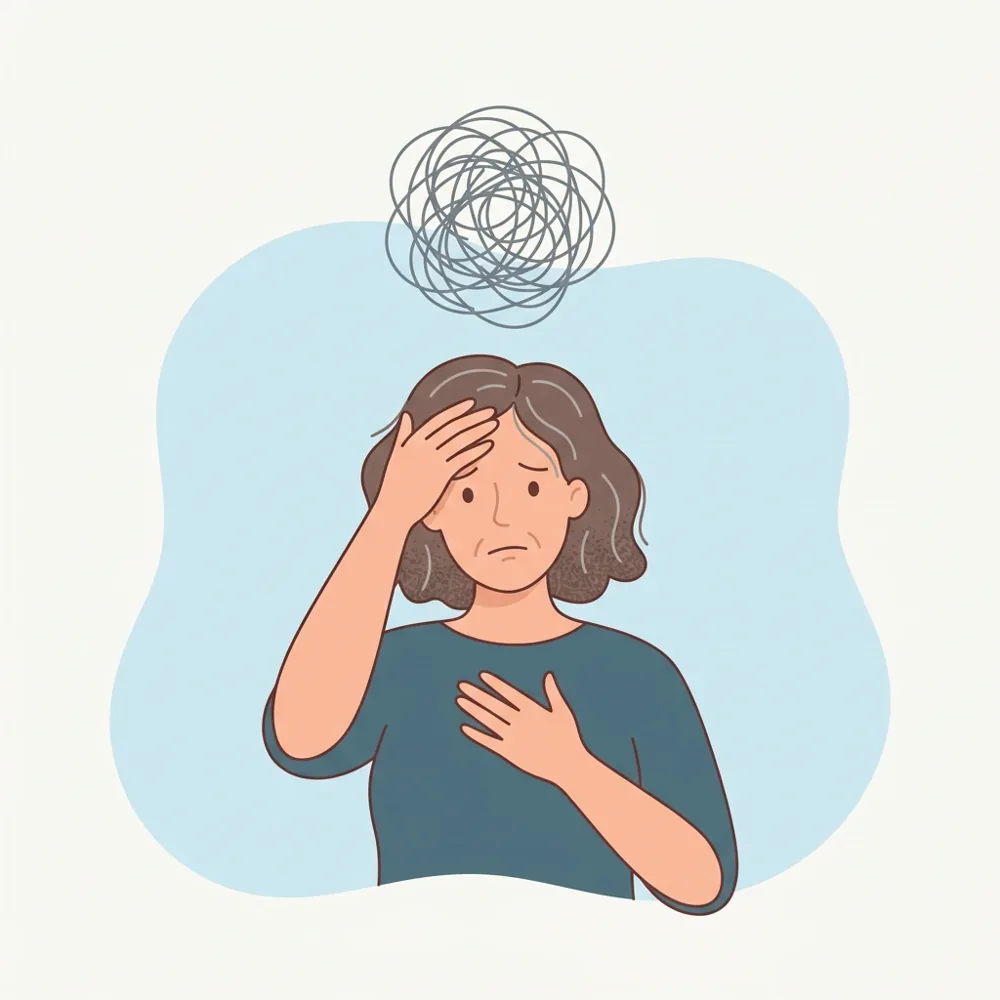
It's 2am. You're lying still and, out of nowhere, your heart starts pounding, hard and fast. One ice-cold thought lands: is this my heart giving out? That fear is real and valid. Yet these palpitations are a common, recognised symptom of menopause. Here's why your heart does this, and how to take back control.
Your racing heart is usually your hormones, not your heart
Palpitations are a recognised symptom of perimenopause and menopause [1]. The large majority of them are benign, meaning not life-threatening [5]. They feel catastrophic. They rarely are. Only a medical check-up can confirm that for you personally, so this article is here to inform, not to replace a visit.
Your estrogen doesn't only act on your periods. It also helps keep your nervous system in "calm" mode [3]. As menopause approaches, estrogen levels swing up and down. With each drop, the balance tips toward "alarm" mode, the sympathetic nervous system [3].
The result: your heart can speed up, pound harder, or seem to skip a beat for no obvious reason. This is physiology, not imagination. The menopause transition is a genuine window of cardiovascular change [3]. Your heart isn't "giving out," it's reacting to a shifting hormonal environment.
Sources (3)
- [1] Carpenter JS, Sheng Y, Pike C, Elomba CD, Alwine JS, Chen CX, Tisdale JE. Correlates of palpitations during menopause: A scoping review. Womens Health (Lond). 2022;18:17455057221112267. doi:10.1177/17455057221112267
- [5] British Heart Foundation. Palpitations and the menopause. 2021
- [3] El Khoudary SR, Aggarwal B, Beckie TM, et al. Menopause Transition and Cardiovascular Disease Risk: Implications for Timing of Early Prevention. A Scientific Statement From the American Heart Association. Circulation. 2020;142(25):e506-e532. doi:10.1161/CIR.0000000000000912
Palpitations and hot flashes: the hormonal duo
Your heart often races at the exact moment a wave of heat rises. That's no coincidence: the same hormonal disruption triggers both. A hot flash comes with a surge of adrenaline and a sudden widening of your blood vessels, which your heart compensates for by speeding up [1].
Palpitations, hot flashes, sleep problems and anxiety are clearly linked [1][2]. So you don't have one isolated symptom, you have a cluster that shares the same hormonal root.
Watch for one trap: a sudden palpitation triggers fear, fear releases adrenaline, and adrenaline speeds the heart up even more [1]. That's why a palpitation is so easily mistaken for a panic attack. But the starting point is often hormonal [1]. Just naming this loop already helps you step out of it.
Sources (2)
- [1] Carpenter JS, Sheng Y, Pike C, Elomba CD, Alwine JS, Chen CX, Tisdale JE. Correlates of palpitations during menopause: A scoping review. Womens Health (Lond). 2022;18:17455057221112267. doi:10.1177/17455057221112267
- [2] Carpenter JS, Tisdale JE, Larson JC, Sheng Y, Chen CX, Von Ah D, Kovacs R, Reed SD, Guthrie KA. A MsFLASH investigation of self-reported menopausal palpitation distress. J Womens Health (Larchmt). 2021;30(4):533-538. doi:10.1089/jwh.2020.8586
Calm the wave in 3 minutes with slow breathing
Here's a tool you can use tonight, free and with no equipment. When you breathe slowly, at about 6 breaths per minute, you activate a sensor in your arteries called the baroreflex. It switches on your parasympathetic "brake," the system that slows your heart [4].
Here's how:
- Breathe in gently through your nose for about 4 seconds.
- Breathe out slowly through your mouth for about 6 seconds.
- Keep going for 3 minutes, without straining.
The long exhale does most of the work: that's when your vagus nerve brakes your heart rate hardest [4]. Practise when you feel fine, so it becomes automatic when a wave hits.
This is where an app helps: when you log a palpitation, it can start a guided breathing exercise on the spot, so you don't have to count while the panic builds.
Sources (1)
- [4] Lehrer PM, Gevirtz R. Heart rate variability biofeedback: how and why does it work? Front Psychol. 2014;5:756. doi:10.3389/fpsyg.2014.00756
Fewer episodes: stimulants, movement, MHT
Beyond breathing, several levers can lower how often episodes hit. Caffeine, alcohol and nicotine are stimulants that can stir an already-jumpy system [5]. Spotting your triggers, a late coffee or an evening glass of wine, helps you dial them down. Regular exercise supports a steadier nervous system, and the menopause transition is a key window for your heart [3].
On the medical side, menopausal hormone therapy (MHT, also called HRT) is now the first-line treatment for hot flashes. Recent guidelines prefer transdermal estrogen (a patch or gel, with less clot risk), at the lowest effective dose [7][8]. By calming the flashes, it can reduce the palpitations that travel with them [7]. The decision is made with your doctor, based on your profile.
A cardiologist may also prescribe beta-blockers in selected cases (a confirmed rhythm problem), never as a first move. These palpitations are almost always benign, but chest pain, breathlessness or fainting need prompt medical review, all the more since cardiac signs are often atypical in women [6].
Sources (5)
- [5] British Heart Foundation. Palpitations and the menopause. 2021
- [3] El Khoudary SR, Aggarwal B, Beckie TM, et al. Menopause Transition and Cardiovascular Disease Risk: Implications for Timing of Early Prevention. A Scientific Statement From the American Heart Association. Circulation. 2020;142(25):e506-e532. doi:10.1161/CIR.0000000000000912
- [7] The North American Menopause Society (NAMS). The 2022 Hormone Therapy Position Statement of The North American Menopause Society. Menopause. 2022;29(7):767-794. doi:10.1097/GME.0000000000002028
- [8] National Institute for Health and Care Excellence (NICE). Menopause: identification and management (NG23). Last updated November 2024
- [6] Gulati M, Levy PD, Mukherjee D, et al. 2021 AHA/ACC Guideline for the Evaluation and Diagnosis of Chest Pain. Circulation. 2021;144(22):e368-e454. doi:10.1161/CIR.0000000000001029
Your heart racing in menopause is, most of the time, your hormones acting up, not your heart giving out. Falling estrogen pushes your nervous system into alarm mode, the same cascade that triggers your hot flashes. It's real, and it can be soothed. Start with breathing at 6 cycles a minute, practised when you're calm. Cut back on coffee, alcohol and lost sleep. And keep the warning signs in mind: chest pain, breathlessness, fainting. If one shows up, or if a doubt lingers, see a doctor without hesitating.
This article is for information only and does not replace the advice of a health professional. If a symptom worries you, talk to a doctor.