How do you handle a hot flash in a meeting?
A discreet arsenal, a slow-breath brake, and the one truth that changes everything: trying to hide it makes it worse.
4 min read

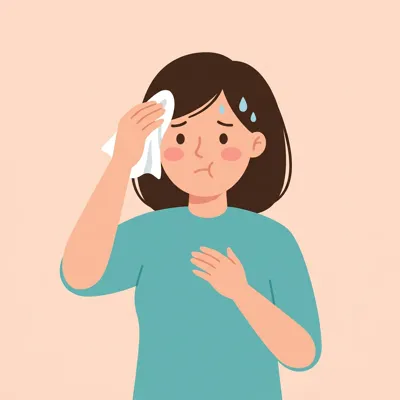
You're in a meeting and the wave climbs: your chest, your neck, your face, with one thought on a loop, please don't let it show. These hot flashes are real and physical, and they hit up to 8 in 10 women at this stage of life. They have nothing to do with how good you are at your job. Here's how to take back control, quietly.
Your internal thermostat has shrunk its comfort zone
Picture a thermostat in your brain, in the hypothalamus (the area that sets your temperature). As long as your temperature stays inside its comfort zone, you feel nothing. Falling estrogen shrinks that zone [1].
So a rise of a few tenths of a degree, invisible to you five years ago, now trips a "too hot" alarm [1]. Your body widens the blood vessels and sweats to cool down fast. Hence the wave, the hot neck, the flushed cheeks.
This is purely mechanical. It has nothing to do with your composure or your ability to run the meeting [4]. Many women report that these waves weigh on their work, and some even consider scaling back their careers [11].
And it isn't a phase of a few months. The median duration of these waves is 7.4 years, and for some it runs past a decade [2]. They affect up to 8 in 10 women during the transition [9]. So "just toughing it out" is not a workable plan.
Sources (5)
- [1] Freedman RR. Menopausal hot flashes: mechanisms, endocrinology, treatment. J Steroid Biochem Mol Biol. 2014;142:115-120. doi:10.1016/j.jsbmb.2013.08.010
- [4] Faubion SS, et al. Impact of menopause symptoms on women in the workplace. Mayo Clin Proc. 2023.
- [11] Chartered Institute of Personnel and Development (CIPD). Menopause at Work surveys, UK. 2019 and 2023.
- [2] Avis NE, Crawford SL, Greendale G, et al. Duration of menopausal vasomotor symptoms over the menopause transition (SWAN). JAMA Intern Med. 2015;175(4):531-539. doi:10.1001/jamainternmed.2014.8063
- [9] The North American Menopause Society (NAMS). Position statement on the management of vasomotor symptoms. 2022.
Hiding the wave feeds the stress that fuels it
Here's the truth that changes everything. When you panic at the thought of the wave showing, your body releases stress hormones. They shrink your thermal comfort zone even further [1].
Stress is a common aggravating factor for hot flashes [7]. And anticipatory anxiety, "what if it hits right now, in front of everyone," keeps your body on alert and amplifies the distress you feel [4]. Just before a wave, in fact, your cardiac vagal control drops, the signature of a stress response [6].
The result: hiding feeds the stress, and the stress intensifies the wave. It's a loop, fear of judgment, rising stress, a stronger wave.
That's exactly where your power is. Cognitive behavioural therapy (work on your thoughts and stress) reduces the perceived impact of the waves, even without changing how many you get [3]. Letting go of the fight doesn't make you lose control. It hands it back.
Sources (5)
- [1] Freedman RR. Menopausal hot flashes: mechanisms, endocrinology, treatment. J Steroid Biochem Mol Biol. 2014;142:115-120. doi:10.1016/j.jsbmb.2013.08.010
- [7] British Menopause Society. Tools and guidance for clinicians: lifestyle and non-hormonal management of vasomotor symptoms. 2022.
- [4] Faubion SS, et al. Impact of menopause symptoms on women in the workplace. Mayo Clin Proc. 2023.
- [6] Thurston RC, Christie IC, Matthews KA. Hot flashes and cardiac vagal control during women's daily lives. Menopause. 2012;19(4):406-412. doi:10.1097/gme.0b013e3182337166
- [3] Hunter MS, Smith M. Cognitive behaviour therapy (CBT) for menopausal symptoms: management of hot flushes and night sweats. Maturitas. 2017;105:117-123. doi:10.1016/j.maturitas.2017.05.001
In the moment: breathe, cool a pulse point, drop a layer
When the wave starts, the instinct is to tense up and hold your breath. Do the opposite, quietly, without anyone noticing a thing.
- Breathe from the belly. Inhale through the nose for 4 to 5 seconds, exhale gently for 6 to 7. This slow breathing reactivates your calming nervous system and settles the stress response [5].
- Cool a key point. A little cool water on the wrists, a sip of iced water, a neck fan on its low setting, all help your body dip back under the alarm threshold [8].
- Drop a layer. A cardigan or blazer you slip off in one move, air that moves, and the wave passes without leaving a visible trace [8].
Set the stage with clothing: dress in layers you can build on, and favour breathable natural fabrics, linen or cotton, that let air move instead of pinning sweat to your skin [8].
Just before a wave, your calming nervous system eases off [6]. Slow exhaling switches it back on. The evidence is modest, but the technique is risk-free, free of charge and invisible [5]. Change the inner script too: instead of "please don't let it show," tell yourself "a wave is rising, I breathe, it will pass."
Sources (3)
- [5] Carpenter JS, Burns DS, Wu J, et al. Paced respiration for vasomotor and other menopausal symptoms: a randomized controlled trial. J Gen Intern Med. 2013;28(2):193-200. doi:10.1007/s11606-012-2202-6
- [8] National Institute for Health and Care Excellence (NICE). Menopause: diagnosis and management (NG23). 2015 (updated 2019).
- [6] Thurston RC, Christie IC, Matthews KA. Hot flashes and cardiac vagal control during women's daily lives. Menopause. 2012;19(4):406-412. doi:10.1097/gme.0b013e3182337166
Anticipate your triggers, and the proven treatments that exist
You can also see your high-risk slots coming. Coffee, alcohol, spicy or hot food, spikes of stress: each one raises your temperature or your inner alert level, and can set off a wave [7].
These triggers vary from one woman to the next. The only way to learn yours is to track them over time [7]. An app that logs your waves, your meals, your stress and your schedule surfaces your patterns and flags your risky slots. You anticipate instead of enduring: a big presentation at 11 a.m.? You shift the coffee and pick a lighter lunch.
If your waves are frequent, intense and weigh on your sleep and your work, proven treatments exist. Menopausal hormone therapy (MHT) is the most effective and cuts waves by about 75% [9]. It's a first-line treatment, to discuss with your doctor based on your profile, such as any history of cardiovascular disease or hormone-sensitive cancers [9].
If MHT isn't right for you, non-hormonal options exist. Certain antidepressants (such as venlafaxine or paroxetine) reduce waves by 30 to 60% [8]. Fezolinetant, a newer medicine, targets the neurons that set your internal thermostat and lowers how often waves occur [10]. Cognitive behavioural therapy works on the other side, the stress and the anticipation [3]. All of these are prescribed and followed with a doctor. And flag any unusual bleeding, it's worth having checked.
Sources (5)
- [7] British Menopause Society. Tools and guidance for clinicians: lifestyle and non-hormonal management of vasomotor symptoms. 2022.
- [9] The North American Menopause Society (NAMS). Position statement on the management of vasomotor symptoms. 2022.
- [8] National Institute for Health and Care Excellence (NICE). Menopause: diagnosis and management (NG23). 2015 (updated 2019).
- [10] U.S. Food and Drug Administration. Approval of fezolinetant (NK3 receptor antagonist) for moderate-to-severe vasomotor symptoms. 2023.
- [3] Hunter MS, Smith M. Cognitive behaviour therapy (CBT) for menopausal symptoms: management of hot flushes and night sweats. Maturitas. 2017;105:117-123. doi:10.1016/j.maturitas.2017.05.001
You came in with one phrase on a loop, please don't let it show. You leave with concrete levers: the linen on your shoulders, the fan in your bag, the slow breath at the first flush of heat, the risky slot you spotted the day before. The waves won't vanish overnight, but the energy you spent pretending, you can now redirect. Pick one thing to try in your next meeting. And if they weigh too heavily, book an appointment: you have proven options.
This article is for information only and does not replace the advice of a health professional. If a symptom worries you, talk to a doctor.