Night sweats at 3am: how do you get your sleep back?
Why menopause hot flashes get worse after dark, and five practical levers to try tonight so you stop waking up drenched.
4 min read
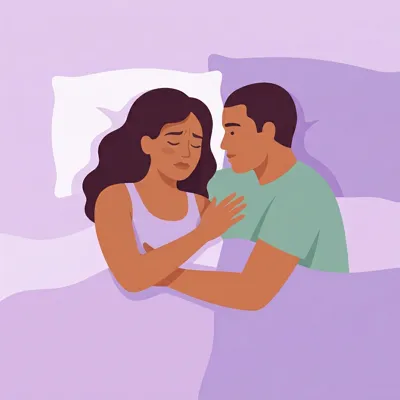
You wake at 3am, pyjamas soaked, and the next day runs on fumes. That exhaustion is real. Up to 3 in 4 women go through these hot flashes and night sweats at menopause. The cause is physical: an internal thermostat that's misfiring. The good news is that several concrete levers can help.
Why your hot flashes hit hardest at night
Your sweats aren't weakness or a lack of discipline. Picture an internal thermostat, tucked in your brain, that keeps your temperature steady [1]. Right now, its comfort zone has narrowed.
That drop in tolerance comes from falling estrogen. Small neurons (the KNDy neurons, which control both your hormones and your temperature) go into overdrive and disrupt the heat center [2]. The smallest rise now crosses the threshold and fires a flash [1].
Why the evening? To fall asleep, your body naturally lowers its core temperature. A warm room or a heavy duvet gets in the way of that cooling [3]. You stay close to the threshold, and the alarm goes off over nothing.
Each night sweat fragments your sleep: the wave of heat triggers a micro-waking and adds around half an hour of being awake [4]. Sleep problems are common at this stage, and their impact on your days is real [5]. The hardest part is often the next morning.
Sources (5)
- [1] Freedman RR. Menopausal hot flashes: mechanisms, endocrinology, treatment. J Steroid Biochem Mol Biol. 2014;142:115-120. doi:10.1016/j.jsbmb.2013.08.010
- [2] Rance NE, Dacks PA, Mittelman-Smith MA, Romanovsky AA, Krajewski-Hall SJ. Modulation of body temperature and LH secretion by hypothalamic KNDy neurons: a novel hypothesis on the mechanism of hot flushes. Front Neuroendocrinol. 2013;34(3):211-227. doi:10.1016/j.yfrne.2013.07.003
- [3] Okamoto-Mizuno K, Mizuno K. Effects of thermal environment on sleep and circadian rhythm. J Physiol Anthropol. 2012;31(1):14. doi:10.1186/1880-6805-31-14
- [4] de Zambotti M, Colrain IM, Javitz HS, Baker FC. Magnitude of the impact of hot flashes on sleep in perimenopausal women. Fertil Steril. 2014;102(6):1708-1715. doi:10.1016/j.fertnstert.2014.08.016
- [5] Baker FC, de Zambotti M, Colrain IM, Bei B. Sleep problems during the menopausal transition: prevalence, impact, and management challenges. Nat Sci Sleep. 2018;10:73-95. doi:10.2147/NSS.S125807
Lever number one: a cool room and sheets that breathe
If you change one thing, change your room temperature. A cool bedroom, around 16 to 18°C, keeps you below the trigger threshold [1][6]. It feels cool at first, and that's exactly the point.
A warm room does the opposite: it increases night-time wakings and cuts your deep sleep [3]. Tonight, turn the heating down, air the room for ten minutes before bed, and set a fan to move the air without blowing straight at you.
For anything that touches your skin, choose fabrics that breathe [6]:
- Cotton, linen or silk: they let air through and wick moisture away.
- Avoid polyester and thick flannel, which trap heat against you.
- Split your duvet from your partner's, so you can throw yours off in seconds.
Keep a dry T-shirt and a towel on the nightstand. If a sweat soaks you, you change just the top instead of remaking the whole bed. You fall back asleep faster, and your night breaks up less.
Sources (3)
- [1] Freedman RR. Menopausal hot flashes: mechanisms, endocrinology, treatment. J Steroid Biochem Mol Biol. 2014;142:115-120. doi:10.1016/j.jsbmb.2013.08.010
- [6] The NAMS 2023 Nonhormone Therapy Position Statement Advisory Panel. The 2023 nonhormone therapy position statement of The North American Menopause Society. Menopause. 2023;30(6):573-590. doi:10.1097/GME.0000000000002200
- [3] Okamoto-Mizuno K, Mizuno K. Effects of thermal environment on sleep and circadian rhythm. J Physiol Anthropol. 2012;31(1):14. doi:10.1186/1880-6805-31-14
Your evening reset and the triggers that are yours alone
Two evening moves can lower your temperature before bed. First, a warm-then-cool shower instead of a hot one. It helps your body drop in temperature and can make falling asleep easier [3][7].
Second, look at your evening plate. Alcohol widens your blood vessels and fragments sleep, while spicy or very hot dishes raise your temperature [6]. Some women wonder whether evening sugar plays a role too; that isn't well established, so treat it as something to test for yourself.
Your triggers aren't your neighbour's. Spotting and cutting the ones that affect you beats blanket restriction [6]. Tracking helps: each night, log how intense your sweats were, what you drank and ate, and your stress level.
Over two or three weeks, patterns surface. You move from "I'm hit at random" to "Friday's wine costs me a night." And you walk into your appointment with real data, not a vague impression.
Sources (4)
- [3] Okamoto-Mizuno K, Mizuno K. Effects of thermal environment on sleep and circadian rhythm. J Physiol Anthropol. 2012;31(1):14. doi:10.1186/1880-6805-31-14
- [7] Guthrie KA, Larson JC, Ensrud KE, et al. Effects of pharmacologic and nonpharmacologic interventions on insomnia symptoms and self-reported sleep quality in women with hot flashes (MsFLASH). Sleep. 2018;41(1):zsx190. doi:10.1093/sleep/zsx190
- [6] The NAMS 2023 Nonhormone Therapy Position Statement Advisory Panel. The 2023 nonhormone therapy position statement of The North American Menopause Society. Menopause. 2023;30(6):573-590. doi:10.1097/GME.0000000000002200
- [8] Avis NE, Crawford SL, Greendale G, et al. Duration of menopausal vasomotor symptoms over the menopause transition (SWAN Study). JAMA Intern Med. 2015;175(4):531-539. doi:10.1001/jamainternmed.2014.8063
When it's not just menopause, and what your options are
Up to 3 in 4 women go through these symptoms at menopause [9]. In the vast majority of cases, your sweats come from the hormone shift. But not always.
Other causes exist: an infection, an overactive thyroid, certain medications, more rarely other conditions [10]. A simple work-up, like a clinical exam and a blood test, often rules them out quickly.
If it is menopause, you have more options than a cool room alone. Cognitive behavioural therapy (CBT, a structured talking therapy) has solid evidence for sleep and hot flashes, without hormones [6].
There are also non-hormonal medications and menopausal hormone therapy (MHT). MHT is the first-line treatment for hot flashes, often given through the skin (a patch or gel applied to the skin) at the lowest effective dose [11][12]. These choices are a conversation to have with your doctor.
Sources (5)
- [9] Stuenkel CA, Davis SR, Gompel A, et al. Treatment of symptoms of the menopause: an Endocrine Society Clinical Practice Guideline. J Clin Endocrinol Metab. 2015;100(11):3975-4011. doi:10.1210/jc.2015-2236
- [10] Mold JW, Mathew MK, Belgore S, DeHaven M. Prevalence of night sweats in primary care patients: an OKPRN and TAFP-Net collaborative study. J Fam Pract. 2002;51(5):452-456
- [6] The NAMS 2023 Nonhormone Therapy Position Statement Advisory Panel. The 2023 nonhormone therapy position statement of The North American Menopause Society. Menopause. 2023;30(6):573-590. doi:10.1097/GME.0000000000002200
- [11] National Institute for Health and Care Excellence. Menopause: identification and management (NG23). 2015, updated 2024.
- [12] The 2022 Hormone Therapy Position Statement Advisory Panel. The 2022 hormone therapy position statement of The North American Menopause Society. Menopause. 2022;29(7):767-794. doi:10.1097/GME.0000000000002028
You can't command your hormones. But your room temperature, your sheets, your evening shower and knowing your own triggers are all within reach. Don't launch all five levers at once: pick one for tonight, ideally a cooler room. The first night you wake once instead of four times can already change the day that follows. And if nothing shifts despite your efforts, your doctor is still your best support.
This article is for information only and does not replace the advice of a health professional. If a symptom worries you, talk to a doctor.