I'm suddenly burning up, what's going on?
Hot flashes before menopause, and the twist nobody warns you about: they can hit at 40, even while your periods are still regular.
4 min read
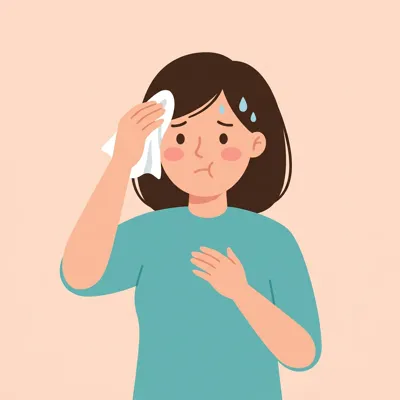
You're in a meeting, or in the checkout line, totally fine. Then a wave of heat climbs to your face, sweat beads on your lip, your heart speeds up. The worst part isn't the heat, it's not understanding it. This wave has a precise hormonal explanation, and it can start well before your periods stop. Understanding it is the first step to taking back control.
This wave is real, and it can hit at 40
This wave is real and it has a physical cause. It often starts in your chest, spreads to your face and neck, your skin flushes, sweat beads, sometimes your heart races. Then it fades, sometimes leaving you chilled. At night it's the same story: you wake up with soaked sheets.
Up to 80% of women go through these vasomotor symptoms (the medical name for hot flashes and night sweats) during the transition to menopause [1]. About one in four affected women report a strong impact on their quality of life [2]. You're not exaggerating.
If you've been told "it's in your head" or "it's just stress," the science says otherwise. A hot flash is measurable: the widening blood vessels, the rise in skin temperature, the sweating [3]. Stress can make it worse, but it isn't the cause.
Another surprise: your periods don't have to stop first. These waves can appear as early as 35 to 40, while your cycles are still regular [4][5]. Perimenopause, the transition before periods stop, lasts about 4 to 8 years on average [1]. The waves last a median of 7.4 years, sometimes over 11 when they start early [6]. You're not too young, and nothing is "wrong" with you.
Sources (6)
- [1] Santoro N, Roeca C, Peters BA, Neal-Perry G. The Menopause Transition: Signs, Symptoms, and Management Options. J Clin Endocrinol Metab. 2021;106(1):1-15. doi:10.1210/clinem/dgaa764
- [2] Groupe d'Étude sur la Ménopause et le Vieillissement hormonal (GEMVi). Recommandations sur la prise en charge des femmes ménopausées. 2021.
- [3] Freedman RR. Menopausal hot flashes: Mechanisms, endocrinology, treatment. J Steroid Biochem Mol Biol. 2014;142:115-120.
- [4] Gold EB, Crawford SL, et al. Study of Women's Health Across the Nation (SWAN). Menopause. 2017.
- [5] Freeman EW, Sammel MD, Lin H, Gracia CR, Pien GW, Nelson DB, Sheng L. Symptoms associated with menopausal transition and reproductive hormones in midlife women. Obstet Gynecol. 2007;110(2 Pt 1):230-240.
- [6] Avis NE, Crawford SL, Greendale G, Bromberger JT, Everson-Rose SA, Gold EB, et al. Duration of Menopausal Vasomotor Symptoms Over the Menopause Transition. JAMA Intern Med. 2015;175(4):531-539.
The mechanism: an internal thermostat thrown off by hormones
Picture a thermostat, like the one for your heating. A small brain region does that job for your body: it decides when to cool you down. Estrogen is a bit like its remote control.
In perimenopause, that remote gets glitchy. Estrogen doesn't drop steadily: it rides a rollercoaster, swinging up and down without warning [5]. It's these swings, more than the decline, that throw the system off [5].
The result: your "thermal comfort zone" shrinks [3]. Now the smallest warm-up (a hot room, a coffee, a spike of stress) is enough to cross the line. Your brain thinks you're overheating, when your temperature barely moved, and slams on emergency cooling: dilated vessels, flushed skin, sweat. That's the wave.
Neighboring cells called KNDy neurons fire off false alarms when estrogen swings [7]. This is exactly the mechanism targeted by a newer non-hormonal drug, fezolinetant, worth discussing with a doctor depending on your situation [7].
Sources (3)
- [5] Freeman EW, Sammel MD, Lin H, Gracia CR, Pien GW, Nelson DB, Sheng L. Symptoms associated with menopausal transition and reproductive hormones in midlife women. Obstet Gynecol. 2007;110(2 Pt 1):230-240.
- [3] Freedman RR. Menopausal hot flashes: Mechanisms, endocrinology, treatment. J Steroid Biochem Mol Biol. 2014;142:115-120.
- [7] Rance NE, Dacks PA, Mittelman-Smith MA, Romanovsky AA, Krajewski-Hall SJ. Modulation of body temperature and LH secretion by hypothalamic KNDy neurons: a novel hypothesis on the mechanism of hot flushes. Front Neuroendocrinol. 2013;34(3):211-227.
What calms the wave, and the longer-term options that exist
Here's how to take back control when a wave rises. No single move is magic, but together they add up.
- Breathe slowly: in for about 4 to 5 seconds, out even more slowly. Paced breathing acts on the nerve circuit that precedes a flush [3].
- Work your temperature: dress in layers you can peel off, keep cold water within reach, sleep in a cool room.
- Spot your triggers: alcohol, caffeine, spicy food, an overheated room and stress are the usual suspects [8].
Beyond these reflexes, longer-term options exist. Menopausal hormone therapy (MHT) is the first-line and most effective treatment for hot flashes; the transdermal route (a gel or patch on the skin) is preferred for its lower clotting risk, at the lowest effective dose [1][9][12][13]. When hormones are contraindicated, non-hormonal medicines can be offered [9]. Cognitive behavioural therapy (a structured talking approach) eases the distress of the waves, even without lowering their frequency [9][14]. You don't have to grit your teeth in silence: a doctor can weigh the option that fits you best.
Sources (7)
- [3] Freedman RR. Menopausal hot flashes: Mechanisms, endocrinology, treatment. J Steroid Biochem Mol Biol. 2014;142:115-120.
- [8] Thurston RC, Joffe H. Vasomotor symptoms and menopause: findings from the Study of Women's Health Across the Nation. Obstet Gynecol Clin North Am. 2011;38(3):489-501.
- [1] Santoro N, Roeca C, Peters BA, Neal-Perry G. The Menopause Transition: Signs, Symptoms, and Management Options. J Clin Endocrinol Metab. 2021;106(1):1-15. doi:10.1210/clinem/dgaa764
- [9] National Institute for Health and Care Excellence (NICE). Menopause: diagnosis and management (NG23). 2024.
- [12] The 2022 Hormone Therapy Position Statement of The North American Menopause Society (NAMS) Advisory Panel. Menopause. 2022;29(7):767-794. doi:10.1097/GME.0000000000002028
- [13] Haute Autorité de Santé (HAS). Réévaluation des spécialités indiquées dans le traitement hormonal de la ménopause. Avis de la Commission de la transparence. 14 octobre 2025.
- [14] Ayers B, Smith M, Hellier J, Mann E, Hunter MS. Effectiveness of group and self-help cognitive behavior therapy to reduce problematic menopausal hot flushes and night sweats (MENOS 2): a randomized controlled trial. Menopause. 2012;19(7):749-759.
When it's not hormonal: the signals worth checking
The vast majority of hot flashes between 40 and 55 are hormonal. But not all, and telling them apart is a form of calm vigilance.
An overactive thyroid, infections or certain medications can mimic a hot flash [10]. See a doctor rather than blaming hormones if you notice:
- fever alongside the sweats;
- unexplained weight loss, with no change to your diet;
- drenching night sweats that soak your bedding, unrelated to your cycle;
- marked, lingering palpitations.
A note on age, too. Over 45, a doctor can diagnose perimenopause from your symptoms alone, with no blood test [9]. Between 40 and 45, a blood test (FSH) can help [9]. Before 40, persistent hot flashes warrant a workup, because premature ovarian insufficiency (the ovaries stopping early, which affects about 1 in 100 women under 40) should be ruled out [11].
Sources (3)
- [10] Mohyi D, Tabassi K, Simon J. Differential diagnosis of hot flashes. Maturitas. 1997;27(3):203-214.
- [9] National Institute for Health and Care Excellence (NICE). Menopause: diagnosis and management (NG23). 2024.
- [11] European Society for Human Reproduction and Embryology (ESHRE) Guideline Group on POI; Webber L, Davies M, Anderson R, et al. ESHRE Guideline: management of women with premature ovarian insufficiency. Hum Reprod. 2016;31(5):926-937. doi:10.1093/humrep/dew027
That wave that used to ambush you now has a name, a mechanism and a logic: an internal thermostat made oversensitive by swinging hormones. Nothing is broken, your body is recalibrating. Next concrete step: at your next flash, log it in the app (time, context, intensity). Within a few weeks a pattern surfaces, and that precise history also helps your doctor choose the best option with you.
This article is for information only and does not replace the advice of a health professional. If a symptom worries you, talk to a doctor.