My nails keep splitting at menopause: what's really going on?
The estrogen, keratin and hydration link explained, plus the real levers you control, biotin included.
3 min read
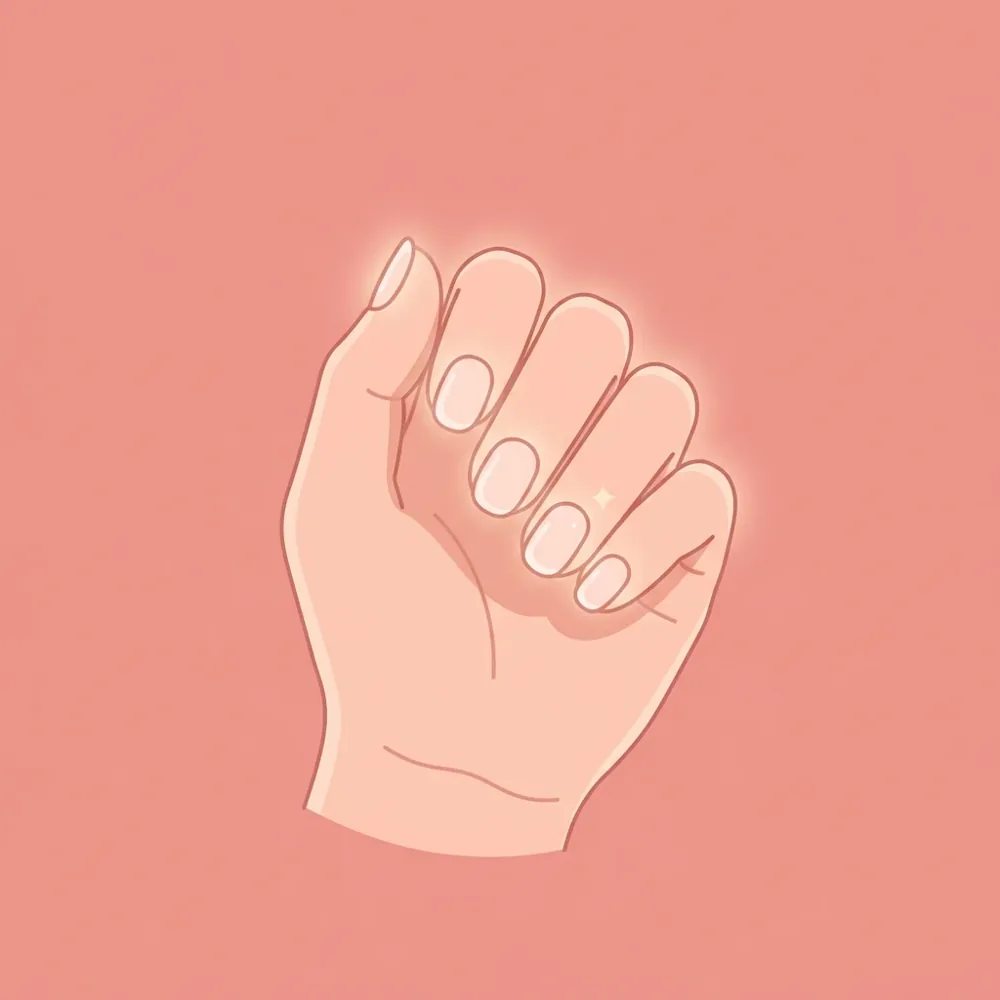
A nail that snaps at the slightest knock. A tip that peels into thin layers. Vertical ridges that weren't there two years ago. These changes are real and they have a physical cause. Nearly one in three women reports brittle nails after menopause [2]. This isn't just aging, and it's nobody's fault.
Your nails react to the same hormonal signal as your skin
Your nails aren't giving out at random. Estrogen works like a built-in moisturizer: it helps your body hold water and make the collagen that keeps tissues supple [4][6]. At menopause that supply drops, and the nail matrix (its root, where keratin is made) produces a drier, stiffer plate [3].
Well-hydrated keratin bends under pressure and springs back. Dry keratin cracks, like a strip of leather left in the sun [3]. That's the layered peeling (onychoschizia) and the vertical ridges you're noticing.
Skin, hair and nails belong to the same family, all sensitive to estrogen [4][6]. When levels fall, they take the hit together: not ten separate problems, but one mechanism showing in three places. You're not imagining it: up to one in three women reports brittle nails after 50, and women are affected about twice as often as men [1][2]. After menopause, skin can lose up to 30% of its collagen in five years [4][5].
Sources (6)
- [4] Brincat MP, Baron YM, Galea R. Estrogens and the skin. Climacteric. 2005;8(2):110-123.
- [6] Thornton MJ. Estrogens and aging skin. Dermatoendocrinol. 2013;5(2):264-270.
- [3] Stephens-Boal A, Eckhart L. Brittle Nail Syndrome: Treatment and Prevention. Skin Appendage Disord. 2021;7(4):247-252.
- [1] Iorizzo M, Pazzaglia M, Piraccini BM, et al. Brittle nails. J Cosmet Dermatol. 2004;3(3):138-144.
- [2] Iorizzo M, Pazzaglia M, Piraccini BM, et al. Brittle nails. Am J Clin Dermatol. 2009;10(6):399-406.
- [5] Brincat M, Kabalan S, Studd JW, et al. A study of the decrease in skin collagen content, skin thickness, and bone mass in the postmenopausal woman. Obstet Gynecol. 1987;70(6):840-845.
Biotin only helps if you're truly short of it
If the biotin gummies changed nothing, that's not your failure. An old study found that 2.5 mg a day improved nail firmness in 63% of people, thickening the plate by about 25% [8].
But those trials were small, old and mostly involved people who were genuinely deficient [9]. True biotin deficiency is rare on a normal diet. If the real driver is hormonal or low iron, biotin won't touch it.
Collagen peptides have slightly stronger data: in one trial, 2.5 g a day raised nail growth by 12% and cut breaks by 42% [10]. Promising, but slow. The rule: check first, supplement second.
Sources (4)
- [8] Hochman LG, Scher RK, Meyerson MS. Brittle nails: response to daily biotin supplementation. Cutis. 1993;51(4):303-305.
- [9] Lipner SR, Scher RK. Biotin for the treatment of nail disease: what is the evidence? J Dermatolog Treat. 2018;29(4):411-414.
- [10] Hexsel D, Zague V, Schunck M, et al. Oral supplementation with specific bioactive collagen peptides improves nail growth and reduces symptoms of brittle nails. J Cosmet Dermatol. 2017;16(4):520-526.
- [16] US Food and Drug Administration. The FDA Warns that Biotin May Interfere with Lab Tests: FDA Safety Communication. 2017.
The daily habits that protect your nails' water
Brittleness comes mostly from dehydration and tiny shocks. Three simple habits target both [1][3].
- File, don't cut, in one direction: clippers crush the layers and trigger peeling [1].
- Gloves for water: dishes, cleaning and frequent washing swell then dry the nail, prying its layers apart [3].
- Oil at night on the cuticle and plate (jojoba, castor) rehydrates and limits flaking [1].
Go easy on acetone removers and harsh hardeners, which dry the nail out. And you don't need to let nails "breathe" either: they're made of dead keratin and get nothing through their surface, so polish doesn't suffocate them [17]. Three habits you keep beat ten you drop.
Sources (3)
- [1] Iorizzo M, Pazzaglia M, Piraccini BM, et al. Brittle nails. J Cosmet Dermatol. 2004;3(3):138-144.
- [3] Stephens-Boal A, Eckhart L. Brittle Nail Syndrome: Treatment and Prevention. Skin Appendage Disord. 2021;7(4):247-252.
- [17] American Academy of Dermatology. Nail care guidance. AAD; 2022.
The most useful step: an iron and thyroid check
Before stacking supplements, a simple blood test can clear things up. Two common shortfalls hide in your blood.
- Iron: about one in four pre-menopausal women is short of it [13]. It makes nails thin, brittle, sometimes spoon-shaped (koilonychia) [11][12]. Ask for ferritin, which can be low even when your blood count looks normal.
- Thyroid: when underactive, it leaves nails ridged and slow-growing, often with fatigue and hair loss [7][15]. A TSH test spots it.
- Zinc and silicon: both help build keratin and can run low at menopause [14].
Correcting low ferritin or a slow thyroid restores nail quality where no cream can [11]. And if you take biotin, say so: it distorts the thyroid result.
Sources (6)
- [13] Santé publique France. Étude Esteban : statut en fer de la population adulte. 2019.
- [11] Hardman J, Berens E. Common nail disorders. Am Fam Physician. 2017.
- [12] Holzberg M, Walker HK. Nail signs of systemic disease and nutritional deficiencies. Clin Dermatol. 2021;39(2):254-263.
- [7] van Beek N, Bodó E, Kromminga A, et al. Thyroid hormones directly alter human hair follicle functions. J Clin Endocrinol Metab. 2008;93(11):4381-4388.
- [15] Haute Autorité de Santé. Hypothyroïdie : prise en charge. 2019.
- [14] Scheinfeld N, Dahdah MJ, Scher R. Vitamins and minerals: their role in nail health and disease. J Drugs Dermatol. 2007;6(8):782-787.
Your nails aren't betraying you, they're talking to you. Behind that sense of everything crumbling are a few identifiable causes, and several are fixable. This week, pick two habits: oil at night and gloves at the sink. Next month, ask for a simple ferritin and TSH check. Save biotin for later, and only if a deficiency shows up. Nails grow slowly, so give the results a few weeks to reach the tip.
This article is for information only and does not replace the advice of a health professional. If a symptom worries you, talk to a doctor.