Your skin feels tight and you changed nothing: here's the real reason
Why menopause makes your skin dry, tight and itchy so fast, and the gentle routine that brings back comfort.
3 min read
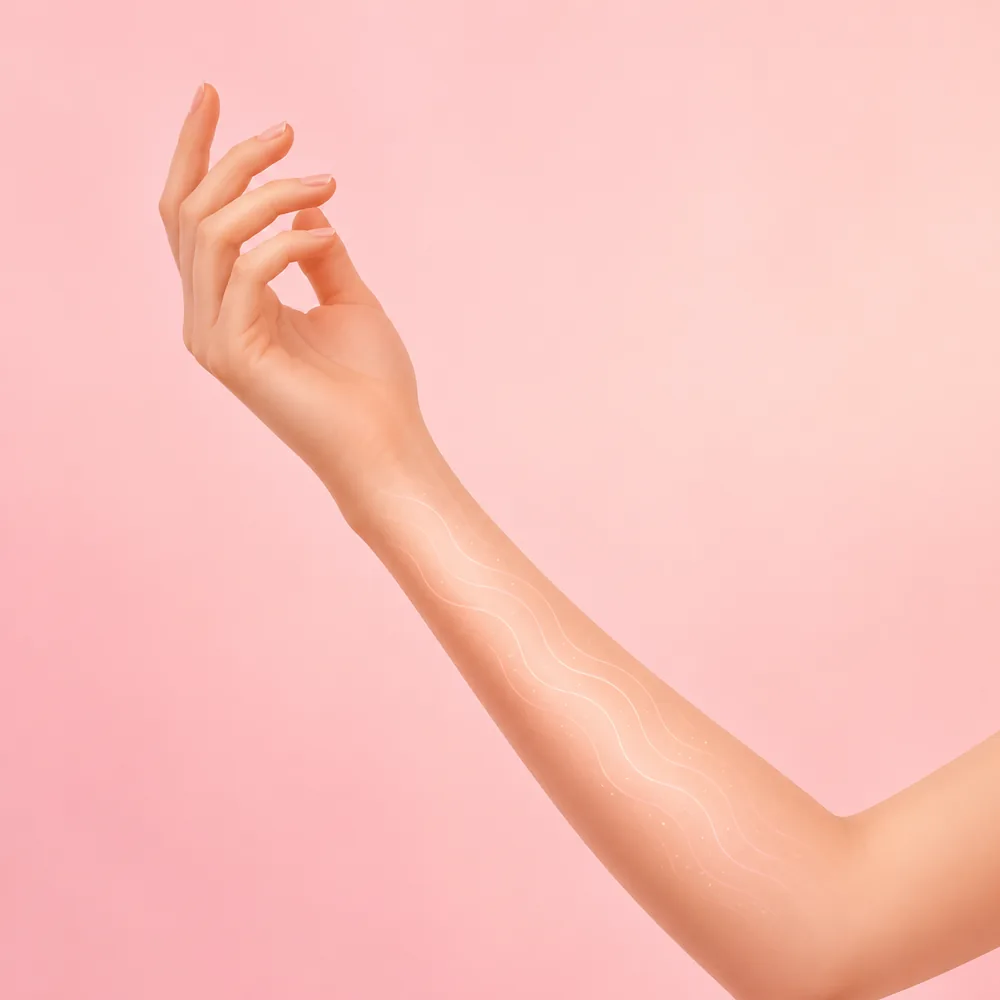
You step out of the shower and your skin pulls, as if it turned too small for your face. At night, your back and shins itch for no reason. That cardboard feeling is real, and it's not your fault. Many women live it at menopause. The cause fits in one sentence: your collagen and hyaluronic acid are leaving at the same time as your estrogen.
Your skin really changed, and it's not your fault
Let's name what you're feeling. It pulls in the morning, it itches at night, and the skin looks thinner and duller. This has a precise biological cause, nothing to do with willpower.
The numbers reassure: up to 64% of menopausal women report dry, itchy skin [1]. You're not an isolated case or a fussy exception.
What unsettles you is the speed. Skin reacts strongly and fast to falling estrogen, sometimes in perimenopause, before your periods even stop [2]. The change is real and measurable, so it's something you can act on.
Sources (2)
- [1] Rzepecki AK, Murase JE, Juran R, et al. Estrogen-deficient skin: The role of topical therapy. Int J Womens Dermatol. 2019;5(2):85-90. doi:10.1016/j.ijwd.2019.01.001
- [2] Calleja-Agius J, Brincat M. The effect of menopause on the skin and other connective tissues. Gynecol Endocrinol. 2012;28(4):273-277. doi:10.3109/09513590.2011.613970
Estrogen, collagen, hyaluronic acid: the trio that leaves together
Picture your skin as a mattress. Collagen is the firm structure, the spring that holds it up. Hyaluronic acid is the sponge inside, holding water and keeping everything plump.
Estrogen is the site manager: it tells your skin to make collagen and hyaluronic acid [3]. At menopause it drops, and the construction site slows sharply.
The effects are measurable. You can lose about 30% of your skin collagen in the first five years after menopause [4]. Skin then thins by roughly 1% a year [5].
Meanwhile the sponge empties: hyaluronic acid falls, and water holds less well [6]. Your skin barrier, in turn, is like a brick wall. The mortar between the bricks (fats called ceramides) runs low, so water escapes through the gaps [7]. That's exactly the cardboard feeling.
Sources (5)
- [3] Thornton MJ. Estrogens and aging skin. Dermatoendocrinol. 2013;5(2):264-270. doi:10.4161/derm.23872
- [4] Brincat M, Versi E, Moniz CF, et al. Skin collagen changes in postmenopausal women receiving different regimens of estrogen therapy. Br J Obstet Gynaecol. 1987;94(2):126-129.
- [5] Shah MG, Maibach HI. Estrogen and skin. An overview. Am J Clin Dermatol. 2001;2(3):143-150. doi:10.2165/00128071-200102030-00003
- [6] Ghersetich I, Lotti T, Campanile G, et al. Hyaluronic acid in cutaneous intrinsic aging. Int J Dermatol. 1994;33(2):119-122. doi:10.1111/j.1365-4362.1994.tb01540.x
- [7] Bonté F, Girard D, Archambault JC, Desmoulière A. Skin Changes During Ageing. Subcell Biochem. 2019;91:249-280. doi:10.1007/978-981-13-3681-2_10
What you can do tonight to ease it
Good news: because the mechanism is known, you can offset it, step by step. Two jobs your skin no longer does alone: hydrate (add water) and nourish (add fats).
Starting tonight:
- Lukewarm water, not hot: hot water dissolves the protective oil film, like dish soap on a plate [10].
- Cream on damp skin, within three minutes of showering: you trap the water inside [9].
- Ingredients that matter: ceramides to refill the wall, hyaluronic acid and glycerin to hold water [8][9].
Ease off scrubs, strong exfoliants and alcohol toners. Your skin doesn't need stripping, it needs protecting. Less, but better.
On the plate, a quieter role. With age, low-grade inflammation simmers and weakens tissues [11]. Omega-3s from oily fish, flaxseed and walnuts help calm it [11]. The evidence is modest, but the approach is safe.
Watch one stubborn myth: drinking three litres of water won't patch a cracked barrier. Hydration works first at the surface, with rich care [8].
Sources (4)
- [10] Polefka TG, Bianchini RJ, Shapiro S. Interaction of mineral salts with the skin: a literature survey. Int J Cosmet Sci. 2012;34(5):416-423. doi:10.1111/j.1468-2494.2012.00731.x
- [9] Spada F, Barnes TM, Greive KA. Skin hydration is significantly increased by a cream formulated to mimic the skin's own natural moisturizing systems. Clin Cosmet Investig Dermatol. 2018;11:491-497. doi:10.2147/CCID.S177697
- [8] Lephart ED, Naftolin F. Menopause and the Skin: Old Favorites and New Innovations in Cosmeceuticals for Estrogen-Deficient Skin. Dermatol Ther (Heidelb). 2021;11(1):53-69. doi:10.1007/s13555-020-00468-7
- [11] Pilkington SM, Bulfone-Paus S, Griffiths CEM, Watson REB. Inflammaging and the Skin. J Invest Dermatol. 2021;141(4S):1087-1095. doi:10.1016/j.jid.2020.11.006
The one sign that means a blood test, not another cream
A safety net, because not everything is hormonal. One precise pattern deserves a call to your doctor.
The sign: skin that itches persistently, with no rash or redness, and resists moisturizing despite weeks of rich care. The cause may then be internal.
Two paths to explore with a doctor:
- The thyroid: an underactive thyroid (hypothyroidism) is among the possible causes of dry, itchy skin.
- Iron: a deficiency, with or without anemia, can also cause itching with no visible lesion.
The test is simple: a TSH (a blood test for the thyroid) and a ferritin (a measure of iron stores). In older women, this chronic itch is common and worth investigating [12].
Asking for this isn't a failure of your routine, it's a smart step. Logging your skin each day gives you concrete data to share, instead of a vague impression.
Sources (1)
- [12] Valdes-Rodriguez R, Mollanazar NK, Gonzalez-Muro J, et al. Itch prevalence and characteristics in a Hispanic geriatric population. Acta Derm Venereol. 2015;95(4):417-421. doi:10.2340/00015555-1968
You didn't lose control of your skin, only the old rules. Your estrogen dropped, and with it the collagen and hyaluronic acid. Tonight: a lukewarm shower, a rich ceramide and hyaluronic acid cream on damp skin, and no more harsh products. Keep the routine, because consistency is what pays, not a miracle jar. Track how it changes day to day so you can watch the tightness ease over the coming weeks. And if it itches with no rash despite your efforts, talk to your doctor.
This article is for information only and does not replace the advice of a health professional. If a symptom worries you, talk to a doctor.