You're losing your hair at menopause: is it permanent?
The hormonal shift behind the shedding, and the concrete levers to slow it, in the right order.
4 min read
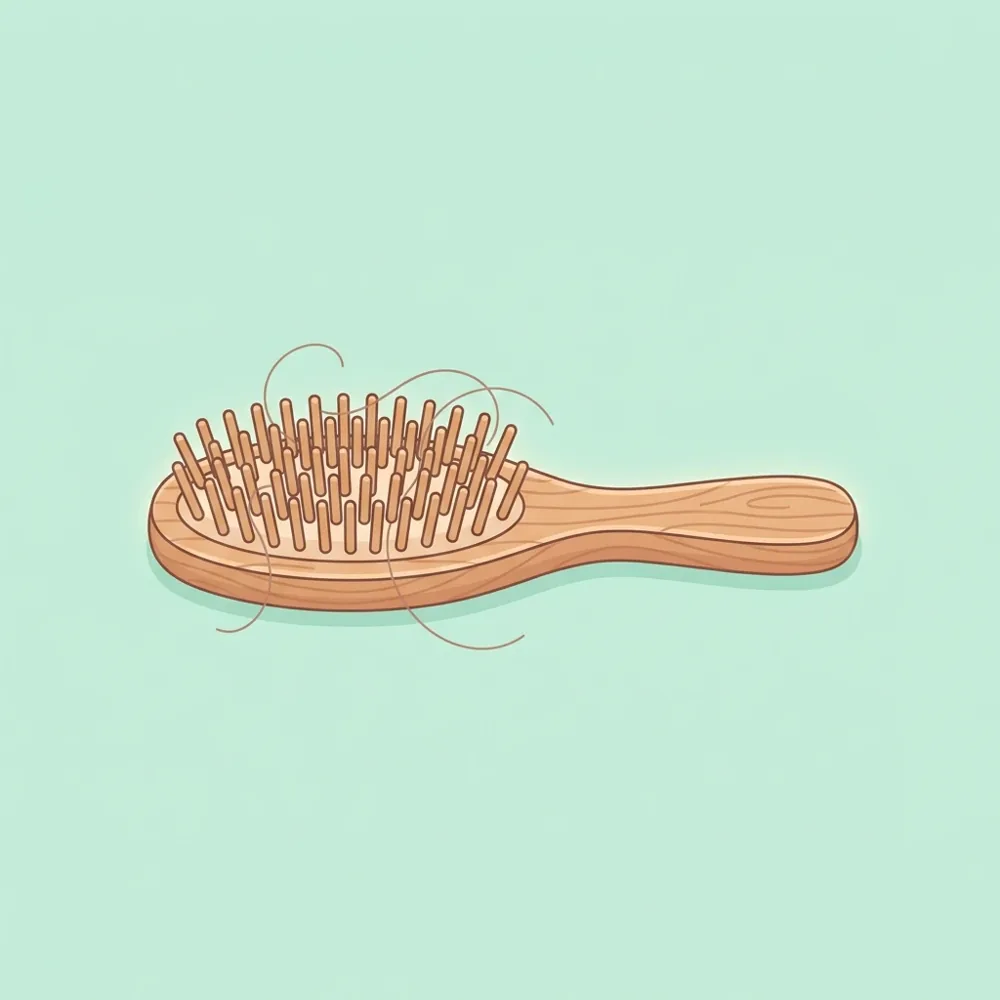
You pull a handful of hair from the shower drain, again. In the mirror, you part your hair and the line of scalp looks wider than last month. That worry is valid: your hair is part of how you recognise yourself. Here's the key point: at menopause, this thinning usually isn't permanent. And the first useful move isn't a serum, it's a blood test.
Why now: oestrogen drops and androgens take over the room
For most of your adult life, your ovaries made plenty of oestrogen, and it protected your hair. Your body also makes small amounts of androgens, the so-called male hormones. Every woman has them.
At menopause, oestrogen falls sharply and for good [1]. Your androgens don't really rise. But the counterweight is gone, so they suddenly carry far more weight. That's the relative testosterone effect: the balance tips, without you making more hormones [1].
On certain zones of the scalp, follicles are very sensitive to these androgens. Under their influence, the follicle miniaturises (it shrinks): with each cycle the hair grows back finer and shorter, until it's almost invisible [1]. That's why the scalp starts to show through.
This thinning has a signature. It often spares your front hairline but widens the part and thins the crown (the vertex) and temples [2]. It isn't a masculinising, it's a balance that changed its setting. And it's nobody's fault.
Sources (2)
- [1] Mirmirani P. Hormonal changes in menopause: do they contribute to a 'midlife hair loss' in women? Maturitas. 2011;69(2):145-152.
- [2] Dinh QQ, Sinclair R. Female pattern hair loss: current treatment concepts. Clin Interv Aging. 2007;2(2):189-199.
Is it permanent: in many cases, no
This is probably the question you typed late at night, stomach a little tight. Here's an honest answer, without false hope or doom.
It depends on the cause. If your shedding comes from a deficiency (iron, for example) or a thyroid imbalance, it's often reversible once the cause is fixed [4]. A big stress or a shock can trigger it too, then it settles. This kind has a name: telogen effluvium (a temporary shedding).
For purely hormonal thinning (female pattern hair loss, tied to that imbalance), the right words aren't regrow it all. It's stabilise and slow the loss, sometimes improve density with early treatment [8].
The key message fits in one line: the earlier you act, the better your chances. A recently miniaturised follicle responds better than one that shut down years ago [8].
Sources (2)
- [4] Trost LB, Bergfeld WF, Calogeras E. The diagnosis and treatment of iron deficiency and its potential relationship to hair loss. J Am Acad Dermatol. 2006;54(5):824-844.
- [8] American Academy of Dermatology (AAD). Hair loss and hair care guidelines. 2022.
Where to start: a blood test, not a serum
Before buying the next serum, start with the move that changes everything: a blood panel. Behind shedding there's often a hidden cause, common and reversible, that you can't spot in the mirror.
Two suspects come up again and again:
- Iron. We measure ferritin (your iron stores). Low stores, even without visible anaemia, slow growth [4]. For regrowth, guidelines often aim for 40 to 70 ng/mL [4].
- Thyroid. Your thyroid hormones speak directly to the hair root [5]. A thyroid problem, very common after 45, can trigger diffuse shedding [9]. A simple TSH test (a hormone that reflects how the thyroid is working) checks it.
So ask your doctor for a panel with ferritin, TSH, and depending on your profile, vitamin D. Correcting a real deficiency can be enough to stop the shedding, with no heavy treatment. Zinc or vitamin D only help if a genuine deficiency shows up on the test [3].
One detail that matters: if you take biotin, say so. It can skew some blood tests, thyroid ones especially, and blur the results [10].
Sources (5)
- [4] Trost LB, Bergfeld WF, Calogeras E. The diagnosis and treatment of iron deficiency and its potential relationship to hair loss. J Am Acad Dermatol. 2006;54(5):824-844.
- [5] van Beek N, Bodo E, Kromminga A, et al. Thyroid hormones directly alter human hair follicle functions. J Clin Endocrinol Metab. 2008;93(11):4381-4388.
- [9] Vanderpump MPJ. The epidemiology of thyroid disease. Br Med Bull. 2011;99:39-51.
- [3] Almohanna HM, Ahmed AA, Tsatalis JP, Tosti A. The Role of Vitamins and Minerals in Hair Loss: A Review. Dermatol Ther (Heidelb). 2019;9(1):51-70.
- [10] Patel DP, Swink SM, Castelo-Soccio L. A Review of the Use of Biotin for Hair Loss. Skin Appendage Disord. 2017;3(3):166-169.
What actually helps, and who to see
Once the panel is done and any deficiencies treated, you can add concrete steps. None is magic on its own, but together and over time, they count.
- Topical minoxidil (2 or 5%) is the reference treatment, the only one approved for this use in women [2]. Results show after 3 to 6 months, and you have to keep applying it, because the benefit stops when you stop [6].
- Scalp massage, free and risk-free, may thicken the strand over time [7]. The secret isn't intensity, it's regularity.
- A gentle routine: suitable washing, no tight pulling, little heat. Drop the myth of washing less to shed less: those hairs were going to fall anyway [8].
For lasting shedding, the right person is a dermatologist, ideally with trichology training (the hair and scalp specialist). They can confirm the diagnosis and discuss other paths: an oral anti-androgen like spironolactone (off-label, supervised) [2], menopause hormone therapy (MHT), which sometimes improves hair quality without being prescribed for it [1], or techniques like PRP (platelet-rich plasma) with emerging evidence [2].
One last thing: make sure you're taken seriously. The distress of hair loss is real and well documented [11]. You have every right to insist, ask for the blood panel, or see another doctor.
Sources (6)
- [2] Dinh QQ, Sinclair R. Female pattern hair loss: current treatment concepts. Clin Interv Aging. 2007;2(2):189-199.
- [6] Blume-Peytavi U, Hillmann K, Dietz E, et al. A randomized, single-blind trial of 5% minoxidil foam once daily versus 2% minoxidil solution twice daily in women with androgenetic alopecia. J Am Acad Dermatol. 2011;65(6):1126-1134.
- [7] English RS Jr, Barazesh JM. Self-administered Scalp Massage. Dermatol Ther (Heidelb). 2019;9(1):167-178.
- [8] American Academy of Dermatology (AAD). Hair loss and hair care guidelines. 2022.
- [1] Mirmirani P. Hormonal changes in menopause: do they contribute to a 'midlife hair loss' in women? Maturitas. 2011;69(2):145-152.
- [11] Hunt N, McHale S. The psychological impact of alopecia. BMJ. 2005;331(7522):951-953.
Your body changed the rules without warning: oestrogen dropped, the balance tipped, and your most sensitive follicles responded first. But now you know the rules, and that changes everything. Your plan: book a blood test (ferritin, TSH, and vitamin D depending on your profile), start a gentle routine and a few minutes of scalp massage tonight, and note what you observe (dates, photos) so you can speak precisely with your doctor. Acting early puts the odds on your side. No guaranteed regrowth, but solid, honest hope.
This article is for information only and does not replace the advice of a health professional. If a symptom worries you, talk to a doctor.