These crawling sensations under your skin have a name: formication
That crawling, tingling, electric-zap feeling in your hands, feet and skin is a real, documented menopause symptom, and here's why your tests came back 'normal'.
3 min read
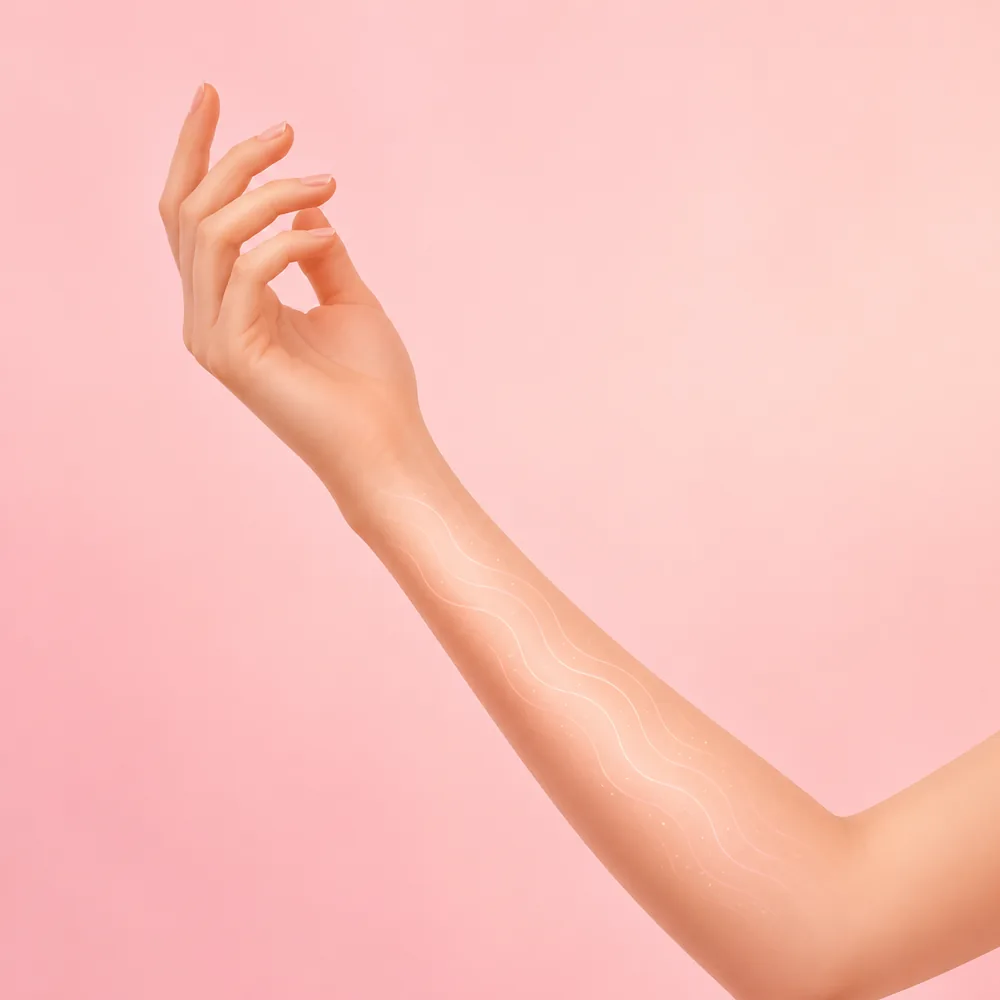
It's 3am. You wake up certain an insect is crawling on your arm. You check your skin: nothing there. That sensation is real, though. It has a name, formication, and it's tied to your hormones. Plenty of women live through it during menopause, and almost no one warned them it existed.
These sensations have a name: formication
That feeling of insects crawling under your skin has a name: formication, from the Latin formica, meaning ant. Putting a word to it already pulls you out of the scary unknown.
It rarely comes alone. Many women in perimenopause and menopause describe tingling in the hands and feet, prickling, numbness, and sometimes brief electric zaps. The medical term for the whole cluster is paresthesia [1].
It's neither rare nor marginal. Abnormal skin sensations, including tingling and formication, are reported by a notable share of women during the menopause transition [1], [2]. The real problem isn't the symptom: it's that no one warned you it existed. That silence turns a common hormonal sensation into a source of panic.
Sources (2)
- [1] Santoro N, Roeca C, Peters BA, Neal-Perry G. The Menopause Transition: Signs, Symptoms, and Management Options. J Clin Endocrinol Metab. 2021;106(1):1-15. doi:10.1210/clinem/dgaa764
- [2] Wilkinson HN, Hardman MJ. The menopause and the skin: old favourites and new developments. J Am Acad Dermatol. 2019.
Why your nerves misfire: the estrogen connection
Think of estrogen as a regulator that keeps your nerves calm and your small blood vessels stable. During perimenopause, its level doesn't fall smoothly: it swings, spikes and dips.
Without that steady influence, the nerve endings under your skin get 'chattier' and fire false signals to your brain: tingling, prickling, that crawling feeling. It's not your imagination, it's chemistry [1], [3].
One detail unlocks it: timing. Your internal thermostat, the hypothalamus (the brain area that controls temperature), becomes hypersensitive when estrogen drops. Just before a hot flash arrives, it produces nerve and skin reactions [3]. Formication is often the early warning, not a separate disease.
Brain imaging shows that falling estrogen changes how the brain works in areas that process sensation [4], which makes a biological origin plausible. Stress adds a layer: worry ramps up your nervous system and turns up the 'volume' on these sensations, while calming techniques help bring the intensity down [9].
Sources (4)
- [1] Santoro N, Roeca C, Peters BA, Neal-Perry G. The Menopause Transition: Signs, Symptoms, and Management Options. J Clin Endocrinol Metab. 2021;106(1):1-15. doi:10.1210/clinem/dgaa764
- [3] Freedman RR. Menopausal hot flashes: mechanisms, endocrinology, treatment. J Steroid Biochem Mol Biol. 2014;142:115-120. doi:10.1016/j.jsbmb.2013.08.010
- [4] Mosconi L, Berti V, Dyke J, et al. Menopause impacts human brain structure, connectivity, energy metabolism, and amyloid-beta deposition. Sci Rep. 2021;11:10867.
- [9] The 2023 Nonhormone Therapy Position Statement of The North American Menopause Society Advisory Panel. Menopause. 2023;30(6):573-590.
Your tests came back normal, and that's good news
You may have had an MRI (a brain scan), an EMG (a test that measures how your nerves conduct signals), a neurology visit. And they found 'nothing'. That word can feel deflating, as if you'd wasted everyone's time.
Flip it. A normal MRI and EMG show this isn't a stroke, a tumour or multiple sclerosis. That's exactly the result you wanted [5], [6].
Here's what no one explains: these tests look for structural damage and nerve conduction problems. They aren't built to detect hormone-driven nerve sensitivity. The symptom lives elsewhere, in your hormonal chemistry, where these machines don't look.
Worth knowing too: serious neurological disease tends to be one-sided, persistent or progressive, and comes with motor or visual problems [6]. Your pattern, on both sides, coming and going, linked to your cycle, is the reassuring one.
Sources (2)
- [5] England JD, Gronseth GS, Franklin G, et al. Practice Parameter: evaluation of distal symmetric polyneuropathy. Neurology. 2009;72(2):177-184.
- [6] Compston A, Coles A. Multiple sclerosis. Lancet. 2008;372(9648):1502-1517.
What you can try, and the MHT conversation
None of these is a magic switch. Think of them as options to test, ideally with your doctor in the loop.
- Magnesium: it helps your nerves and muscles fire correctly. When it runs low, nerves get more excitable, which can amplify tingling and cramps [7]. Topping up a genuine deficiency may help, though evidence for menopausal paresthesia stays limited and indirect.
- Vitamin D: insufficiency is common and linked to neuromuscular symptoms; correcting a documented gap can ease some of them [8]. Evidence specific to menopause is still limited, so a blood test before supplementing beats guessing.
- Hydration and stress: enough water, movement and better sleep support nerve function. Slow breathing, mindfulness and cognitive behavioural therapy lower the intensity you feel [9].
Menopausal hormone therapy (MHT) belongs on the table. It's first-line for hot flashes [10], with data showing up to around 75% reduction [12]. Its effect on formication is plausible but not proven at that level of evidence [11]. Under 60, or within ten years of menopause, the benefit-risk balance is often favourable [11]. It's also not a form of contraception, which matters if you're still in perimenopause. It isn't a decision to make alone, but an option to discuss based on your history.
Sources (6)
- [7] Veronese N, Stubbs B, Solmi M, et al. Effect of magnesium supplementation on physical and neuromuscular outcomes: a meta-analysis. Nutrients. 2018.
- [8] Anagnostis P, Livadas S, Goulis DG, et al. Vitamin D and the menopause: a clinical review. Maturitas. 2017.
- [9] The 2023 Nonhormone Therapy Position Statement of The North American Menopause Society Advisory Panel. Menopause. 2023;30(6):573-590.
- [10] National Institute for Health and Care Excellence. Menopause: diagnosis and management. NICE Guideline NG23. 2024.
- [12] Marjoribanks J, Farquhar C, Roberts H, Lethaby A, Lee J. Long-term hormone therapy for perimenopausal and postmenopausal women. Cochrane Database Syst Rev. 2017;1:CD004143.
- [11] The 2022 Hormone Therapy Position Statement of The North American Menopause Society Advisory Panel. Menopause. 2022;29(7):767-794.
These sensations are strange, sometimes frightening, often lonely. But they're no longer a mystery: a name, formication; a cause, estrogen swings that make your nerves hypersensitive; a logic, the timing that links them to your hot flashes. Logging each episode, the time, the spot, what follows (a hot flash? a spike of stress?) turns your experience into data. You then walk into your appointment with a clear pattern, no longer navigating blind.
This article is for information only and does not replace the advice of a health professional. If a symptom worries you, talk to a doctor.