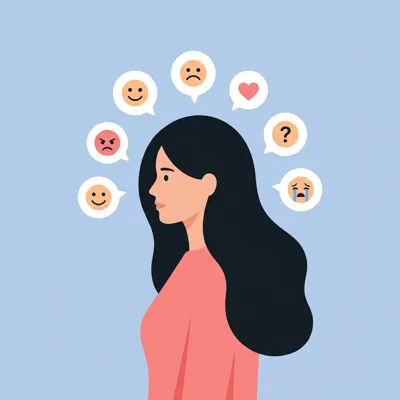
The anxiety that jumps you out of nowhere: could it be your hormones?
Panic attacks and anxiety can land in perimenopause with zero hot flashes and normal periods. Here's the missing piece, and what actually helps.
3 min read
At a red light, your chest tightens and your heart pounds for no reason at all. What you feel is real and physical. Here's what almost nobody tells you: anxiety and panic attacks can come from your hormones, even with no hot flashes and normal periods. About 1 in 6 midlife women report a recent panic attack. You're not alone, and there are answers.
Anxiety can hit without a single hot flash
You were sold menopause as hot flashes and a desk fan. If you're not sweating, you assume it can't be hormonal. That's the trap.
Research says otherwise. Many women feel anxiety and mood changes during the menopause transition, sometimes with no hot flashes at all [1]. The absence of a visible symptom does not rule out a hormonal cause.
One striking number: women with low anxiety before perimenopause are about three times more likely to report high anxiety during the transition [1]. This held true even after accounting for other life stressors.
What you feel is real. It's not in your head, and it's nobody's fault. If you're worried something more serious is going on, a check-up can help rule out other causes.
Sources (1)
- [1] Bromberger JT, Kravitz HM, Chang Y, et al. Does risk for anxiety increase during the menopausal transition? Study of Women's Health Across the Nation (SWAN). J Affect Disord. 2013;150(3):1075-1082.
Why so early: it can start 10 years before your periods stop
One simple distinction, once. Menopause is 12 months with no period. Perimenopause is the long stretch before it, when your hormones start to fluctuate.
This stretch can begin years before your final period, often around ages 40-45, while your cycles still look regular [2]. That's why the anxiety feels like it came from nowhere.
Researchers call these years a window of vulnerability [3]. Psychological symptoms often begin early in perimenopause and peak later in the transition [4]. Having always felt steady is no shield: the risk also rises in women who were calm until then [1].
This isn't weakness. It's your nervous system reacting to a real biological shift, earlier and quieter than anyone warned you. If the anxiety takes over your daily life, a healthcare professional can help you make sense of it.
Sources (5)
- [2] Santoro N, Roeca C, Peters BA, Neal-Perry G. The Menopause Transition: Signs, Symptoms, and Management Options. J Clin Endocrinol Metab. 2021;106(1):1-15.
- [3] Soares CN. Mood disorders in midlife women: understanding the critical window and its clinical implications. Menopause. 2014;21(2):198-206.
- [4] Bromberger JT, Kravitz HM. Mood and menopause: findings from the Study of Women's Health Across the Nation (SWAN) over 10 years. Obstet Gynecol Clin North Am. 2011;38(3):609-625.
- [1] Bromberger JT, Kravitz HM, Chang Y, et al. Does risk for anxiety increase during the menopausal transition? Study of Women's Health Across the Nation (SWAN). J Affect Disord. 2013;150(3):1075-1082.
- [6] Smoller JW, Pollack MH, Wassertheil-Smoller S, et al. Prevalence and correlates of panic attacks in midlife women (Women's Health Initiative). Arch Gen Psychiatry. 2003;60(12):1228-1234.
What's happening in your brain, and no, it's not permanent
Your hormones don't just run your periods: they talk to your brain. Estrogen helps regulate serotonin and GABA, the messengers that turn your inner alarm up or down [3].
In perimenopause, estrogen doesn't drop in a straight line. It swings. Those rapid swings, more than the low level itself, are what unsettle your mood [5]. It's like a hand yanking the volume knob back and forth.
Progesterone matters too. It converts into allopregnanolone, a natural calming brake on the brain [12]. When it drops, that brake weakens, and the alarm fires over nothing: racing heart, short breath, trembling [3].
These sensations are intense, but they usually reflect a panic response, not a failing heart. Still, if you have chest pain, fainting or new, unusual symptoms, seek medical advice.
The good news: this isn't fixed. Panic symptoms tend to settle as the body moves through and past the transition [6].
Sources (4)
- [3] Soares CN. Mood disorders in midlife women: understanding the critical window and its clinical implications. Menopause. 2014;21(2):198-206.
- [5] Freeman EW, Sammel MD, Lin H, Nelson DB. Associations of hormones and menopausal status with depressed mood in women with no history of depression. Arch Gen Psychiatry. 2006;63(4):375-382.
- [12] Hantsoo L, Epperson CN. Allopregnanolone in premenstrual dysphoric disorder (PMDD): dysregulated sensitivity to GABA-A receptor modulating neuroactive steroids. Front Endocrinol / Neurobiology of Stress. 2020.
- [6] Smoller JW, Pollack MH, Wassertheil-Smoller S, et al. Prevalence and correlates of panic attacks in midlife women (Women's Health Initiative). Arch Gen Psychiatry. 2003;60(12):1228-1234.
What actually helps, from quickest to deepest
You don't have to white-knuckle this. Here are tools with documented benefit, to pick from based on your life.
- Cardiac coherence: breathe slowly, five seconds in, five seconds out, for a few minutes. This slow breathing switches on your calming system and eases the physical symptoms [9].
- Movement: regular activity has an anxiety-lowering effect confirmed by a meta-analysis [10]. A brisk walk counts; consistency beats intensity.
- Sophrology and mindfulness: these relaxation approaches improve mood and lower perceived stress in menopause [11].
- CBT (cognitive behavioural therapy): recommended first-line for perimenopausal mood symptoms, it retrains you to defuse the spiral of fear [7].
On the medical side, menopause hormone therapy (MHT) may help some women when anxiety is linked to hormonal instability, to discuss with a doctor [8]. On its own, it isn't a treatment for severe anxiety. SSRIs and SNRIs, prescribed and monitored by a doctor, are effective for moderate-to-severe anxiety and panic [8].
Sources (5)
- [9] Lehrer PM, Gevirtz R. Heart rate variability biofeedback: how and why does it work? Front Psychol. 2014;5:756.
- [10] Stubbs B, Vancampfort D, Rosenbaum S, et al. An examination of the anxiolytic effects of exercise for people with anxiety and stress-related disorders: a meta-analysis. Psychiatry Res. 2017;249:102-108.
- [11] Goldstein KM, Shepherd-Banigan M, Coeytaux RR, et al. Use of mindfulness, meditation and relaxation to treat vasomotor symptoms and mood in menopause: a systematic review. Climacteric. 2017;20(3):178-182.
- [7] Maki PM, Kornstein SG, Joffe H, et al. Guidelines for the evaluation and treatment of perimenopausal depression: summary and recommendations. NAMS / Women and Mood Disorders Task Force. Menopause. 2019;26(10):1186-1202.
- [8] The North American Menopause Society (NAMS). The 2022 Hormone Therapy Position Statement of The North American Menopause Society. Menopause. 2022;29(7):767-794.
The anxiety that jumped you at the red light wasn't random, and it wasn't a sign you're breaking. It's your chemistry reorganizing, sometimes 10 years before your periods stop. Start small tonight: five minutes of slow breathing. Log your attacks in the app, the time, length, intensity and where you are in your cycle, so you walk into your doctor's office with evidence, not apology. You understand what's happening now, and you're not alone.
This article is for information only and does not replace the advice of a health professional. If a symptom worries you, talk to a doctor.