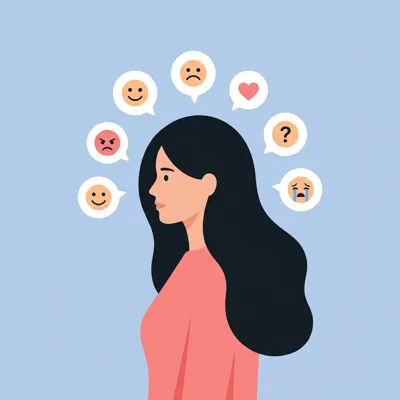
Mood and menopause: when to consult, and exactly what to ask
The clear signals that say 'consult now', and the precise checklist so you're never told it's all in your head.
4 min read

You've been putting off this appointment for weeks, wondering if it's 'bad enough' to mention. That doubt is a signal, not an overreaction. In perimenopause, the risk of depression is two to four times higher [1]. This isn't in your head, it isn't your fault, and it can be treated. And if dark thoughts ever surface, 3114 answers 24/7 (details below).
Your unsteady mood is biology, not weakness
Feeling low in perimenopause is neither rare nor imagined. Mood symptoms are common during this transition [1]. You're not overreacting, you're responding to a real signal.
Estrogen helps your brain regulate serotonin, the chemical that keeps your mood steady. In perimenopause it doesn't just quietly drop: it swings up and down without warning. It's this variability, not low levels alone, that destabilises your mood [3][4].
A second mechanism piles on. As progesterone's calming by-products fall, the brake on your stress system weakens and cortisol can run high [4]. Night sweats and hot flashes fragment your sleep, and broken sleep in turn feeds low mood and irritability [5].
So your low mood is a physical response, not a lack of willpower. Trying to 'cope' alone means asking your brain to out-muscle its own chemistry. And that chemistry can be treated.
Sources (4)
- [1] Bromberger JT, Kravitz HM, Chang YF, et al. Major depression during and after the menopausal transition: Study of Women's Health Across the Nation (SWAN). Psychol Med. 2011;41(9):1879-1888.
- [3] Joffe H, de Wit A, Coborn J, et al. Impact of Estradiol Variability and Progesterone on Mood in Perimenopausal Women With Depressive Symptoms. J Clin Endocrinol Metab. 2020;105(3):e642-e650.
- [4] Gordon JL, Girdler SS, Meltzer-Brody SE, et al. Ovarian hormone fluctuation, neurosteroids, and HPA axis dysregulation in perimenopausal depression: a novel heuristic model. Am J Psychiatry. 2015;172(3):227-236.
- [5] Baker FC, de Zambotti M, Colrain IM, Bei B. Sleep problems during the menopausal transition. Sleep Med Clin. 2018;13(3):443-456.
The threshold to consult: more than two weeks, most days
The threshold isn't collapse. It's the point where what you feel stops you living the way you want. When low mood settles in almost every day, most of the day, for more than two weeks, it's no longer passing. That's the exact line doctors use to name a depressive episode [7], and treatment is recommended at that point [6].
Loss of pleasure is the clearest signal. The things that used to lift you do nothing now, or take enormous effort. That's not tiredness, it's disconnection.
Look at the concrete impact on your days:
- you struggle to get up, to concentrate, to finish ordinary tasks
- you withdraw, you cancel, you stop calling people
- your sleep breaks, you wake at 3am and can't drift off
- you're on edge, or the opposite, switched off
- you eat much more, or much less, than before
One detail changes everything: if you've had strong premenstrual syndrome, depression after childbirth, or a mood dip on the pill, your brain is likely more sensitive to hormonal shifts [3]. That's valuable information for your doctor, and one more reason not to wait.
Sources (3)
- [7] Haute Autorité de Santé. Épisode dépressif caractérisé de l'adulte : prise en charge en premier recours. Recommandations HAS. 2017.
- [6] National Institute for Health and Care Excellence. Menopause: identification and management (NG23). NICE Guideline. 2024.
- [3] Joffe H, de Wit A, Coborn J, et al. Impact of Estradiol Variability and Progesterone on Mood in Perimenopausal Women With Depressive Symptoms. J Clin Endocrinol Metab. 2020;105(3):e642-e650.
When not to wait a single day
Some signals no longer leave room for the 'right moment' question. You don't wait.
Thoughts that life isn't worth living, that others would be better off without you, a sense of losing control or not being safe with yourself: these are emergency signals. They don't make you weak. They're a symptom, like a fever, and they can be treated. Assessing this risk is part of caring for depression, and it's always better to speak up early [7].
In France, 3114 is the national suicide prevention line, free and confidential. If the danger is immediate, call 15.
Sources (1)
- [7] Haute Autorité de Santé. Épisode dépressif caractérisé de l'adulte : prise en charge en premier recours. Recommandations HAS. 2017.
What to ask, and how to be taken seriously
Walking in with a precise request changes everything. Doctors work with dated facts: the more concrete you bring, the more seriously you're heard. Instead of 'I'm tired and sad', say: 'for seven weeks I've woken at 3am most nights, lost all pleasure, and cancelled three plans for lack of energy'.
Here's the checklist to ask for, by name:
- a thyroid test (TSH): an underactive thyroid mimics depression, and is worth ruling out first [8]
- a deficiency check (iron, ferritin, vitamin D, B12), which can also imitate low mood [8]
- a mood screen using the PHQ-9, a validated nine-question tool [2]
- a referral for cognitive behavioural therapy (CBT), recommended as first-line [6]
- whether menopausal hormone therapy (MHT) could help your mood, especially if you also have hot flashes [2]
Because yes, this is treatable. CBT, concrete work on your thoughts, matches antidepressants for moderate depression [9]. Some antidepressants, like venlafaxine or escitalopram, also ease hot flashes [2]. Taking them is neither a failure nor a life sentence.
If a doctor brushes off your request, you're allowed to insist or ask for a second opinion [2]. A tracking app can log your symptoms day by day and prepare a clear recap, so you arrive with facts, not empty-handed.
Sources (4)
- [8] Soares CN. Depression and Menopause: Current Knowledge and Clinical Recommendations for a Critical Window. Psychiatr Clin North Am. 2017;40(2):239-254.
- [2] Maki PM, Kornstein SG, Joffe H, et al. Guidelines for the Evaluation and Treatment of Perimenopausal Depression: Summary and Recommendations. J Womens Health. 2018/2019.
- [6] National Institute for Health and Care Excellence. Menopause: identification and management (NG23). NICE Guideline. 2024.
- [9] Cuijpers P, Karyotaki E, Eckshtain D, et al. Psychotherapy for Depression Across Different Age Groups: A Systematic Review and Meta-analysis. JAMA Psychiatry. 2020;77(7):694-702.
A few minutes ago you were wondering whether you had the right to ask for help. Now you know the threshold (more than two weeks, most days, a loss of pleasure), the emergency signals, and the exact checklist to put on the table. The next step is simple: book the appointment, and until then note your symptoms, how often, and since when. You no longer have to carry this in silence. And if dark thoughts return, 3114 is there, 24/7.
This article is for information only and does not replace the advice of a health professional. If a symptom worries you, talk to a doctor.