Hot one second, sobbing the next: what's going on?
Why a hot flash and a crying spell crash in together during perimenopause, and the levers that actually calm the rollercoaster.
4 min read
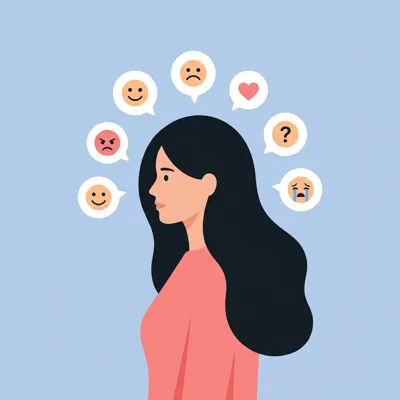
It's 9 p.m., a wave of heat climbs up your neck, your top sticks to your back. Thirty seconds later the tears come over nothing, then a flash of shame. What you're feeling is real and physical: it's called perimenopause. The heat and the tears didn't arrive together by chance, they come from the same hormonal shift.
Heat and tears come from the same hormonal glitch
What you feel is real and documented, not a character flaw. During perimenopause, up to 70% of women report increased irritability [3]. And about 80% go through hot flashes [10].
One small conductor in your brain explains the link: the hypothalamus, your internal thermostat. When estrogen drops, certain neurons (the KNDy neurons) fire up and throw off that thermostat. Your body thinks it's too hot and sets off a flash [13].
This same hypothalamus sits right next to the regions that handle emotion. When estrogen falls, serotonin and dopamine, your mood chemicals, fall with it. The tears then rise for no clear reason [1].
It's not you overflowing, it's your chemistry lurching. Heat and tears share the same rattled conductor, which is why they land within seconds of each other.
Sources (4)
- [3] Bromberger JT, Kravitz HM, Chang YF, Cyranowski JM, Brown C, Matthews KA. Major depression during and after the menopausal transition: Study of Women's Health Across the Nation (SWAN). Psychol Med. 2011;41(9):1879-1888. doi:10.1017/S003329171100016X
- [10] Freeman EW, Sammel MD, Sanders RJ. Risk of long-term hot flashes after natural menopause. Menopause. 2014;21(9):924-932. doi:10.1097/GME.0000000000000196
- [13] Rance NE, Dacks PA, Mittelman-Smith MA, Romanovsky AA, Krajewski-Hall SJ. Modulation of body temperature and LH secretion by hypothalamic KNDy (kisspeptin, neurokinin B and dynorphin) neurons. Front Neuroendocrinol. 2013;34(3):211-227. doi:10.1016/j.yfrne.2013.07.003
- [1] Maki PM, Kornstein SG, Joffe H, Bromberger JT, Freeman EW, Athappilly G, et al. Guidelines for the Evaluation and Treatment of Perimenopausal Depression: Summary and Recommendations. Menopause. 2018;25(10):1069-1085. doi:10.1097/GME.0000000000001174
This phase has an end: about 7 years on average
This is the question that worries you most: will it last forever? No. This rollercoaster is a transition, not a life sentence.
Vasomotor symptoms (hot flashes and night sweats) last a median of about 7.4 years [9]. It varies widely: a few months for some, longer for others. They ease once menopause is confirmed.
For mood, the risk of depressive symptoms is two to four times higher during the transition [2]. That window of vulnerability tends to close afterward. Sleep problems, meanwhile, affect 38 to 60% of women in transition [11].
A quick vocabulary note: menopause is confirmed after twelve months without a period. Before that, during perimenopause, hormones fluctuate, and that's when the swings are strongest. In France, the average age of menopause is 51 [12].
Sources (4)
- [9] Avis NE, Crawford SL, Greendale G, et al. Duration of menopausal vasomotor symptoms over the menopause transition (SWAN Study). JAMA Intern Med. 2015;175(4):531-539. doi:10.1001/jamainternmed.2014.8063
- [2] Freeman EW, Sammel MD, Lin H, Nelson DB. Associations of hormones and menopausal status with depressed mood in women with no history of depression. Arch Gen Psychiatry. 2006;63(4):375-382. doi:10.1001/archpsyc.63.4.375
- [11] Kravitz HM, Zhao X, Bromberger JT, et al. Sleep disturbance during the menopausal transition in a multi-ethnic community sample of women. Sleep. 2008;31(7):979-990.
- [12] INSERM / Santé publique France. Enquête santé publique sur la ménopause. 2019.
Your daily levers: sleep, blood sugar, omega-3, movement
You don't just endure all of this. Several concrete levers soften the jolts, each tied to a specific mechanism.
- Sleep first. Nighttime flashes wake you, sometimes without memory, and broken sleep leaves the next day's mood more reactive [4]. A cool room and a steady bedtime protect your nights.
- Blood sugar. A fast sugar spikes then crashes your glucose, so your body releases adrenaline and cortisol, which feels like irritability and a slump [6]. Pair protein, fiber and good fats at every meal.
- Omega-3s (EPA and DHA). They feed brain-cell membranes and calm inflammation, and supplementation shows a modest-to-moderate effect on mood [5]. Oily fish twice a week, or a supplement discussed with a professional.
- Movement. Regular aerobic exercise improves mood and sleep and lowers anxiety [1]. Brisk walking, cycling, swimming: aim for consistency, not performance.
Finally, easing stress. Mindfulness lowers the distress tied to hot flashes and lifts mood, even without cutting their frequency [7]. Cognitive behavioural therapy (CBT) has strong evidence for hot flashes, mood and sleep [8].
Sources (6)
- [4] Joffe H, Crawford SL, Freeman MP, White DP, Bianchi MT, et al. Independent Contributions of Nocturnal Hot Flashes and Sleep Disturbance to Depression in Estrogen-Deprived Women. J Clin Endocrinol Metab. 2016;101(10):3847-3855. doi:10.1210/jc.2016-2348
- [6] Penckofer S, Quinn L, Byrn M, Ferrans C, Miller M, Strange P. Does glycemic variability impact mood and quality of life? Diabetes Technol Ther. 2012;14(4):303-310. doi:10.1089/dia.2011.0191
- [5] Mocking RJT, Harmsen I, Assies J, Koeter MWJ, Ruhe HG, Schene AH. Meta-analysis and meta-regression of omega-3 polyunsaturated fatty acid supplementation for major depressive disorder. Transl Psychiatry. 2016;6(3):e756. doi:10.1038/tp.2016.29
- [1] Maki PM, Kornstein SG, Joffe H, Bromberger JT, Freeman EW, Athappilly G, et al. Guidelines for the Evaluation and Treatment of Perimenopausal Depression: Summary and Recommendations. Menopause. 2018;25(10):1069-1085. doi:10.1097/GME.0000000000001174
- [7] Goldstein KM, Shepherd-Banigan M, Coeytaux RR, McDuffie JR, Adam S, et al. Use of mindfulness-based interventions to address vasomotor and mood symptoms during the menopausal transition: A systematic review. Menopause. 2017;24(11):1306-1312. doi:10.1097/GME.0000000000000921
- [8] National Institute for Health and Care Excellence (NICE). Menopause: diagnosis and management (NG23). 2024.
When to see your doctor, and why MHT is a conversation
Spotting your triggers gives you a head start. Logging your episodes (time, sleep, meals, stress) reveals patterns over a few weeks. You move from 'it hits at random' to 'it mostly happens when I've slept badly.'
That's what the app helps you record. At an appointment, you arrive with concrete data instead of a vague 'I don't feel right.'
Menopause hormone therapy (MHT) supplies estrogen, paired with a progestogen if you still have your uterus. It reduces hot flashes and can improve the low mood tied to the transition [8].
Two safety points to keep in mind:
- MHT is not a contraceptive. Pregnancy is still possible until menopause is confirmed [8].
- No self-medication. MHT must be prescribed and monitored, after weighing your personal benefits and risks [8].
Certain antidepressants (paroxetine, venlafaxine) can help with depression and also reduce hot flashes, especially when MHT isn't an option [1]. For a simple low mood without depression, they aren't recommended first-line [8]. If your mood weighs heavily, you have every right to help.
Sources (2)
- [8] National Institute for Health and Care Excellence (NICE). Menopause: diagnosis and management (NG23). 2024.
- [1] Maki PM, Kornstein SG, Joffe H, Bromberger JT, Freeman EW, Athappilly G, et al. Guidelines for the Evaluation and Treatment of Perimenopausal Depression: Summary and Recommendations. Menopause. 2018;25(10):1069-1085. doi:10.1097/GME.0000000000001174
Next time the heat rises and the tears follow, you'll know why: your brain's thermostat is racing and your mood chemicals are lurching, from the same hormonal source. It's real, not a personality trait, and it's not permanent. Protect your nights, steady your blood sugar, move, and log your episodes in the app. And if your mood weighs heavily, talk to your doctor about MHT or another option.
This article is for information only and does not replace the advice of a health professional. If a symptom worries you, talk to a doctor.