Menopause: who is this woman in the mirror?
Feeling like a stranger to yourself is not a flaw in your mind, it's your emotional shock absorber that dropped.
4 min read

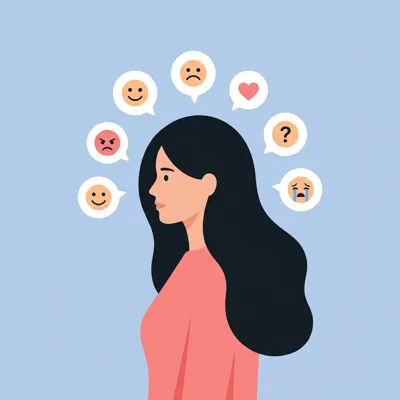
You looked in the mirror and didn't recognize the woman looking back: too raw, crying for no reason, snapping over nothing. What you feel is real, and it has a precise physiological cause. During perimenopause, your hormones reshape your brain chemistry. This is not in your head, it's nobody's fault, and it has a name.
Your emotional shock absorber dropped, this isn't your mind
Let's say it plainly: what you feel is real and documented. That new reactivity, the sudden tears, the irritability that surprises you all have a biological basis [1][5]. Researchers even describe a "changed sense of self" during perimenopause [2].
The mechanism fits one image. When your body makes progesterone, it converts some of it into allopregnanolone (a calming molecule). It acts on your GABA system, the brain's natural brake, like a cushion between you and stress [5].
In perimenopause, progesterone drops and turns erratic. That cushion vanishes at times, without warning [5]. Suddenly the sharp comment, the queue, the dishes left out: everything hits you full force, unabsorbed.
You're not overreacting because you're defective. You react harder because a calming filter grew scarce. That's chemistry, not character.
Sources (3)
- [1] Gordon JL, Girdler SS, Meltzer-Brody SE, et al. Ovarian hormone fluctuation, neurosteroids, and HPA axis dysregulation in perimenopausal depression: a novel heuristic model. Am J Psychiatry. 2015;172(3):227-236.
- [5] Schiller CE, Johnson SL, Abate AC, et al. Reproductive steroid regulation of mood and behavior. Compr Physiol. 2016;6(3):1135-1160.
- [2] Maki PM, Kornstein SG, Joffe H, et al. Guidelines for the evaluation and treatment of perimenopausal depression: summary and recommendations. J Womens Health. 2019;28(2):117-134.
It's the swings in hormones, not the low levels, that unsettle mood
Progesterone isn't the only one at play. Estrogen helps your brain make serotonin and dopamine, the chemicals behind mood, pleasure and motivation [5]. When its level rides a rollercoaster, those circuits misfire.
Here's the key point: it's not so much the lack of hormones that shakes you, it's the fluctuation. Sharp, unpredictable swings throw the brain off far more than the decline itself [10]. That's why you can feel entirely yourself one day and lost the next.
Then comes the fog: words that won't come, memory blanks. It's real and measurable, tied to falling estrogen, and it usually eases once the transition passes [8].
Finally, your hormones and cortisol (the stress hormone) are linked. When they fluctuate, your alarm system fires faster [1]. You recover more slowly and feel swamped by things you used to absorb with ease.
Sources (4)
- [5] Schiller CE, Johnson SL, Abate AC, et al. Reproductive steroid regulation of mood and behavior. Compr Physiol. 2016;6(3):1135-1160.
- [10] Freeman EW, Sammel MD, Lin H, Nelson DB. Associations of hormones and menopausal status with depressed mood in women with no history of depression. Arch Gen Psychiatry. 2006;63(4):375-382.
- [8] Weber MT, Maki PM, McDermott MP. Cognition and mood in perimenopause: a systematic review and meta-analysis. J Steroid Biochem Mol Biol. 2014;142:90-98.
- [1] Gordon JL, Girdler SS, Meltzer-Brody SE, et al. Ovarian hormone fluctuation, neurosteroids, and HPA axis dysregulation in perimenopausal depression: a novel heuristic model. Am J Psychiatry. 2015;172(3):227-236.
Millions of women live this too, and the risk is real
The little voice saying you're the only one not coping is wrong. Many women in perimenopause report irritability, new anxiety and emotional ups and downs [3].
Above all, the risk of a depressive episode is two to four times higher during the transition than before, including in women with no prior history [4]. Specialists call it a "window of vulnerability": a stretch when the brain is temporarily more reactive [7].
This transition is not a bad week. Perimenopause often lasts four to eight years [11]. It's a genuine season of life that deserves to be taken seriously.
Menopause was long reduced to hot flashes, brushing aside the emotional side. The data say otherwise. If a doctor, a partner or your inner critic called you "too much", that's a script that hasn't caught up with the science.
Sources (4)
- [3] Bromberger JT, Kravitz HM, Chang Y, et al. Does risk for anxiety increase during the menopausal transition? Study of Women's Health Across the Nation. J Affect Disord. 2013;150(2):540-547.
- [4] Cohen LS, Soares CN, Vitonis AF, et al. Risk for new onset of depression during the menopausal transition: the Harvard Study of Moods and Cycles. Arch Gen Psychiatry. 2006;63(4):385-390.
- [7] Soares CN. Depression and menopause: current knowledge and clinical recommendations for a critical window. Psychiatr Clin North Am. 2017;40(2):239-254.
- [11] Harlow SD, Gass M, Hall JE, et al. Executive summary of the Stages of Reproductive Aging Workshop +10 (STRAW+10). J Clin Endocrinol Metab. 2012;97(4):1159-1168.
Taking back control: read your waves and know your options
Understanding the mechanism already puts you a step ahead. One simple move helps today: note your mood, anxiety and energy each day. Formal evidence for tracking is limited, but in practice it helps you spot patterns and feel less overwhelmed.
After a few weeks, the chaos takes shape: a dip that returns at a point in your cycle, irritability clustering around poor sleep. You move from enduring to understanding. That data is also valuable for your doctor: harder to dismiss you with evidence in hand.
You have other levers too, to discuss with a healthcare professional:
- Regular physical activity, which can support mood and sleep [9].
- Cognitive behavioral therapy (CBT), recognized for easing the anxiety and distress of this stage [2].
- Menopausal hormone therapy (MHT), a validated option that can improve mood [6][9].
One line still matters: telling passing waves from a darkness that settles in. If sadness lingers, if nothing feels meaningful, or if dark thoughts appear, talk to a doctor without waiting. That's not weakness, it's strength. In France, 3114 (the national suicide prevention line) is free, confidential and available 24/7.
Sources (3)
- [9] National Institute for Health and Care Excellence (NICE). Menopause: identification and management (NG23). 2024.
- [2] Maki PM, Kornstein SG, Joffe H, et al. Guidelines for the evaluation and treatment of perimenopausal depression: summary and recommendations. J Womens Health. 2019;28(2):117-134.
- [6] Gordon JL, Rubinow DR, Eisenlohr-Moul TA, et al. Efficacy of transdermal estradiol and micronized progesterone in the prevention of depressive symptoms in the menopause transition. JAMA Psychiatry. 2018;75(2):149-157.
The woman in the mirror is not a stranger: she's you, in transition, inside a hormonal storm that has its own logic. Starting tonight, note your mood to watch your waves take shape and prepare a clear story for your doctor. If the distress runs deep or comes with dark thoughts, speaking up without waiting is an act of strength. 3114 answers at any hour, for free.
This article is for information only and does not replace the advice of a health professional. If a symptom worries you, talk to a doctor.