TENS for endometriosis pain: a tool you control yourself
How this small neurostimulation device works on pelvic pain, what science really says, and how to try it.
3 min read
Your endometriosis pain is real, it has a physical cause, and it deserves better than silence. TENS does not cure the disease, and no honest article will claim it does. But this device that you control yourself can ease daily pain, and research is starting to confirm it.
A medical device you adjust yourself
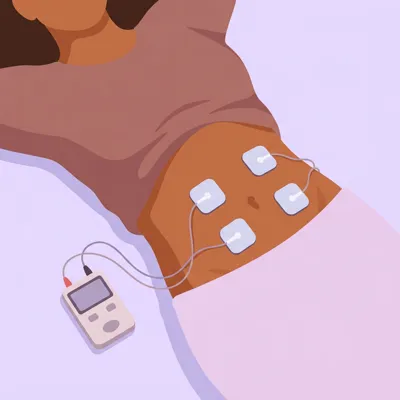
TENS (transcutaneous electrical nerve stimulation) is a small portable device. It sends mild electrical impulses through the skin, using adhesive electrodes placed on the lower abdomen or the lower back.
This is not a gadget. This medical device has been used for decades in rehabilitation, pain centers, and maternity wards. Medical societies recognize it as a complementary option for chronic pain [1]. The European guidelines (ESHRE) list complementary therapies among the options to consider for endometriosis pain [2].
You stay fully in control: you choose the intensity, the duration, and the timing. The sensation is a simple tingling, never painful.
Sources (2)
- [1] Johnson MI, Paley CA, Jones G, Mulvey MR, Wittkopf PG. Efficacy and safety of transcutaneous electrical nerve stimulation (TENS) for acute and chronic pain in adults: a systematic review and meta-analysis of 381 studies. BMJ Open. 2022;12(2):e051073.
- [2] ESHRE Endometriosis Guideline Development Group. Endometriosis: Guideline of the European Society of Human Reproduction and Embryology. ESHRE Guidelines. 2022.
How it works: gate control and endorphins
TENS works on the pain circuit on two levels.
First, gate control. Picture a gate in your spinal cord: it lets pain signals pass through to the brain, or blocks them. By stimulating the fast touch fibers, high-frequency TENS (50 to 120 impulses per second) closes that gate, so the pain message gets through less easily [3] [4]. It is the same reflex as rubbing an elbow you just bumped.
Second, endorphins. Low-frequency TENS (1 to 10 impulses per second) prompts your body to release its own natural painkillers, close to morphine [4] [5].
This dual action matters with endometriosis. The pain there combines several mechanisms: inflammation, nerve damage, and a nervous system that ends up amplifying signals, known as central sensitization [6]. Like an alarm that goes off at the slightest draft. TENS acts directly on this nerve circuit, where a single medication is often not enough [4] [5].
Sources (4)
- [3] Melzack R, Wall PD. Pain mechanisms: a new theory. Science. 1965;150(3699):971-979.
- [4] Vance CGT, Dailey DL, Rakel BA, Sluka KA. Using TENS for pain control: the state of the evidence. Pain Management. 2014;4(3):197-209.
- [5] Sluka KA, Walsh D. Transcutaneous electrical nerve stimulation: basic science mechanisms and clinical effectiveness. Journal of Pain. 2003;4(3):109-121.
- [6] Zondervan KT, Becker CM, Missmer SA. Endometriosis. N Engl J Med. 2020;382(13):1244-1256.
What the studies show: encouraging but still limited
You deserve honest data, not sugar-coated promises.
The strongest study is a 2020 randomized trial (Mira team), run in women with deep endometriosis, one of the most painful forms [7]. One group used a real TENS, the other a placebo device, identical but inactive. The real TENS significantly reduced pelvic pain, pain during intercourse (deep dyspareunia), and bowel pain [7].
Two reviews point the same way: a 2018 review calls TENS promising for endometriosis pain [8], and a 2022 meta-analysis covering 381 studies confirms it reduces pain versus placebo across many chronic pain conditions [1].
The limits matter just as much. Trials specific to endometriosis are still few, sample sizes are modest, and long-term follow-up is lacking [8]. Results vary from one woman to another. What can be said: the data are encouraging, the mechanisms are well understood, and the safety profile is excellent [1].
Sources (3)
- [7] Mira TAA, Yela DA, Podgaec S, Baracat EC, Benetti-Pinto CL. Hormonal treatment isolated versus hormonal treatment associated with electrotherapy for pelvic pain control in deep endometriosis: Randomized clinical trial. Eur J Obstet Gynecol Reprod Biol. 2020;255:134-141. PMID: 33129015
- [8] Mira TAA, Buen MM, Borges MG, Yela DA, Benetti-Pinto CL. Systematic review and meta-analysis of complementary treatments for women with symptomatic endometriosis. Int J Gynaecol Obstet. 2018;143(1):2-9.
- [1] Johnson MI, Paley CA, Jones G, Mulvey MR, Wittkopf PG. Efficacy and safety of transcutaneous electrical nerve stimulation (TENS) for acute and chronic pain in adults: a systematic review and meta-analysis of 381 studies. BMJ Open. 2022;12(2):e051073.
Using it day to day, safely and as a complement
TENS adds to your care, it does not replace it. Here are concrete pointers, to fine-tune with your doctor or physiotherapist.
Where to place the electrodes, depending on the day's pain:
- on the lower abdomen, just above the pubic bone;
- on the lower back, at the sacrum, for pain that radiates.
Which settings: high frequency relieves quickly during a flare-up, low frequency acts more slowly but lasts longer. The intensity should stay clear but comfortable, never painful. Sessions last 20 to 60 minutes, several times a day if needed [7] [4].
Its strengths: no substance circulates through the whole body, no risk of dependence, and you are the one who decides [1]. The only reported issue is minor skin irritation under the electrodes.
A few precautions: TENS is not advised with a pacemaker, with uncontrolled epilepsy, or on the abdomen during pregnancy. It is compatible with an intrauterine device. In many countries it can be prescribed and partly reimbursed for chronic pain.
Sources (4)
- [7] Mira TAA, Yela DA, Podgaec S, Baracat EC, Benetti-Pinto CL. Hormonal treatment isolated versus hormonal treatment associated with electrotherapy for pelvic pain control in deep endometriosis: Randomized clinical trial. Eur J Obstet Gynecol Reprod Biol. 2020;255:134-141. PMID: 33129015
- [4] Vance CGT, Dailey DL, Rakel BA, Sluka KA. Using TENS for pain control: the state of the evidence. Pain Management. 2014;4(3):197-209.
- [1] Johnson MI, Paley CA, Jones G, Mulvey MR, Wittkopf PG. Efficacy and safety of transcutaneous electrical nerve stimulation (TENS) for acute and chronic pain in adults: a systematic review and meta-analysis of 381 studies. BMJ Open. 2022;12(2):e051073.
- [9] Armour M, Sinclair J, Chalmers KJ, Smith CA. Self-management strategies amongst Australian women with endometriosis: a national online survey. BMC Complement Altern Med. 2019;19(1):17. PMID: 30646891
Trying TENS tomorrow, in a month, or not at all: that choice is yours. It is a possible ally, to adapt at your own pace, alongside your medical care. Talk about it with your doctor, your gynecologist, or your pain center. Staying informed and refusing to just endure pain is already a strength.
This article is for information only and does not replace the advice of a health professional. If a symptom worries you, talk to a doctor.