Heat or cold for an endometriosis flare-up: which to choose?
A hot water bottle can relieve pain as well as ibuprofen. Here's how to use it.
4 min read
Your endometriosis pain is real, intense, and you don't have to justify it. About half of women with endometriosis live with chronic pelvic pain that disrupts daily life [1]. Heat and cold are not just tricks: they are tools with documented effectiveness, ready to use in your next flare-up, at home, with no prescription.
Legitimate tools, not "little tricks"
Heat and cold are neither "grandma's remedies" nor placebos. They are complementary approaches whose mechanisms are documented by pain physiology research [2]. They are among the non-drug strategies recognized in endometriosis care.
A national Australian survey found that 70% of women with endometriosis use heat during flare-ups, with an average reported effectiveness of 6.5 out of 10 [3]. When that many women turn to a tool and benefit from it, it deserves to be taken seriously.
These tools do not replace specialist care and do not treat the disease. But they belong to you. No one needs to prescribe them, and you can use them right now: at home, at work, at 3 a.m.
Sources (3)
- [2] Nadler SF, Weingand K, Kruse RJ. The physiologic basis and clinical applications of cryotherapy and thermotherapy for the pain practitioner. Pain Physician. 2004;7(3):395-399.
- [3] Armour M, Sinclair J, Chalmers KJ, Smith CA. Self-management strategies amongst Australian women with endometriosis: a national online survey. BMC Complement Altern Med. 2019;19(1):17. doi:10.1186/s12906-019-2431-x
- [4] EndoFrance & Inserm. Stratégie nationale contre l'endométriose. Ministère de la Santé, France. 2022.
Heat relaxes the uterus and blocks the pain signal
That sense of relief under a heat source isn't just in your head. Heat relaxes the muscle fibers of the uterus, the ones that contract sharply from prostaglandins during flare-ups [5]. It also "occupies" the nerve pathways and blocks part of the pain signal from reaching the brain: this is the gate control theory [2]. By widening blood vessels, it improves local circulation and helps flush out inflammatory substances.
Its effectiveness is no placebo. Continuous local heat at 40°C on the lower abdomen proved as effective as ibuprofen 400 mg for period pain, in a controlled trial of 84 participants [5]. That study looked at dysmenorrhea (period pain), but the mechanisms, contractions and prostaglandins, are shared. A 2018 meta-analysis confirmed the effect [6].
In practice:
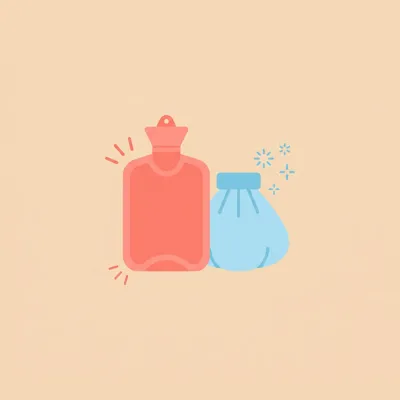
- Hot water bottle: water at 38-42°C, always a cloth between the bottle and your skin (pain lowers sensitivity, a burn can go unnoticed), 20 to 30 minutes on the lower abdomen or lower back [5].
- Heat patches: continuous heat for 8 to 12 hours, discreet under clothing, not exceeding 42°C.
- Hot bath: 37-39°C, 15 to 20 minutes; avoid above 40°C, which can cause faintness.
Sources (3)
- [5] Akin MD, Weingand KW, Hengehold DA, Goodale MB, Hinkle RT, Smith RP. Continuous low-level topical heat in the treatment of dysmenorrhea. Obstet Gynecol. 2001;97(3):343-349. doi:10.1016/S0029-7844(00)01163-7
- [2] Nadler SF, Weingand K, Kruse RJ. The physiologic basis and clinical applications of cryotherapy and thermotherapy for the pain practitioner. Pain Physician. 2004;7(3):395-399.
- [6] Jo J, Lee SH. Heat therapy for primary dysmenorrhea: a systematic review and meta-analysis of its effects on pain relief and quality of life. Sci Rep. 2018;8(1):16252. doi:10.1038/s41598-018-34303-z
Cold calms inflammation and quiets the nerves
Cold for pelvic pain can be surprising: we link it to sprains, not endometriosis. Yet it helps when a flare-up is very inflammatory. It tightens blood vessels, reduces swelling, and slows the pain signal, like turning down the volume on an alarm [2] [7].
The data come mainly from musculoskeletal and chronic pain, and suggest a real drop in intensity [2] [7]. Data specific to pelvic pain remain limited, but the physiological mechanisms are solid. Cold does not act on the uterus itself: the belief that it "contracts the uterus" is not founded [7].
In practice:
- Cold pack: always in a thin cloth, never on bare skin, 10 to 15 minutes maximum [2].
- Caution: not advised if you have Raynaud's syndrome or vascular disorders; when in doubt, talk to your doctor [7].
- Heat-cold alternation: about 20 minutes of heat then 10 minutes of cold, listening to your body [7].
A word on derivative baths (cold applied to the perineum or groin): some women report relief, but no clinical trial proves an effect specific to endometriosis [1] [9]. The idea that they "detoxify" the body is false: endometriosis is multifactorial, not a matter of toxins [1]. Keep them if they help you, never in place of medical care [9].
Sources (4)
- [2] Nadler SF, Weingand K, Kruse RJ. The physiologic basis and clinical applications of cryotherapy and thermotherapy for the pain practitioner. Pain Physician. 2004;7(3):395-399.
- [7] Malanga GA, Yan N, Stark J. Mechanisms and efficacy of heat and cold therapies for musculoskeletal injury. Postgrad Med. 2015;127(1):57-65. doi:10.1080/00325481.2015.992719
- [1] Zondervan KT, Becker CM, Missmer SA. Endometriosis. N Engl J Med. 2020;382(13):1244-1256. doi:10.1056/NEJMra1810764
- [9] Becker CM, Bokor A, Heikinheimo O, et al. ESHRE guideline: endometriosis. Hum Reprod Open. 2022;2022(2):hoac009. doi:10.1093/hropen/hoac009
Heat, cold or both: listen to your body
There is no universal rule: the same body may prefer heat one day, cold the next.
- Lean toward heat for uterine cramps, lower-back tension, or to unwind in the evening [5].
- Lean toward cold when pain comes with swelling, heaviness or acute inflammation [2].
- Alternate when a flare-up drags on and a single tool loses its edge [7].
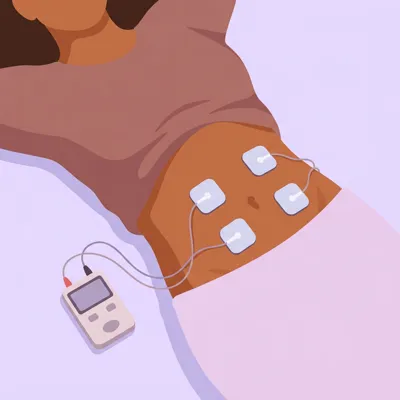
Other tools round out your kit. TENS (a small device sending gentle electrical pulses through electrodes on the skin) works by the same gate control effect and releases endorphins [9]. Slow breathing (inhale 5 seconds, exhale 5 seconds) activates your rest-and-recovery nervous system through the vagus nerve and can lower perceived pain [13].
These tools ease the flare-up, they don't treat the disease. Endometriosis needs specialist care: hormonal treatment, surgery if needed, pelvic physiotherapy, psychological support [9] [1]. A non-drug tool helping you does not mean your endometriosis is "mild": pain intensity is not tied to how extensive the lesions are [1] [9].
Sources (6)
- [5] Akin MD, Weingand KW, Hengehold DA, Goodale MB, Hinkle RT, Smith RP. Continuous low-level topical heat in the treatment of dysmenorrhea. Obstet Gynecol. 2001;97(3):343-349. doi:10.1016/S0029-7844(00)01163-7
- [2] Nadler SF, Weingand K, Kruse RJ. The physiologic basis and clinical applications of cryotherapy and thermotherapy for the pain practitioner. Pain Physician. 2004;7(3):395-399.
- [7] Malanga GA, Yan N, Stark J. Mechanisms and efficacy of heat and cold therapies for musculoskeletal injury. Postgrad Med. 2015;127(1):57-65. doi:10.1080/00325481.2015.992719
- [9] Becker CM, Bokor A, Heikinheimo O, et al. ESHRE guideline: endometriosis. Hum Reprod Open. 2022;2022(2):hoac009. doi:10.1093/hropen/hoac009
- [13] Laborde S, Mosley E, Thayer JF. Heart Rate Variability and Cardiac Vagal Tone in Psychophysiological Research – Recommendations for Experiment Planning, Data Analysis, and Data Reporting. Front Psychol. 2017;8:213. doi:10.3389/fpsyg.2017.00213
- [1] Zondervan KT, Becker CM, Missmer SA. Endometriosis. N Engl J Med. 2020;382(13):1244-1256. doi:10.1056/NEJMra1810764
You live with a disease that causes real, intense pain. You now have more tools in your kit, with documented mechanisms, ready to use tonight. They don't replace full medical care, but they belong to you: no one can take them away. Looking for ways through your flare-ups is not weakness, it's strategy. And you are not alone: about 190 million women worldwide live with endometriosis [12].
This article is for information only and does not replace the advice of a health professional. If a symptom worries you, talk to a doctor.