Osteopathy, acupuncture, spa therapy: real allies against endometriosis pain?
What science really says about these approaches, and how to add them to your care without false hope.
4 min read
Seeking relief from your pain is not an admission of failure, it's a strength. Many women with endometriosis say the same thing: hormonal treatment helps, surgery brings relief, but daily life stays hard. Osteopathy, acupuncture and spa therapy do not cure the disease. They can ease its consequences, as long as they complete your medical care and never replace it.
Pain travels four routes, not just one
Your pain is real and it has physical causes. Endometriosis is a chronic inflammatory disease that affects about 1 woman in 10 of reproductive age [1]. Its pain has no single cause, but several that feed each other.
- Adhesions: inflammation creates bands of scar tissue that glue organs together and pull with every movement [1].
- Chronic inflammation: the lesions constantly release substances (prostaglandins, cytokines) that irritate nearby nerves [1].
- Nerve sensitization: when pain lasts, the nervous system amplifies the signals, like a volume knob stuck at maximum [1].
- Muscle tension: the pelvic floor muscles contract as a protective reflex and become painful themselves [7].
Because pain travels these four routes, a single approach is rarely enough. Complementary approaches do not act on the disease, but on its muscular, nervous and tissue consequences.
Sources (2)
- [1] Zondervan KT, Becker CM, Missmer SA. Endometriosis. N Engl J Med. 2020;382(13):1244-1256. doi:10.1056/NEJMra1810764
- [7] Abaraogu UO, Igwe SE, Tabansi-Ochiogu CS, Duru DO. A Systematic Review and Meta-Analysis of the Efficacy of Manipulative Therapy in Women with Primary Dysmenorrhea. Explore (NY). 2017;13(6):386-392. doi:10.1016/j.explore.2017.06.007
Osteopathy restores mobility to frozen tissues
Osteopathy does not make lesions disappear: no manual manipulation can. It acts on the mechanical consequences of the disease, the stiff tissues and the muscles locked by reflex [4].
The practitioner uses gentle visceral techniques to improve mobility around areas of adhesions (scar tissue that glues organs together), especially around the uterus and intestine. Musculoskeletal techniques also release the psoas, the diaphragm and the pelvic muscles [7].
What does the research say? A pilot study by Professor Daraï's team showed that 5 sessions of visceral osteopathy improved the quality of life of women with deep endometriosis, with less pelvic pain and less pain during sex [4]. A later study of 46 patients confirmed that some benefit more than others [9].
Let's be honest: these results come from pilot studies, not yet from large randomized trials. The level of evidence stays encouraging but preliminary [6]. Osteopathy complements hormonal treatment or surgery, it does not replace them.
Sources (4)
- [4] Daraï C, Deboute O, Zacharopoulou C, Laas E, Canlorbe G, Belghiti J, Zilberman S, Ballester M, Daraï E. Impact of osteopathic manipulative therapy on quality of life of patients with deep infiltrating endometriosis with colorectal involvement: results of a pilot study. Eur J Obstet Gynecol Reprod Biol. 2015;188:70-73.
- [7] Abaraogu UO, Igwe SE, Tabansi-Ochiogu CS, Duru DO. A Systematic Review and Meta-Analysis of the Efficacy of Manipulative Therapy in Women with Primary Dysmenorrhea. Explore (NY). 2017;13(6):386-392. doi:10.1016/j.explore.2017.06.007
- [9] Daraï C, Bendifallah S, Demoulin G, Canlorbe G, Ballester M, Daraï E. Osteopathic manipulative treatment in gynecology: a cluster analysis of patients with endometriosis. Gynecol Obstet Fertil Senol. 2017;45(9):472-477. doi:10.1016/j.gofs.2017.07.002
- [6] ESHRE Endometriosis Guideline Development Group. Endometriosis: diagnosis and management. European Society of Human Reproduction and Embryology. 2022.
Acupuncture turns down pain, without treating the lesions
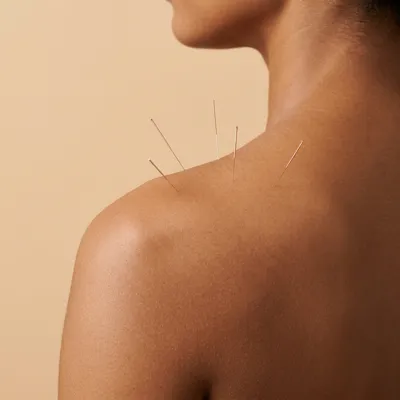
Acupuncture is neither a pure placebo nor a solution for everyone. The needles stimulate precise points that trigger the release of endorphins and enkephalins, the brain's natural painkillers [3]. It's a bit like turning down the volume of pain.
Several randomized controlled trials (which split patients into groups by lottery) have tested acupuncture. A meta-analysis published in PLoS ONE (Xu et al., 2017) shows a drop in pain scores, around 30 to 50% in some analyses [2][3]. A crossover trial found that Japanese acupuncture, added to standard treatment, reduced pain beyond the treatment period [5].
The European ESHRE guidelines call these results encouraging, while stressing that study quality stays variable: small samples, mixed protocols [6]. Larger studies are needed [2].
One key point: acupuncture has shown no effect on the progression of the lesions. It acts on pain and local inflammation, not on the disease itself [3].
Sources (4)
- [3] Xu Y, Zhao W, Li T, Zhao Y, Bu H, Song S. Effects of acupuncture for the treatment of endometriosis-related pain: a systematic review and meta-analysis. PLoS ONE. 2017;12(10):e0186616.
- [2] Mira TAA, Buen MM, Borges MG, Yela DA, Benetti-Pinto CL. Systematic review and meta-analysis of complementary treatments for women with symptomatic endometriosis. Int J Gynecol Obstet. 2018;143(1):2-9.
- [5] Rubi-Klein K, Kucera-Sliutz E, Nissel H, Bijak M, Stockenhuber D, Fink M, Wolkenstein E. Is acupuncture in addition to conventional medicine effective as pain treatment for endometriosis? A randomised controlled cross-over trial. Eur J Obstet Gynecol Reprod Biol. 2010;153(1):90-93. doi:10.1016/j.ejogrb.2010.06.023
- [6] ESHRE Endometriosis Guideline Development Group. Endometriosis: diagnosis and management. European Society of Human Reproduction and Embryology. 2022.
Spa therapy fits a coordinated care plan, it doesn't replace it
Gynecological spa therapy is one of the rare complementary approaches reimbursed in France [8]. A course lasts 18 days in specialized spa towns (Challes-les-Eaux, Salies-de-Béarn), with local baths, mud poultices and mineral water irrigations [8].
The heat widens blood vessels and relaxes the pelvic muscles; minerals like sulfur and magnesium have a local anti-inflammatory effect [8]. One observational study reports pain improvement in about 7 spa patients in 10 at 6 months, with fewer painkillers [8][10]. This work still lacks a large randomized comparison group: the evidence is promising, not definitive.
How do you fit all this together? These approaches do not replace medicine, they widen its reach. ESHRE encourages doctors to discuss them openly [6]. You can simply say: "I'd like to explore osteopathy as a complement. What do you think?"
One essential point: no complementary approach should delay needed treatment. With deep endometriosis, bowel or urinary involvement, or a pregnancy plan, medical or surgical treatment stays the priority [6]. "Complementary" means in addition, never instead.
Sources (3)
- [8] Gourbil M, Music A, Borghese B, Chapron C. Crénothérapie et endométriose : évaluation de l'efficacité de la cure thermale gynécologique sur la douleur et la qualité de vie. Gynécol Obstét Fertil Sénol. 2019;47(11):789-794.
- [10] Étude observationnelle Challes-les-Eaux / AFRETH. Rapport sur l'efficacité de la crénothérapie gynécologique. 2019-2020.
- [6] ESHRE Endometriosis Guideline Development Group. Endometriosis: diagnosis and management. European Society of Human Reproduction and Embryology. 2022.
When pain never really goes away, wanting to explore other paths is legitimate. Osteopathy, acupuncture and spa therapy rest on concrete mechanisms: restoring mobility, calming a nervous system on alert, releasing muscles held tight for too long. They enrich your treatment, they do not replace it. You remain the expert of your own body, and your caregivers are your partners. Informing yourself today is already an act of self-care.
This article is for information only and does not replace the advice of a health professional. If a symptom worries you, talk to a doctor.