Why does your gut go haywire during your period?
Diarrhoea, constipation, pain on the toilet: the real hormonal link between your cycle and your belly, and when to see a doctor.
3 min read
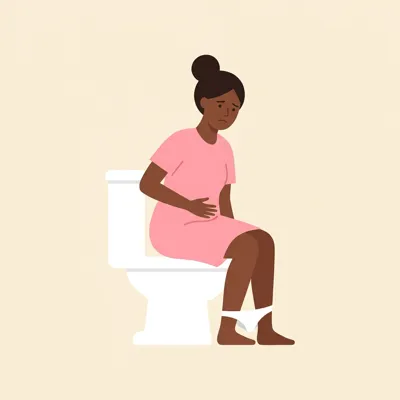
Your period starts and your gut goes off the rails: cramps, dashes to the bathroom, bloating, sometimes pain during a bowel movement. You are not imagining it, and it is not "just stress". Nearly 3 in 4 women report at least one digestive symptom during their period [1]. It is a real biological phenomenon, and it has an explanation.
Prostaglandins squeeze your uterus and your gut together
Your cramps are real and have a physical cause. To shed its lining, the uterus contracts thanks to powerful chemical messengers called prostaglandins (molecules that trigger contractions).
These messengers do not stay in the uterus. They enter the bloodstream and stimulate other muscles, especially those of the intestines next door [2]. That is why uterine cramps and gut cramps show up together.
In women with painful periods, these levels are 2 to 7 times higher [3]. The more there are, the stronger the contractions, and the more your gut speeds up: diarrhoea affects nearly 1 in 4 women during their period [1]. Your body is not failing you, it is reacting.
Sources (3)
- [2] Heitkemper MM, Chang L. Do fluctuations in ovarian hormones affect gastrointestinal symptoms in women with irritable bowel syndrome? Gender Medicine. 2009;6(Suppl 2):152-167. doi:10.1016/j.genm.2009.03.004
- [3] Dawood MY. Nonsteroidal anti-inflammatory drugs and changing attitudes toward dysmenorrhea. American Journal of Medicine. 1988;84(5A):23-29. doi:10.1016/0002-9343(88)90473-1
- [1] Bernstein MT, Graff LA, Avery L, Palatnick C, Parnerowski K, Targownik LE. Gastrointestinal symptoms before and during menses in healthy women. BMC Women's Health. 2014;14:14. doi:10.1186/1472-6874-14-14
Before your period, progesterone slows everything down
The constipation of the days before is hormonal, not a diet problem. After ovulation, your body makes lots of progesterone to prepare for a possible pregnancy.
This hormone relaxes smooth muscle, including in your intestines [2]. Your gut slows down and constipation sets in. Then, just before your period, progesterone drops and prostaglandins surge.
This switch explains the fast shift from constipation to diarrhoea that so many women know. Around 1 in 4 women report constipation before their period [2]. It is neither random nor in your head.
Sources (1)
- [2] Heitkemper MM, Chang L. Do fluctuations in ovarian hormones affect gastrointestinal symptoms in women with irritable bowel syndrome? Gender Medicine. 2009;6(Suppl 2):152-167. doi:10.1016/j.genm.2009.03.004
Cycle-timed pain on the toilet: do not ignore it
Pain when having a bowel movement during your period is a taboo subject, felt by many and rarely spoken about. You have no reason to feel ashamed.
Anatomy explains it: the uterus and the rectum are separated by only a few millimetres. When the uterus contracts, pressure and inflammation reach the neighbouring rectum [4][5]. This cyclical pain has a name: catamenial dyschezia (pain on defecation linked to periods).
Moderate, occasional discomfort is common. But digestive symptoms that follow your cycle and worsen over time should raise a flag. They can point to digestive endometriosis, when tissue like the uterine lining grows on the bowel. It affects 5 to 12% of women with endometriosis [6]. Contrary to a common belief, the fact that your symptoms only strike during your period does not rule endometriosis out: that cyclical pattern is precisely the signal [6][7].
Sources (5)
- [4] Haute Autorité de Santé (HAS). Prise en charge de l'endométriose - Recommandation de bonne pratique. Décembre 2017.
- [5] Becker CM, Bokor A, Heikinheimo O, et al. ESHRE guideline: endometriosis. Human Reproduction Open. 2022;2022(2):hoac009. doi:10.1093/hropen/hoac009
- [6] Chapron C, Fauconnier A, Vieira M, et al. Anatomical distribution of deeply infiltrating endometriosis: surgical implications and proposition for a classification. Human Reproduction. 2003;18(1):157-161. PMID 12525459. doi:10.1093/humrep/deg009
- [7] Roman H, Ness J, Suciu N, et al. Are digestive symptoms in women presenting with pelvic endometriosis specific to lesion localizations? A preliminary prospective study. Human Reproduction. 2012;27(12):3440-3449. PMID 22962316. doi:10.1093/humrep/des322
- [8] INSERM. Dossier d'information : Endométriose. 2023. Disponible sur : https://www.inserm.fr/dossier/endometriose/
What you can do for your comfort
Understanding is already acting. Here are options to adapt to your own rhythm, none of them mandatory. Try what works for you, no pressure.
- Food: in the days before and during, cut back on highly fermentable foods (lactose, legumes, polyol sweeteners) and favour soluble fibre (oats, banana, psyllium), which regulates transit without worsening cramps [2]. Limit caffeine and alcohol.
- Heat: a warm hot-water bottle (39 to 40 °C) on the lower belly eases uterine cramps as well as ibuprofen does, and calms intestinal spasms [9].
- Position: a step stool under your feet at the toilet opens the rectal angle and reduces straining.
- Medication: anti-inflammatories (NSAIDs) such as ibuprofen block prostaglandins and reduce both uterine and digestive pain [3]. Taken from the start of your period, they work best. Ask your doctor or pharmacist for the right dose.
If these problems return every cycle and weigh on your daily life, hormonal contraception can reduce the fluctuations and prostaglandins [2]. It is an option to discuss with a healthcare professional.
Sources (3)
- [2] Heitkemper MM, Chang L. Do fluctuations in ovarian hormones affect gastrointestinal symptoms in women with irritable bowel syndrome? Gender Medicine. 2009;6(Suppl 2):152-167. doi:10.1016/j.genm.2009.03.004
- [9] Akin MD, Weingand KW, Hengehold DA, Goodale MB, Hinkle RT, Smith RP. Continuous low-level topical heat in the treatment of dysmenorrhea. Obstetrics & Gynecology. 2001;97(3):343-349. doi:10.1016/S0029-7844(00)01163-7
- [3] Dawood MY. Nonsteroidal anti-inflammatory drugs and changing attitudes toward dysmenorrhea. American Journal of Medicine. 1988;84(5A):23-29. doi:10.1016/0002-9343(88)90473-1
What you go through each month has a clear biological explanation: the prostaglandins that contract your uterus also stimulate your gut, and progesterone slows transit before the drop that triggers your period. You have concrete ways to feel better. And if your symptoms worsen or become debilitating, you have every right and every reason to consult and to keep pushing until you are heard. Your comfort is not a luxury.
This article is for information only and does not replace the advice of a health professional. If a symptom worries you, talk to a doctor.