Does HRT protect you from pregnancy? No, and here is when to stop contraception
Your menopause treatment eases hot flushes, but it does not prevent pregnancy. Here is the simple rule for when you can finally stop.
4 min read
You put on your patch or take your estrogen tablet, your hot flushes have finally eased, and a question surfaces: am I still protected from pregnancy? The answer deserves to be clear. No. HRT eases menopause symptoms, but it does not block ovulation. If you assumed otherwise, that is completely logical, and this article hands you clear markers.
HRT eases your symptoms, it does not switch off your ovaries
Your menopause hormone therapy (HRT, also called MHT) treats your symptoms. It is not a contraceptive [1][7]. The doses it contains are too low to stop an egg being released [1][3].
Here is an image that helps. The contraceptive pill sends your ovaries a strong, steady signal to stay switched off: no ovulation, no possible pregnancy. HRT does the opposite. It gives your body a small top-up of the hormones it is short on, just enough to ease hot flushes and night sweats [3][7].
That top-up is far too light to put your ovaries to sleep. So an egg can still be released while you are on HRT. And even a rare ovulation is still a possible pregnancy [1][4].
This is the half of the information you were not given. You are often told what HRT does for your symptoms, rarely what it does not do.
Worth remembering:
- HRT replaces the hormones you are missing.
- Contraception blocks a pregnancy.
- Two different jobs, two different tools [1][7].
Sources (4)
- [1] Faculty of Sexual & Reproductive Healthcare (FSRH). Contraception for Women Aged Over 40 Years. FSRH Clinical Guideline. 2023.
- [7] Hamoda H, Panay N, Pedder H, et al. The British Menopause Society & Women's Health Concern recommendations on HRT. Post Reprod Health. 2020;26(4):181-209.
- [3] Baldwin MK, Jensen JT. Contraception during the perimenopause. Maturitas. 2013;76(3):235-242. doi:10.1016/j.maturitas.2013.07.009
- [4] Gebbie AE, Hardman SMR. Contraception in the perimenopause - old and new. Menopause Int. 2010;16(1):33-37. doi:10.1258/mi.2010.010001
The mix-up is logical, it is not your fault
If you thought "I'm on hormones, so I'm covered," the logic holds up. HRT and the pill both contain estrogen and a progestogen. They come in similar packets or patches, and are prescribed at the same stage of life [7].
Add your body's confusing signals. Your periods turn irregular, sometimes vanishing for two or three months. Everything seems to say fertility is fading [2][3].
There is also how these visits tend to go. An appointment about hot flushes focuses on hot flushes. The contraception question often is not even raised, because everyone assumes it no longer applies [7].
So you did not miss something obvious. You were handed half the picture, and that half pointed the wrong way. The gap is in the information, not in you [1][7].
Sources (4)
- [7] Hamoda H, Panay N, Pedder H, et al. The British Menopause Society & Women's Health Concern recommendations on HRT. Post Reprod Health. 2020;26(4):181-209.
- [2] National Institute for Health and Care Excellence (NICE). Menopause: diagnosis and management (NG23). 2024.
- [3] Baldwin MK, Jensen JT. Contraception during the perimenopause. Maturitas. 2013;76(3):235-242. doi:10.1016/j.maturitas.2013.07.009
- [1] Faculty of Sexual & Reproductive Healthcare (FSRH). Contraception for Women Aged Over 40 Years. FSRH Clinical Guideline. 2023.
Irregular periods do not mean your fertility has ended
Perimenopause is that in-between phase where the markers blur, and there is a real biological reason for it. Your cycles become unpredictable: some months you ovulate, some months you don't [3].
Irregular periods do not mean ovulation has stopped. They mean it has become erratic [3]. An egg can still slip out in a month you were not expecting, and you cannot tell in advance which months are fertile [6][8].
This phase is not short either. Cycles often stay irregular for 4 to 8 years before menopause is confirmed [3]. That is a long window where "still having symptoms" and "still fertile" sit side by side.
Fertility declines after 40, that is true, but it does not drop to zero until ovulation fully stops [6]. In France, the median age of natural menopause is 51, defined as 12 consecutive months with no periods [9]. A large share of pregnancies after 40 are unplanned [5].
This is not a threat. It is a concrete reminder that residual fertility is real.
Sources (5)
- [3] Baldwin MK, Jensen JT. Contraception during the perimenopause. Maturitas. 2013;76(3):235-242. doi:10.1016/j.maturitas.2013.07.009
- [6] Allen RH, Cwiak CA, Kaunitz AM. Contraception in women over 40 years of age. CMAJ. 2013;185(7):565-573. doi:10.1503/cmaj.121280
- [8] Practice Committee of the American Society for Reproductive Medicine. Optimizing natural fertility: a committee opinion. Fertil Steril. 2022;117(1):53-63. doi:10.1016/j.fertnstert.2021.10.007
- [9] Institut National de la Santé et de la Recherche Médicale (INSERM) / Haute Autorité de Santé (HAS). Données sur la ménopause en France. 2021.
- [5] Hardman SMR, Gebbie AE. Hormonal contraceptive regimens in the perimenopause. Maturitas. 2009;63(3):204-212. doi:10.1016/j.maturitas.2009.04.003
The clear rule: 12 months after 50, 24 months before
You wanted a clear marker instead of anxious fog? Here it is.
Off hormone therapy, menopause is confirmed after 12 months with no periods. You are then advised to continue contraception for 1 more year after your last period if you are over 50, and 2 years if you are under 50 [1]. That window covers a late, unexpected ovulation [3].
HRT changes this, and it matters. Because it drives your bleeding, you can no longer rely on the "12 months with no periods" marker [5]. FSH testing also becomes unreliable on treatment [5]. Both of your usual markers disappear.
That is why, on HRT, guidelines often suggest continuing contraception until about age 55, when natural fertility has essentially ended for nearly all women [1].
This decision is made with your doctor, not because you cannot be trusted, but because the right answer depends on your age, your HRT and your history [1]. Your doctor can also suggest a method that fits:
- the copper coil, hormone-free and compatible with your HRT;
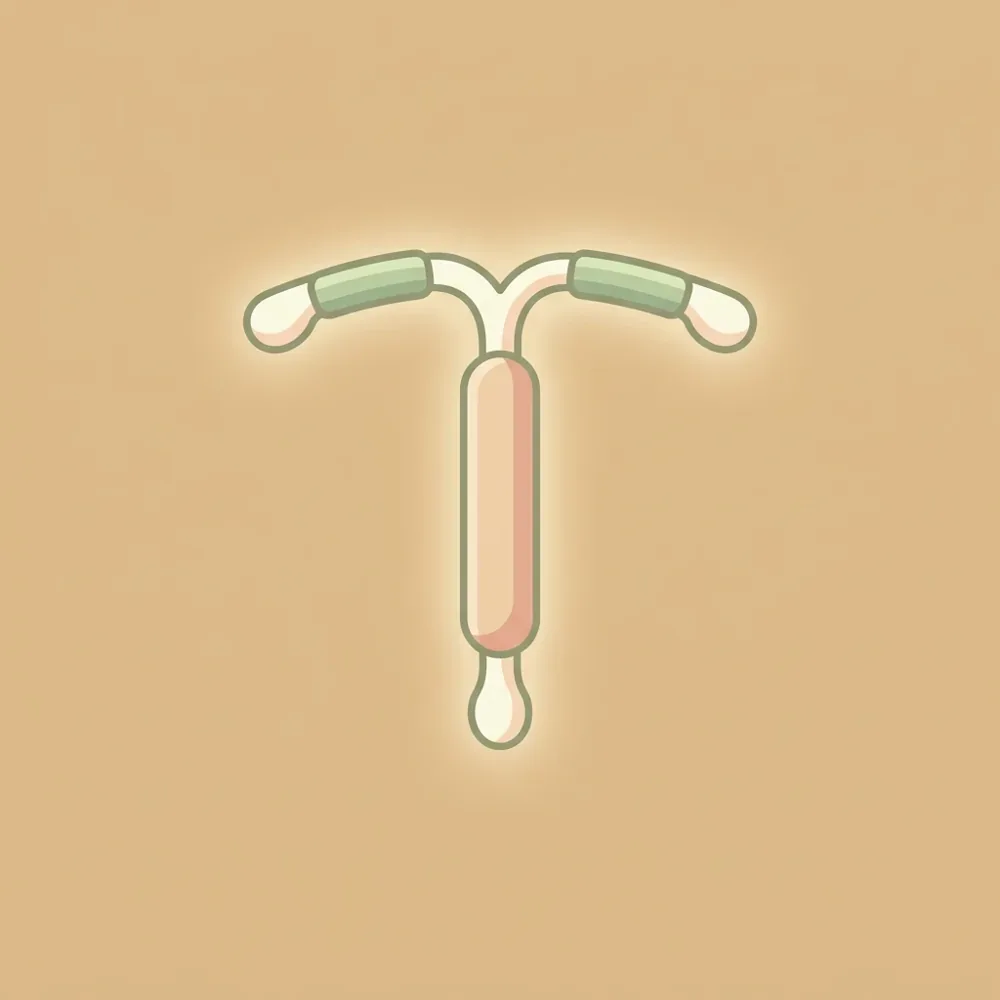
- the hormonal coil (levonorgestrel intrauterine system), which provides contraception and can deliver the progestogen part of your HRT [4];
- the progestogen-only pill, which suits many women over 40 [1].
Sources (4)
- [1] Faculty of Sexual & Reproductive Healthcare (FSRH). Contraception for Women Aged Over 40 Years. FSRH Clinical Guideline. 2023.
- [3] Baldwin MK, Jensen JT. Contraception during the perimenopause. Maturitas. 2013;76(3):235-242. doi:10.1016/j.maturitas.2013.07.009
- [5] Hardman SMR, Gebbie AE. Hormonal contraceptive regimens in the perimenopause. Maturitas. 2009;63(3):204-212. doi:10.1016/j.maturitas.2009.04.003
- [4] Gebbie AE, Hardman SMR. Contraception in the perimenopause - old and new. Menopause Int. 2010;16(1):33-37. doi:10.1258/mi.2010.010001
You are no longer in the fog. HRT and contraception are two different things, and your body can still surprise you until menopause is confirmed. Keep the rule in mind: 12 months with no periods after 50, 24 months before, and up to age 55 on HRT. Track your cycles and symptoms, ideally with a tool like Endora, then ask your doctor directly: given my age and my treatment, when can I safely stop contraception? The decision gets made together, not by chance.
This article is for information only and does not replace the advice of a health professional. If a symptom worries you, talk to a doctor.