Patch, gel or pill: how to choose your menopause hormones
Why the skin route (gel or patch) lowers your clot risk, and how to decide the rest with your doctor.
4 min read
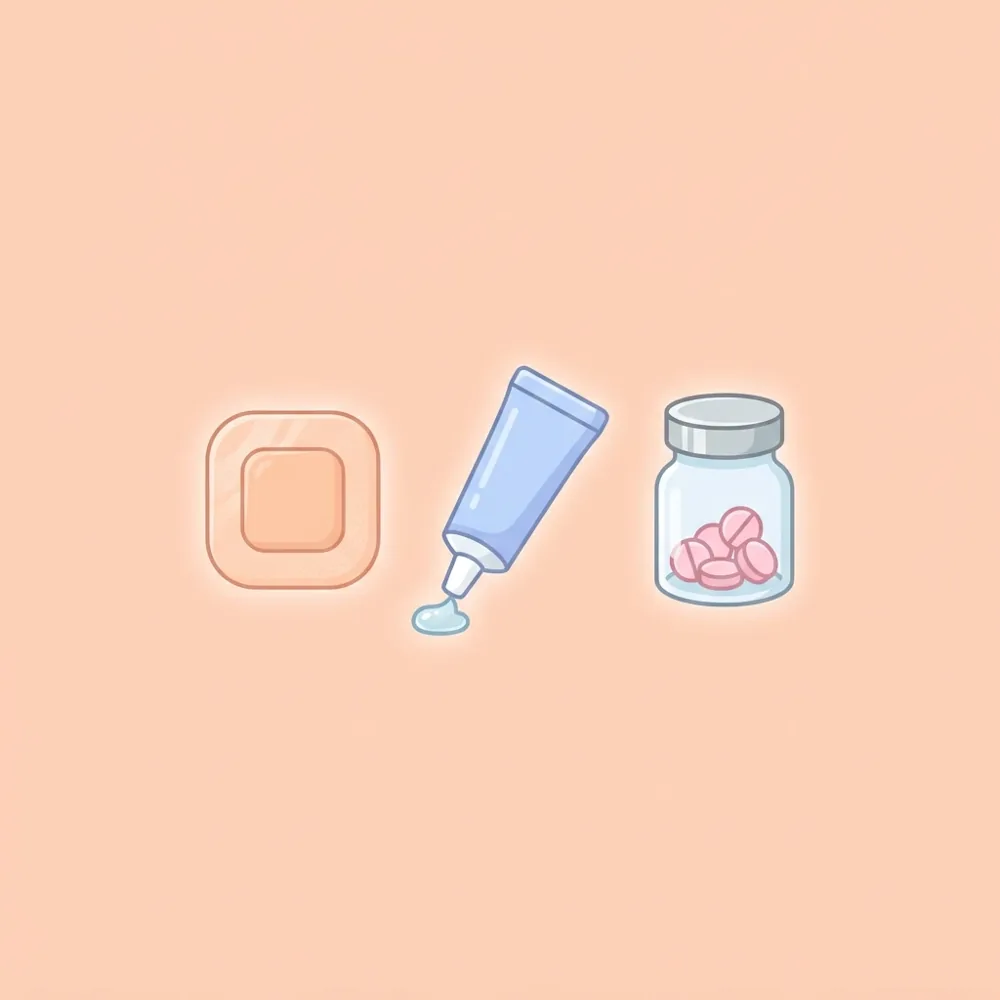
You leave the office, prescription in hand: Oestrogel, Utrogestan, maybe a patch. And that fear of a clot everyone talks about, it's real and legitimate. Here's the key: what changes the risk to your veins isn't the hormone, it's the route. Going through your skin instead of your stomach lowers that risk, and that's exactly why the guidelines changed.
Two hormones on your script, two different jobs
Your prescription often lists two medicines, and that's where it gets confusing. They don't do the same job.
Estrogen (estradiol) is the one that relieves. Hot flashes, night sweats, broken sleep, dryness: the drop in estrogen triggers them, so estrogen is what you replace. Up to 80% of menopausal women get hot flashes, about 1 in 4 in a moderate-to-intense form that really weighs on daily life [1].
Progesterone, often Utrogestan (micronized progesterone), doesn't relieve symptoms: it protects. If you still have your uterus, estrogen alone thickens the uterine lining and raises the risk of endometrial cancer [1][2]. Progesterone balances that out. After removal of the uterus (a hysterectomy), it's usually not needed.
The takeaway: estrogen works for your comfort, progesterone stands guard over your uterus.
Sources (2)
- [1] National Institute for Health and Care Excellence (NICE). Menopause: identification and management (NG23). NICE Guideline; 2024.
- [2] Haute Autorité de Santé (HAS), CNGOF. Traitement hormonal de la ménopause (THM) - Réponses rapides; 2021.
The clot risk: why the route changes everything
This is where your biggest worry sits, and the answer is in a journey.
When you swallow a pill, estrogen passes through your liver before it circulates. Picture the liver as a factory: a big wave of estrogen at once, and it makes more clotting factors, the molecules that make blood clot [5]. Your blood tilts a little toward clotting.
With a gel or patch, estrogen enters your blood straight through the skin. It skips the liver factory, so no overproduction [5][6]. That's the whole secret of the skin route.
The numbers back it up. By mouth, the risk of a venous clot (a clot in a vein) is about 2 times higher in meta-analyses [3], and around 1.6 times in large recent studies [4]. Through the skin, at a standard dose, there's no significant rise [3][6]: one meta-analysis puts the skin route well below the pill (odds ratio 0.63) [10]. Same logic for stroke: the oral route raises it slightly, the low-to-moderate-dose skin route does not [7].
One caveat: clot risk and breast cancer risk are two separate topics. Here, we're only talking about your veins.
Sources (6)
- [5] Canonico M, Oger E, Plu-Bureau G, et al. Hormone therapy and venous thromboembolism among postmenopausal women: impact of the route of estrogen administration and progestogens (ESTHER Study). Circulation. 2007;115(7):840-845. doi:10.1161/CIRCULATIONAHA.106.642280
- [6] Scarabin PY. Progestogens and venous thromboembolism in menopausal women: an updated oral versus transdermal estrogen meta-analysis. Climacteric. 2018;21(4):341-345. doi:10.1080/13697137.2018.1446931
- [3] Canonico M, Plu-Bureau G, Lowe GD, Scarabin PY. Hormone replacement therapy and risk of venous thromboembolism in postmenopausal women: systematic review and meta-analysis. BMJ. 2008;336(7655):1227-1231. doi:10.1136/bmj.39555.441944.BE
- [4] Vinogradova Y, Coupland C, Hippisley-Cox J. Use of hormone replacement therapy and risk of venous thromboembolism: nested case-control studies using the QResearch and CPRD databases. BMJ. 2019;364:k4810. doi:10.1136/bmj.k4810
- [10] Mohammed K, Abu Dabrh AM, Benkhadra K, et al. Oral vs Transdermal Estrogen Therapy and Vascular Events: A Systematic Review and Meta-Analysis. J Clin Endocrinol Metab. 2015;100(11):4012-4020. doi:10.1210/jc.2015-2237
- [7] Vinogradova Y, Coupland C, Hippisley-Cox J. Use of hormone replacement therapy and risk of stroke: nested case-control studies using QResearch and CPRD databases. BMJ. 2024;384:e078078.
Why guidelines now lean toward the skin route
With the mechanism in mind, the recommendation makes full sense. It's not a trend.
France's health authority (HAS) favours the skin route (gel or patch) first-line for estrogen, precisely because it skips the liver and doesn't raise clot or stroke risk at a standard dose [2]. The British (NICE) and North American guidelines say the same. They urge offering it first to women with vascular risk factors: high BMI (body mass index), high blood pressure, migraine with aura, smoking, a history of clots [1][8].
The choice of progestogen matters too. Micronized progesterone (Utrogestan) and dydrogesterone have the gentlest profile for your veins and don't raise clot risk, unlike some older synthetic progestogens [6]. That's why the Oestrogel plus Utrogestan pairing is a classic today: each piece was chosen for safety.
Timing matters as well. Started early, near menopause and before 60, the benefit-risk balance is favourable [8], sometimes even good for the heart [9]. Started more than 10 years later, that balance becomes less appealing. It's a real discussion to have with your doctor, based on your history.
Sources (5)
- [2] Haute Autorité de Santé (HAS), CNGOF. Traitement hormonal de la ménopause (THM) - Réponses rapides; 2021.
- [1] National Institute for Health and Care Excellence (NICE). Menopause: identification and management (NG23). NICE Guideline; 2024.
- [8] The North American Menopause Society (NAMS). The 2022 hormone therapy position statement of The North American Menopause Society. Menopause. 2022;29(7):767-794. doi:10.1097/GME.0000000000002028
- [6] Scarabin PY. Progestogens and venous thromboembolism in menopausal women: an updated oral versus transdermal estrogen meta-analysis. Climacteric. 2018;21(4):341-345. doi:10.1080/13697137.2018.1446931
- [9] Boardman HM, Hartley L, Eisinga A, et al. Hormone therapy for preventing cardiovascular disease in post-menopausal women. Cochrane Database Syst Rev. 2015;(3):CD002229.
Gel or patch, one pump or two: what you decide together
Gel and patch protect your veins the same way: neither goes through the liver. The difference is comfort, not safety [2].
- The gel (Oestrogel, Estreva) goes on your skin each morning. Its strength: fine-tuning the dose, one pump some months, two if symptoms return. The catch: don't forget it, let it dry.
- The patch is changed once or twice a week and delivers a steady dose [2]. Its strength: nothing to think about daily. Its limit: the adhesive can irritate skin or peel off.
- The vaginal ovule or cream treats dryness and painful sex, with very little reaching the blood [2]. But it won't relieve hot flashes.
One pump or two? The principle is the lowest effective dose: the smallest amount that truly relieves you, with the best tolerance [2][8]. You start low, then adjust. Breast tenderness, headaches or nausea can signal too high a dose: these signals guide the tuning.
Nothing is set in stone. By logging your hot flashes, your sleep and your tolerance week by week, with Endora, you arrive at your appointment with real data. Your doctor then fine-tunes the dose on facts, not on a vague memory.
Sources (2)
- [2] Haute Autorité de Santé (HAS), CNGOF. Traitement hormonal de la ménopause (THM) - Réponses rapides; 2021.
- [8] The North American Menopause Society (NAMS). The 2022 hormone therapy position statement of The North American Menopause Society. Menopause. 2022;29(7):767-794. doi:10.1097/GME.0000000000002028
You no longer leave with a prescription you can't read. Two hormones: estrogen that relieves, progesterone that protects the uterus. And a real logic behind the skin route: going through your skin instead of your stomach avoids revving up the liver factory and limits the risk to your veins. Your next steps: spot on the script what's estrogen and what's progesterone, prepare your questions (route, dose, risk factors), and start logging your symptoms. The right treatment is decided with your doctor, tuned to your body and your history.
This article is for information only and does not replace the advice of a health professional. If a symptom worries you, talk to a doctor.