Mirena and menopause: should you take it out?
Why you can't tell if you're in menopause with a Mirena, and how to see the change coming before it surprises you.
4 min read
You haven't had real periods in years, and you can't tell if you're in menopause. That fog isn't your fault: your Mirena erased the simplest signpost, your periods stopping. It protects your womb, but it doesn't touch your hot flashes. Here's what it hides, and how to prepare for the day you take it out.
It protects your womb, but calms no hot flashes
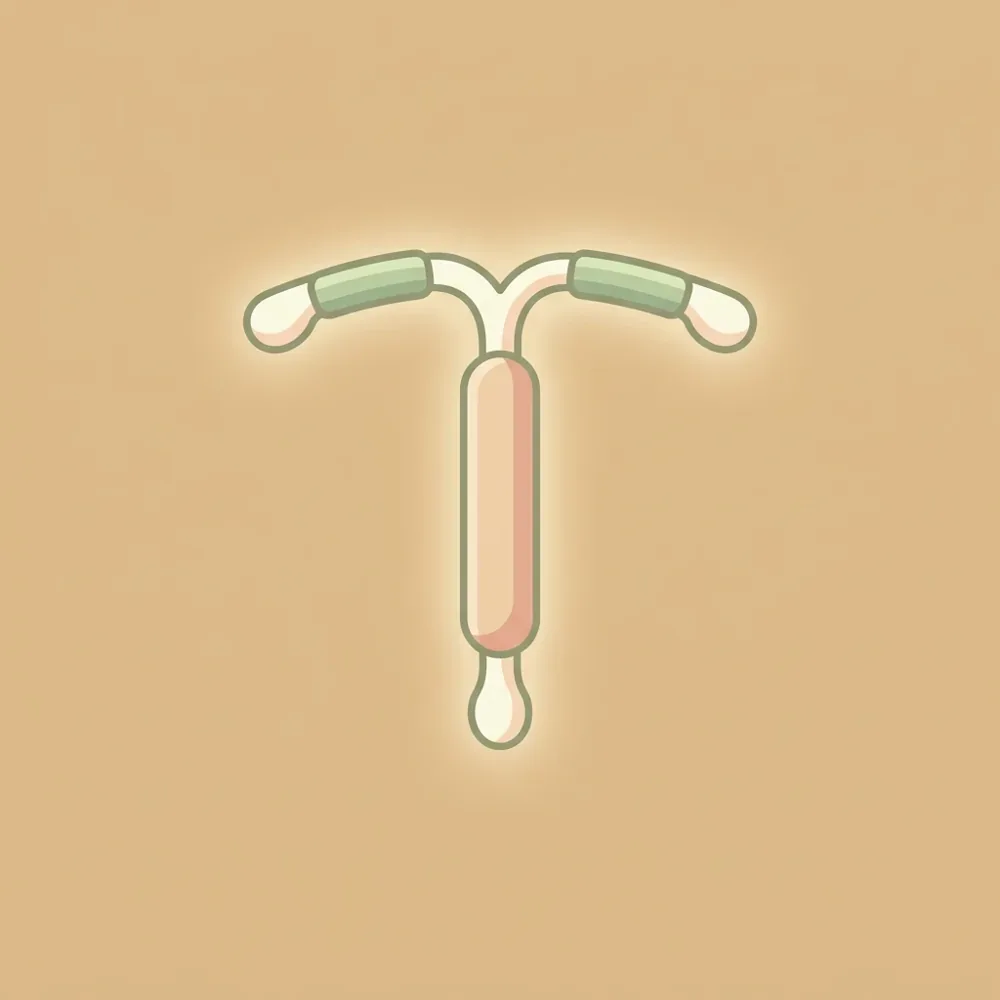
The Mirena is a small device placed in your womb. It releases one hormone, a progestogen (levonorgestrel), and acts mostly locally [1].
This hormone keeps the lining of your womb thin. Your periods get very light, then often stop [1]. Fitted for heavy periods, it cuts bleeding by 70 to 95% [2].
But barely any reaches your blood [3]. So it doesn't treat menopause symptoms. Your hot flashes, night sweats and 3 a.m. wake-ups come from falling estrogen, not from progestogen [9].
That also blurs the calendar. Menopause is confirmed by 12 months without periods. With no periods on the device, that signpost is gone, and you can be in menopause without knowing it [5].
A blood test (FSH, a hormone that rises as your ovaries slow) doesn't always help: after 45 it swings too much to settle it on its own [5].
Sources (5)
- [1] Lindh I, Ellström AA, Milsom I. The long-term influence of the levonorgestrel-releasing intrauterine system on uterine bleeding patterns. Hum Reprod. 2010;25(5):1257-1264.
- [2] Lethaby A, et al. Progesterone or progestogen-releasing intrauterine systems for heavy menstrual bleeding. Cochrane Database Syst Rev. 2020.
- [3] Depypere H, Inki P. The levonorgestrel-releasing intrauterine system for endometrial protection during estrogen replacement therapy: a clinical review. Climacteric. 2015;18(4):470-482.
- [9] Maclaran K, Panay N. Current concepts in the management of the menopause. Best Pract Res Clin Obstet Gynaecol. 2015;29(1):3-12.
- [5] National Institute for Health and Care Excellence. Menopause: diagnosis and management (NG23). NICE Guideline. 2024.
Your IUD can be the protective half of HRT
If hot flashes get in the way, menopause hormone therapy (HRT) is the most effective option to calm them [4]. You add estrogen, usually as a gel or patch on the skin.
This transdermal route (through the skin) is now preferred: it carries a lower clot risk (thrombosis, embolism) than tablets [8]. The aim is the lowest effective dose.
Safety rule: with a womb, you never take estrogen alone. On its own, it thickens the lining and creates a risk for your endometrium [4]. You need a progestogen to balance it.
This is where the Mirena helps. It already delivers that progestogen inside your womb, so it can be the protective half of HRT, with no extra progestogen pill [6]. In this role, it's licensed for 5 years of endometrial protection [5][6].
Do you have to remove it at menopause? Not automatically. Fitted at 45 or older, it can stay until 55 for contraception [7]. The decision is yours with your doctor, who reviews HRT each year [13][14].
Sources (7)
- [4] Marjoribanks J, Farquhar C, Roberts H, Lethaby A, Lee J. Long-term hormone therapy for perimenopausal and postmenopausal women. Cochrane Database Syst Rev. 2017;1:CD004143.
- [8] Stuenkel CA, Davis SR, Gompel A, et al. Treatment of Symptoms of the Menopause: An Endocrine Society Clinical Practice Guideline. J Clin Endocrinol Metab. 2015;100(11):3975-4011.
- [6] British Menopause Society. Consensus statement on the levonorgestrel intrauterine system in HRT. 2022-2023.
- [5] National Institute for Health and Care Excellence. Menopause: diagnosis and management (NG23). NICE Guideline. 2024.
- [7] Faculty of Sexual & Reproductive Healthcare. Contraception for Women Aged Over 40 Years. FSRH Clinical Guideline. 2017 (amendé 2023).
- [13] Agence nationale de sécurité du médicament. Résumé des Caractéristiques du Produit Mirena. 2023.
- [14] Haute Autorité de Santé. Traitements hormonaux de la ménopause. Fiche mémo. 2021.
On removal, symptoms it masked can resurface
We're flagging this on purpose, before not after: if you remove the Mirena and stop estrogen at the same time, long-quiet symptoms can rush back at once.
This isn't your menopause suddenly worsening. Your estrogen was already falling underneath; HRT kept the volume low. Take it away and the volume rises: that's the rebound [9].
Up to 80% of women get hot flashes or night sweats during the transition [5]. On estrogen they were quiet; off it they can return, sometimes sharply [9].
A planned rebound is manageable. Three concrete levers:
- A protective relay: a micronized oral progestogen takes over if you keep estrogen [8].
- Non-hormonal options for flashes exist, to discuss with your doctor [5].
- Tracking: log flashes, sleep, mood and energy before and after removal.
A tool like Endora is built for exactly this. Instead of saying "I don't feel well," you show "my flashes went from 2 to 8 a day." The decision gets precise, and shared.
Sources (4)
- [9] Maclaran K, Panay N. Current concepts in the management of the menopause. Best Pract Res Clin Obstet Gynaecol. 2015;29(1):3-12.
- [5] National Institute for Health and Care Excellence. Menopause: diagnosis and management (NG23). NICE Guideline. 2024.
- [8] Stuenkel CA, Davis SR, Gompel A, et al. Treatment of Symptoms of the Menopause: An Endocrine Society Clinical Practice Guideline. J Clin Endocrinol Metab. 2015;100(11):3975-4011.
- [12] Avis NE, Crawford SL, Greendale G, et al. Duration of menopausal vasomotor symptoms over the menopause transition (Study of Women's Health Across the Nation). JAMA Intern Med. 2015;175(4):531-539.
Bleeding after menopause is always checked
One rule doesn't bend. Once menopause is confirmed, any new or unexpected bleeding needs a doctor's opinion [10].
After menopause, your womb lining should stay quiet. New bleeding signals a change worth checking. Around 9% of postmenopausal bleeding is linked to an endometrial problem [11].
This holds even with a Mirena in place, or just after removal. Having an IUD doesn't excuse you from being seen. The check is usually an ultrasound (an image made with sound waves), sometimes a small sample of the lining (a biopsy) [5].
See this reflex as a seatbelt, not an alarm. Most of these bleeds are harmless [11]. But you only know by looking, and that's how the rare cases that matter get caught early.
Sources (3)
- [10] American College of Obstetricians and Gynecologists. Postmenopausal Bleeding. Obstet Gynecol. 2018.
- [11] Clarke MA, Long BJ, Del Mar Morillo A, et al. Association of endometrial cancer risk with postmenopausal bleeding in women: a systematic review and meta-analysis. JAMA Intern Med. 2018;178(9):1210-1222.
- [5] National Institute for Health and Care Excellence. Menopause: diagnosis and management (NG23). NICE Guideline. 2024.
Removing your Mirena isn't a ticking bomb: it's a moment you can prepare for. Your IUD gives protection, never relief, and it erases your period signpost. Its removal can unmask symptoms that were contained, not gone. So from today: log your symptoms to build a baseline, keep the postmenopausal bleeding rule in mind, and bring your doctor the real questions, keep it or take it out, with or without an HRT relay. Arriving with your own data turns a vague appointment into a shared decision.
This article is for information only and does not replace the advice of a health professional. If a symptom worries you, talk to a doctor.