Bleeding after menopause: what to do, without spiraling
Brown discharge or actual blood years after your periods stopped? Here is the one rule that matters, and why.
4 min read

A smear of brown discharge, or a little fresh blood, when your periods have been gone for months. The quiet voice saying 'it's probably nothing' is human. Here is the one rule that matters: after menopause, any bleeding gets shown to a doctor. Most of the time the cause is harmless, but you check to protect yourself.
After menopause, your uterus should not bleed at all
Menopause is confirmed after 12 full months with no period at all [1]. Not 8 months, not 11. Twelve months in a row, zero bleeding.
Before that mark, you are still in perimenopause. Hormones swing, and irregular cycles are common. Once the 12 months have passed, the picture flips: your uterus should not bleed anymore.
So any trace of blood, even tiny, even brown, even just once, becomes a signal worth checking [1][3]. Brown discharge is not 'lighter', it is simply older blood. It counts as much as fresh red bleeding.
It is not about the amount or the color. This is one of the rare situations where the medical instruction is simple: see someone, soon. Reporting this bleeding is never an overreaction.
Sources (2)
- [1] American College of Obstetricians and Gynecologists (ACOG). The Role of Transvaginal Ultrasonography in Evaluating the Endometrium of Women With Postmenopausal Bleeding. Committee Opinion No. 734. Obstet Gynecol. 2018;131(5):e124-e129.
- [3] National Institute for Health and Care Excellence (NICE). Suspected cancer: recognition and referral (NG12). 2021.
Most of the time, the cause is benign
Let's put the numbers on your side. The most common cause by far is completely harmless: atrophy of the endometrium. On its own it explains 60 to 80% of cases [1].
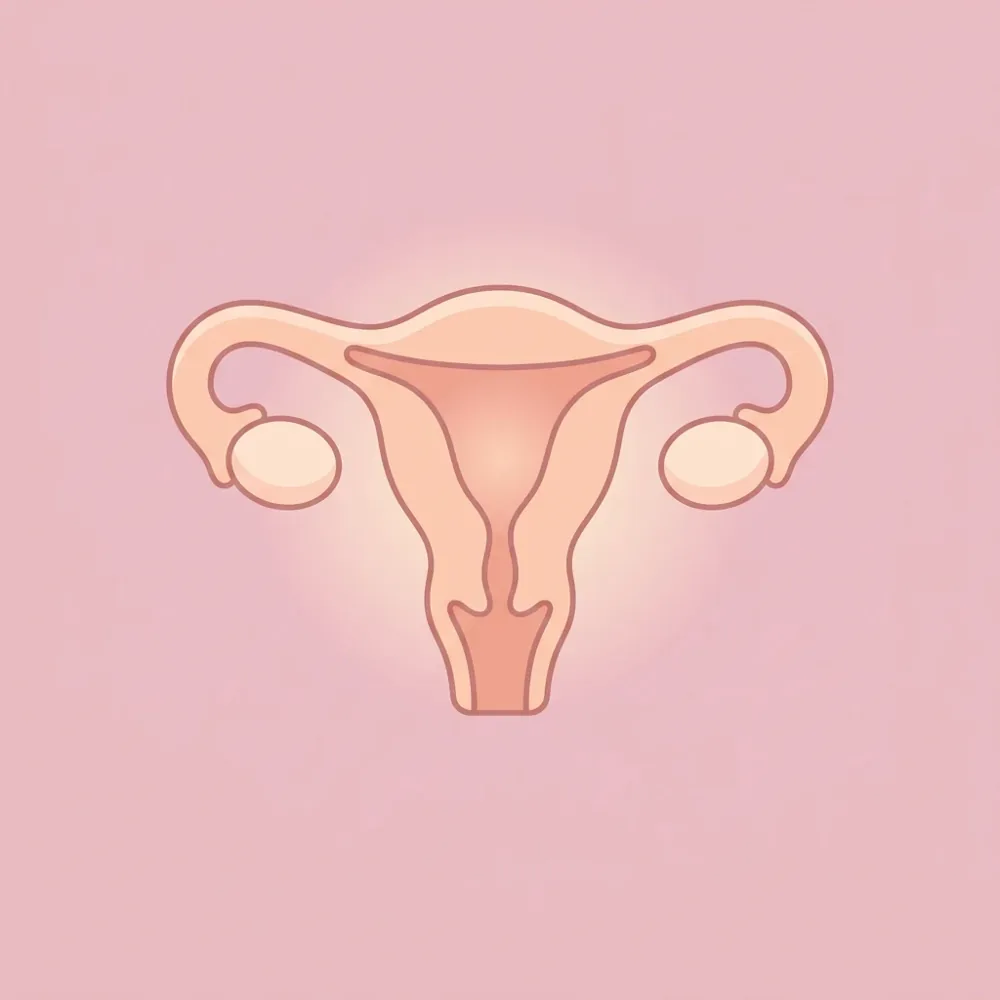
The endometrium is the lining inside your womb. After menopause, with no estrogen to feed it, it becomes thin and fragile. It can then bleed at the slightest friction, sometimes after sex. It is very treatable, often with local estrogen, once the check is done.
Another frequent, benign cause: polyps, small growths attached to the womb wall. They explain 10 to 30% of cases and are easy to remove [7].
So why the vigilance? Because bleeding is also the main sign of endometrial cancer: about 9 in 10 women with this cancer bled first [2]. Yet across all women who bleed, this cancer accounts for only about 1 in 11 cases [2].
Atrophy, polyps and cancer cause the same symptom. Since you cannot tell them apart from the outside, every case gets checked. The good news: caught early thanks to bleeding, this cancer usually responds well.
Sources (4)
- [1] American College of Obstetricians and Gynecologists (ACOG). The Role of Transvaginal Ultrasonography in Evaluating the Endometrium of Women With Postmenopausal Bleeding. Committee Opinion No. 734. Obstet Gynecol. 2018;131(5):e124-e129.
- [7] Salim S, Won H, Nesbitt-Hawes E, et al. Diagnosis and management of endometrial polyps: a critical review of the literature. J Minim Invasive Gynecol. 2011;18(5):569-581.
- [2] Clarke MA, Long BJ, Del Mar Morillo A, et al. Association of Endometrial Cancer Risk With Postmenopausal Bleeding in Women: A Systematic Review and Meta-analysis. JAMA Intern Med. 2018;178(9):1210-1222.
- [8] Astrup K, Olivarius NdF. Frequency of spontaneously occurring postmenopausal bleeding in the general population. Acta Obstet Gynecol Scand. 2004;83(2):203-207.
A history of endometriosis does not excuse skipping the check
People often say endometriosis 'switches off' at menopause. It is partly true: starved of estrogen, the disease tends to quiet down, a real relief after years of pain.
But 'quiet down' does not mean 'disappear'. Lesions can persist, or even reactivate [5]. Two situations relight the fuse:
- MHT (menopausal hormone therapy): by reintroducing estrogen, it can wake up old lesions [6].
- Residual lesions that make their own estrogen locally, even without MHT.
There is also a rare risk, under 1%, that an old lesion turns into something more serious [5]. Small, but real. Not a reason to worry daily, just one more reason to report any bleeding.
If you had endometriosis and you see blood, do not tell yourself 'it's just my endo, I know it'. The reflex is the same: consult and get the full workup. Your history is valuable information for the doctor, not a reason to wait.
Sources (2)
- [5] Secoșan C, Balint O, Pirtea L, et al. Endometriosis in Menopause, Renewed Attention on a Controversial Disease. Diagnostics. 2020;10(3):134.
- [6] Gemmell LC, Webster KE, Kirtley S, et al. The management of menopause in women with a history of endometriosis: a systematic review. Hum Reprod Update. 2017;23(4):481-500.
What actually happens at the doctor's
Fear of the exams is part of what makes you hesitate, and that is legitimate. Let's demystify it, step by step.
The first test is almost always a pelvic ultrasound, often transvaginal (a slim wand gently inserted into the vagina). It is quick and it measures the thickness of your lining [9]. If it is thin, 4 millimeters or less, cancer becomes very unlikely, with a reliability above 99% [1]. That is often enough to reassure you.
If the lining is thicker or the bleeding persists, your doctor may offer:
- An endometrial biopsy: a tiny sample of cells taken with a thin soft tube (the Pipelle), in the office, without anesthesia [9]. It can cause a brief cramp, similar to a period twinge.
- A hysteroscopy: a tiny camera slipped into the womb to look directly inside and remove a polyp if needed [1].
Doctors sort all these causes using a framework called PALM-COEIN [4]. One last point: if the ultrasound is normal but the bleeding comes back, consult again. A reassuring check lowers the risk without erasing it completely.
Sources (3)
- [9] Goldstein SR. Modern Evaluation of the Endometrium. Obstet Gynecol. 2010;116(1):168-176.
- [1] American College of Obstetricians and Gynecologists (ACOG). The Role of Transvaginal Ultrasonography in Evaluating the Endometrium of Women With Postmenopausal Bleeding. Committee Opinion No. 734. Obstet Gynecol. 2018;131(5):e124-e129.
- [4] Munro MG, Critchley HOD, Fraser IS (FIGO Menstrual Disorders Committee). The two FIGO systems for normal and abnormal uterine bleeding symptoms and classification of causes of abnormal uterine bleeding (PALM-COEIN). Int J Gynecol Obstet. 2018;143(3):393-408.
If your periods stopped more than twelve months ago and you see blood, the move is the same for everyone: consult this week, without waiting for it to pass. Acting fast is not giving in to fear, it is taking care of yourself. Note the date of what you saw today and its details (color, amount, context). Endora can time-stamp each episode so you arrive with a clear timeline, then pick up the phone.
This article is for information only and does not replace the advice of a health professional. If a symptom worries you, talk to a doctor.