No more periods: do you still need contraception?
The simple rule nobody spelled out for you, and the HRT trap that catches so many women off guard.
4 min read
Three months without a period, maybe four, and the thought lands one evening: can I finally put contraception away? That fog is real, and nobody gave you the clear marker. Here's the honest truth: in perimenopause you can still get pregnant, even with rare periods. This is the simple rule that tells you exactly when you're truly in the clear.
Rare periods don't mean your fertility is at zero
Your ovaries don't shut down with a clean switch. They wind down unevenly: some months they still release an egg, some months they don't [3]. As long as an ovulation can happen, a pregnancy stays possible, even when your cycles are chaotic [3].
That's where the confusion starts: the slowdown is visible (your periods space out), but the stop can only be confirmed after the fact. Two markers not to mix up. Perimenopause is the whole transition, made of irregular cycles. Confirmed menopause is 12 months in a row with no period at all [2].
Fertility after 45 is low, genuinely low, but not zero. The natural chance of conceiving between 45 and 49 sits around 2 to 3 percent per year [1]. Small, yes, but not nothing, and you can't know in advance which month will be 'active'.
If part of you assumed that chapter had closed, that's a reasonable assumption: your body has been sending mixed signals. It's not a mistake, and it's not your fault.
Sources (3)
- [3] Baldwin MK, Jensen JT. Contraception during the perimenopause. Maturitas. 2013;76(3):235-242.
- [2] National Institute for Health and Care Excellence (NICE). Menopause: diagnosis and management (NG23). 2024.
- [1] Faculty of Sexual & Reproductive Healthcare (FSRH). Contraception for Women Aged Over 40 Years. FSRH Clinical Guideline. 2023.
The rule that tells you when to stop: 1 or 2 years
Here's the marker nobody may ever have given you in plain black and white. Two numbers, that's it.
- Over 50: you can stop contraception 1 year after your last period [1].
- Under 50: wait 2 years after your last period [1].
Why two years before 50? Because a late, surprise ovulation stays a little more likely, so you get a longer safety buffer [1]. There's also an age backstop: for most women, contraception can be stopped at 55, when a spontaneous pregnancy becomes extremely rare [1].
Everything hangs on one date: your last real period. And careful, not every bleed counts. On the combined pill, the monthly bleeds aren't real periods: they're withdrawal bleeds, triggered by the hormone-free days [4]. They can keep showing up even when your menopause is already well underway.
That's also why a blood test (the FSH hormone test) is unreliable while you're on hormonal contraception: the hormones you take scramble the reading [2]. The solid criterion stays the time elapsed without real periods.
Sources (3)
- [1] Faculty of Sexual & Reproductive Healthcare (FSRH). Contraception for Women Aged Over 40 Years. FSRH Clinical Guideline. 2023.
- [4] Hardman SMR, Gebbie AE. Hormonal contraceptive regimens in the perimenopause. Maturitas. 2009;63(3):204-212.
- [2] National Institute for Health and Care Excellence (NICE). Menopause: diagnosis and management (NG23). 2024.
HRT eases your symptoms but doesn't protect you from pregnancy
This is the myth that catches the most women out, so let's fix it right now: menopause hormone therapy (HRT, sometimes called MHT) is not a contraceptive [2].
Picture two different jobs. HRT, often a first-line option for hot flashes [2][11], is the thermostat: it tops up the hormones you're running low on, eases hot flashes and night sweats, and makes daily life comfortable again [5]. Contraception is the locked door: it actively stops an egg from being released.
Why doesn't HRT lock the door? Its hormone doses are deliberately low, just enough to soothe symptoms. The pill, by contrast, uses doses high enough to switch off ovulation on purpose [6]. So your ovaries can keep releasing an egg while you're on HRT [6].
Many women start HRT in perimenopause and drop all contraception, assuming they're covered. Until menopause is confirmed, contraception is still needed ON TOP of HRT [6]. If nobody explained this to you, it's not your fault: this exact point often falls into the blind spot of a rushed appointment.
Sources (4)
- [2] National Institute for Health and Care Excellence (NICE). Menopause: diagnosis and management (NG23). 2024.
- [11] The 2022 Hormone Therapy Position Statement of The North American Menopause Society. Menopause. 2022;29(7):767-794.
- [5] Gebbie AE, Hardman SMR. Contraception in the perimenopause - old and new. Menopause International. 2010;16(1):33-37.
- [6] Davis SR, Baber R, Panay N, et al. IMS recommendations on menopause and hormone therapy. Climacteric. 2016;19(2):109-150.
IUD, pill or condoms: how to choose with your doctor
The right choice depends on your age, your health, your bleeding and whether you smoke. Here are the main options.
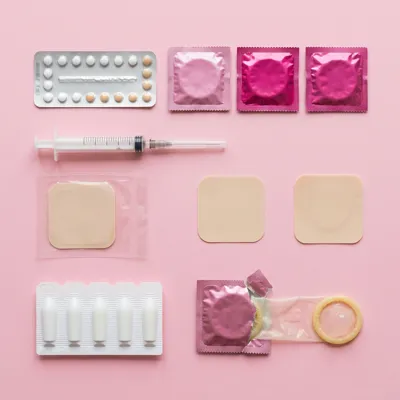
- Hormonal IUD (levonorgestrel): highly effective and long-lasting, it lightens the heavy periods common in perimenopause, and doubles as the progestogen part of HRT if you take estrogen [4][5].
- Copper IUD: hormone-free and highly effective [10]. Fitted at 40 or over, it can stay until menopause is confirmed [1].
- Combined pill: possible up to 50 if you're healthy, a non-smoker with no cardiovascular risk [4]. If you smoke or have vascular risk, your doctor will steer you elsewhere.
- Progestogen-only pill or implant: estrogen-free, suited to women over 40, including when estrogen isn't advised [7].
- Condoms: useful near the finish line, and the only method that also protects against sexually transmitted infections.
Why be this precise? Because a pregnancy at this age carries real risks: more than half of pregnancies after 45 end in miscarriage [8]. And up to 75 percent of pregnancies after 40 are unplanned [9], often because contraception was stopped too soon.
Bringing these markers to your appointment turns a vague 'we'll see' into a real decision. You're allowed to ask the direct question and get a clear answer.
Sources (7)
- [4] Hardman SMR, Gebbie AE. Hormonal contraceptive regimens in the perimenopause. Maturitas. 2009;63(3):204-212.
- [5] Gebbie AE, Hardman SMR. Contraception in the perimenopause - old and new. Menopause International. 2010;16(1):33-37.
- [10] Heinemann K, Reed S, Moehner S, Minh TD. Comparative contraceptive effectiveness of levonorgestrel-releasing and copper intrauterine devices. Contraception. 2015;91(4):280-283.
- [1] Faculty of Sexual & Reproductive Healthcare (FSRH). Contraception for Women Aged Over 40 Years. FSRH Clinical Guideline. 2023.
- [7] Linton A, Golobof A, Shulman LP. Contraception for the perimenopausal woman. Climacteric. 2016;19(6):526-534.
- [8] Andersen AMN, Wohlfahrt J, Christens P, et al. Maternal age and fetal loss: population based register linkage study. BMJ. 2000;320(7251):1708-1712.
- [9] Gebbie A. Contraception in the perimenopause. The Obstetrician & Gynaecologist. 2003;5(3):141-146.
Here's where you land. The rule comes down to two numbers: 1 year after your last period if you're over 50, 2 years if you're under 50. And HRT eases your symptoms, it doesn't replace contraception. Real peace of mind has a date: the date of your last genuine bleed. Log it, track it, an app can count that window for you, then decide with your doctor which method fits you best.
This article is for information only and does not replace the advice of a health professional. If a symptom worries you, talk to a doctor.