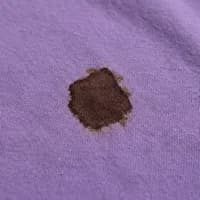
What are these big clots during my period?
Which clots are totally banal, which ones mean it's time to call your doctor, and why they show up more around 50.
4 min read

Seeing a big, dark clot drop into the toilet is startling, and the fear that follows makes sense. What you're seeing is real, and it has a physical explanation. A clot is blood that gelled, not a piece of you falling out. As flow ramps up around ages 45-55, clots get common: up to one in four women have genuinely heavy periods at this stage [1].
A clot is gelled blood, not lost tissue
Here's what defuses half the fear. A clot is mostly coagulated blood, with a little lining, not a piece of an organ falling out [2].
During your period, your uterus runs a system that keeps blood liquid as it flows out. It's called fibrinolysis: an enzyme, plasmin, constantly dissolves fibrin so the blood doesn't gel [2]. On a light day, it keeps up easily.
When flow gets heavy and fast, that system is overwhelmed. Blood pools faster than it can be dissolved, so it gels in place and forms the solid lump you see [2].
Here's the reassuring, counter-intuitive part: a clot isn't a sign of a clotting disorder, it's closer to the opposite [4]. What matters isn't the clot itself, it's how much blood you're losing.
Sources (2)
- [2] Davies J, Kadir RA. Heavy menstrual bleeding: An update on management. Thromb Res. 2017;151 Suppl 1:S70-S77.
- [4] American College of Obstetricians and Gynecologists (ACOG). Management of Acute Abnormal Uterine Bleeding in Nonpregnant Reproductive-Aged Women. Committee Opinion 557 (reaffirmed). Obstet Gynecol. 2022.
Why they show up more around 50: less ovulation
You bled regularly for thirty years, and now everything shifts. It's not your imagination, and it isn't random. As menopause approaches, your ovaries stop ovulating every cycle [5].
Ovulation is what triggers progesterone, the hormone that balances estrogen and organizes the shedding of the uterine lining (the endometrium). Without ovulation, that progesterone is missing, and estrogen works unchecked [3].
The result: the lining thickens without control, then sheds all at once, heavily and irregularly. More tissue to pass means more blood, so bigger clots [3].
Other common causes amplify flow at this age: fibroids (benign muscle growths in the uterine wall) and polyps. Usually benign, they still deserve to be identified. That's why heavy bleeding after 45 warrants an evaluation [1].
Sources (4)
- [5] Study of Women's Health Across the Nation (SWAN). Menstrual cycle changes in the menopausal transition. 2019.
- [3] Munro MG, Critchley HOD, Fraser IS. The FIGO classification of causes of abnormal uterine bleeding in the reproductive years (PALM-COEIN). Int J Gynecol Obstet. 2018;143(3):393-408.
- [1] National Institute for Health and Care Excellence (NICE). Heavy menstrual bleeding: assessment and management (NG88). 2021.
- [6] Baird DD, Dunson DB, Hill MC, Cousins D, Schectman JM. High cumulative incidence of uterine leiomyoma in black and white women. Am J Obstet Gynecol. 2003;188(1):100-107.
Sorting banal from concerning: size, frequency, flooding
Here's the concrete reference you want. Picture a 2-euro coin (about 2.5 cm) as your benchmark.
What's banal during a heavy flow:
- clots smaller than a 2-euro coin,
- mostly on your heaviest days, often in the morning,
- occasional, without soaking through your protection [7].
What's worth raising with your doctor:
- clots bigger than a 2-euro coin,
- coming back cycle after cycle,
- with a flow that floods: changing protection every hour, leaking overnight or through clothes [1].
It's the combination of size, frequency and flooding that counts, not one isolated big clot. This coin size is a landmark to picture things, not a formal clinical cutoff, since guidelines rely on how heavy the flow is [1].
Add a signal that's easy to miss: fatigue. Breathlessness on the stairs, pale skin, a racing heart... you may be losing enough blood to drain your iron stores [8].
Sources (4)
- [7] Royal College of Obstetricians and Gynaecologists (RCOG). Heavy menstrual bleeding: patient information. 2020.
- [1] National Institute for Health and Care Excellence (NICE). Heavy menstrual bleeding: assessment and management (NG88). 2021.
- [8] Pavord S, Daru J, Prasannan N, Robinson S, Stanworth S, Girling J (BSH). UK guidelines on the management of iron deficiency. Br J Haematol. 2020.
- [9] World Health Organization. Iron deficiency anaemia. 2021.
Cutting the flow cuts the clots: what works
You don't have to wait passively for menopause. Because clots come mostly from heavy flow, whatever reduces the flow reduces the clots. These are options to discuss with your doctor.
- Tranexamic acid (Exacyl): a non-hormonal tablet, taken only on your heavy days. It cuts blood loss by 40 to 50% [10]. It stays contraindicated if you have a history of thrombosis (a clot in a vein).
- NSAIDs (ibuprofen, mefenamic acid): they lower flow by around 20 to 40%, and ease period pain [11].
- The hormonal IUD (a levonorgestrel intrauterine system): the first-line treatment for heavy periods. It thins the lining and reduces flow by 70 to 95% [1][12].
Add oral progestogens to steady erratic cycles [3], and iron if a blood test confirms anaemia [9].
One last lever: log what you notice. Clot size (using the 2-euro coin), how often you change protection, your fatigue. This objective data helps your doctor act fast and order a blood test or a pelvic ultrasound (a painless scan that looks at the uterus) at the right time [4].
Sources (7)
- [10] Bryant-Smith AC, Lethaby A, Farquhar C, Hickey M. Antifibrinolytics for heavy menstrual bleeding. Cochrane Database Syst Rev. 2018.
- [11] Bofill Rodriguez M, Lethaby A, Farquhar C. Non-steroidal anti-inflammatory drugs for heavy menstrual bleeding. Cochrane Database Syst Rev. 2019.
- [1] National Institute for Health and Care Excellence (NICE). Heavy menstrual bleeding: assessment and management (NG88). 2021.
- [12] Lethaby A, Hussain M, Rishworth JR, Rees MC. Progesterone or progestogen-releasing intrauterine systems for heavy menstrual bleeding. Cochrane Database Syst Rev. 2015.
- [3] Munro MG, Critchley HOD, Fraser IS. The FIGO classification of causes of abnormal uterine bleeding in the reproductive years (PALM-COEIN). Int J Gynecol Obstet. 2018;143(3):393-408.
- [9] World Health Organization. Iron deficiency anaemia. 2021.
- [4] American College of Obstetricians and Gynecologists (ACOG). Management of Acute Abnormal Uterine Bleeding in Nonpregnant Reproductive-Aged Women. Committee Opinion 557 (reaffirmed). Obstet Gynecol. 2022.
These clots don't make you a helpless bystander to your own body. You know now what they are: gelled blood, because your flow briefly outran the system that keeps it liquid. You know why they show up around 50, and you have your line: bigger than a 2-euro coin, repeated, with a flow that floods. Log what you notice, and if you cross that line, book the call. Real solutions exist, and most of these situations resolve once the cause is found.
This article is for information only and does not replace the advice of a health professional. If a symptom worries you, talk to a doctor.