Shoulder pain that comes with your period: could it be thoracic endometriosis?
This underrecognized form affects the diaphragm and lungs, with symptoms timed to your cycle.
5 min read

That shoulder pain that returns with your period, that sudden breathlessness: what you feel is real and documented. Endometriosis can reach beyond the pelvis to the diaphragm and lungs. It is underrecognized, and even many doctors are unaware of it. This pain has a name, a mechanism, and answers.
Endometriosis can reach the diaphragm and lungs
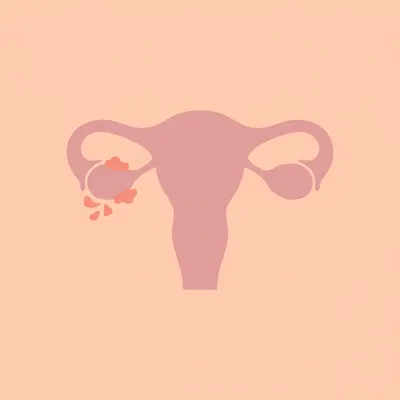
Endometriosis is tissue similar to the uterine lining that grows where it should not. Most often in the pelvis: ovaries, ligaments, bladder, rectum. Sometimes it travels higher.
Thoracic endometriosis syndrome covers the cases where this tissue reaches the diaphragm, the pleura (the thin membrane around the lung), or the lung itself [2]. It is the most common location outside the pelvis: about 12% of extra-pelvic endometriosis cases [1].
How does the tissue get there? The diaphragm is the large muscular membrane that separates your chest from your abdomen and lets you breathe. It can have tiny openings, natural or created by the disease, called fenestrations. Endometriosis cells migrate through these micro-passages, carried by the fluid that circulates in your abdomen [3]. More rarely, they travel through the blood or lymph [2].
If you had never heard of this form, that makes sense. Many healthcare professionals are still unaware of it. It is not a lack of vigilance on your part, but a lack of awareness that is starting to change.
Sources (3)
- [2] Joseph J, Sahn SA. Thoracic endometriosis syndrome: new observations from an analysis of 110 cases. Am J Med. 1996;100(2):164-170. doi:10.1016/S0002-9343(97)89454-5
- [1] Nezhat C, Lindheim SR, Backhus L, Vu M, Vang N, Nezhat A, Nezhat C. Thoracic Endometriosis Syndrome: A Review of Diagnosis and Management. JSLS. 2019;23(3):e2019.00029. PMID 31427853. doi:10.4293/JSLS.2019.00029
- [3] Korom S, Canyurt H, Missbach A, et al. Catamenial pneumothorax revisited: clinical approach and systematic review of the literature. J Thorac Cardiovasc Surg. 2004;128(4):502-508. doi:10.1016/j.jtcvs.2004.04.039
Shoulder pain and breathlessness timed to your period
When pain hits the chest, you think of your heart, your lungs, and you feel afraid. That fear is legitimate. Let us decode what your body is trying to say.
Right shoulder pain, especially if it returns with each cycle, is a major warning sign of diaphragmatic endometriosis [1]. The phrenic nerve, which runs through the diaphragm, shares its nerve roots (C3 to C5) with the shoulder area. When lesions irritate the diaphragm, the brain gets the address wrong and reads the pain as coming from the shoulder [1] [4]. This is called referred pain. It is not in your head: it is a real neurological mechanism.
The other striking sign is catamenial pneumothorax, meaning a partly collapsed lung linked to the cycle. Air seeps in around the lung and stops it from filling. This causes sudden chest pain, breathlessness, and sometimes intense tightness. It happens within 72 hours around the start of your period [3], on the right side in about 90% of cases [3].
You may also feel cyclical chest pain, a cough, or breathlessness that returns with your period. The common thread: their cyclical timing. This is the most valuable clue, and it deserves to be heard. You are not exaggerating, and it is not anxiety.
Sources (3)
- [1] Nezhat C, Lindheim SR, Backhus L, Vu M, Vang N, Nezhat A, Nezhat C. Thoracic Endometriosis Syndrome: A Review of Diagnosis and Management. JSLS. 2019;23(3):e2019.00029. PMID 31427853. doi:10.4293/JSLS.2019.00029
- [4] Rousset-Jablonski C, Alifano M, Plu-Bureau G, et al. Catamenial pneumothorax and endometriosis-related pneumothorax: clinical features and risk factors. Hum Reprod. 2011;26(9):2322-2329. doi:10.1093/humrep/der189
- [3] Korom S, Canyurt H, Missbach A, et al. Catamenial pneumothorax revisited: clinical approach and systematic review of the literature. J Thorac Cardiovasc Surg. 2004;128(4):502-508. doi:10.1016/j.jtcvs.2004.04.039
A long diagnosis, but concrete steps to speed it up
Living with pain that others cannot see is exhausting, physically and emotionally. If you have been through years of uncertainty, it is not your fault. The average diagnostic delay for endometriosis in France is estimated at 7 to 12 years [6], often longer for thoracic forms. This is a systemic problem, not a lack of perseverance.
Several reasons explain it:
- the location is misleading: shoulder pain points to a muscle issue, and a pneumothorax in a young woman is labeled "spontaneous" without anyone asking about the cycle [5];
- imaging has limits: diaphragm lesions are often only millimeters wide, and a normal CT scan or MRI does not rule out the disease [4] [7].
So the diagnosis rests above all on the clinical picture: a careful look at your symptoms and their link to the cycle [7].
To move things forward, keep a journal noting the date of each episode (shoulder, chest, breathlessness, cough) and the date of your period. A cyclical pattern is a strong clinical argument. A dedicated thoracic MRI can reveal nodules [4]. When surgery is needed, VATS confirms the diagnosis. This is video-assisted thoracoscopic surgery, done through small incisions under anesthesia. It lets the surgeon see the lesions directly, found in 38 to 69% of women who have surgery [1] [9]. You can ask for an opinion at an endometriosis reference center, even if your doctor is unfamiliar with this form [8].
Sources (7)
- [6] INSERM. Endométriose. Dossier d'information. 2023. Disponible sur : https://www.inserm.fr/dossier/endometriose/
- [5] Alifano M, Jablonski C, Kadiri H, et al. Catamenial and noncatamenial, endometriosis-related or nonendometriosis-related pneumothorax referred for surgery. Am J Respir Crit Care Med. 2007;176(10):1048-1053. doi:10.1164/rccm.200704-587OC
- [4] Rousset-Jablonski C, Alifano M, Plu-Bureau G, et al. Catamenial pneumothorax and endometriosis-related pneumothorax: clinical features and risk factors. Hum Reprod. 2011;26(9):2322-2329. doi:10.1093/humrep/der189
- [7] Becker CM, Bokor A, Heikinheimo O, et al. ESHRE guideline: endometriosis. Hum Reprod Open. 2022;2022(2):hoac009. doi:10.1093/hropen/hoac009
- [1] Nezhat C, Lindheim SR, Backhus L, Vu M, Vang N, Nezhat A, Nezhat C. Thoracic Endometriosis Syndrome: A Review of Diagnosis and Management. JSLS. 2019;23(3):e2019.00029. PMID 31427853. doi:10.4293/JSLS.2019.00029
- [9] Bagan P, Le Pimpec Barthes F, Assouad J, et al. Catamenial pneumothorax: retrospective study of surgical treatment. Ann Thorac Surg. 2003;75(2):378-381. doi:10.1016/S0003-4975(02)04320-5
- [8] CNGOF. Recommandations pour la pratique clinique : prise en charge de l'endométriose. 2018.
Treatments exist: hormones, surgery, or both
Solutions exist, they are documented, and they help many women regain their quality of life. Here are the main options, with their limits.
Hormonal treatment aims to rest the lesions by lowering estrogen stimulation. Two main options:
- dienogest, a progestogen taken continuously (2 mg a day), which pauses periods and helps lesions shrink [10];
- GnRH agonists (such as leuprolide or triptorelin), which trigger a temporary, reversible menopause over 3 to 6 months, often with "add-back" therapy to limit effects on bones and hot flashes [10].
When symptoms are intense or recurrent, especially with repeated pneumothorax, surgery becomes the standard treatment [1] [10]. Through VATS, the surgeon removes the lesions and repairs diaphragm micro-openings. They may also perform a pleurodesis: fusing the two layers of the pleura to stop air from getting back in. Alone, pleurodesis is not enough: it does not treat the cause [10].
It is the pairing of surgery plus hormonal treatment that gives the best results. The pneumothorax recurrence risk is clearly lower than with surgery alone [10] [11]. If pelvic endometriosis coexists, a combined single-session approach is recommended. It pairs VATS for the chest with laparoscopy, pelvic surgery through small incisions [1] [8]. Pain management and psychological support are also part of the journey.
Sources (4)
- [10] Elsayed H, Hassaballa A, Mostafa A, et al. Is hormonal manipulation after surgical treatment of catamenial pneumothorax effective in reducing the rate of recurrence? A systematic review. Eur J Obstet Gynecol Reprod Biol. 2022;278:141-147. doi:10.1016/j.ejogrb.2022.09.019. PMID: 36179536
- [1] Nezhat C, Lindheim SR, Backhus L, Vu M, Vang N, Nezhat A, Nezhat C. Thoracic Endometriosis Syndrome: A Review of Diagnosis and Management. JSLS. 2019;23(3):e2019.00029. PMID 31427853. doi:10.4293/JSLS.2019.00029
- [11] Soares T, Oliveira MA, Panisset K, et al. Diaphragmatic endometriosis and thoracic endometriosis syndrome: a review on diagnosis and treatment. Horm Mol Biol Clin Investig. 2021;43(2):137-143. PMID 34704688. doi:10.1515/hmbci-2020-0066
- [8] CNGOF. Recommandations pour la pratique clinique : prise en charge de l'endométriose. 2018.
Thoracic endometriosis is a documented and increasingly well-understood medical reality. Diagnosis still comes late, but awareness is growing and reference centers are getting organized in France. You now have the right words to describe what you live with, and in a medical journey, the right words change everything. Your pain has a name, a mechanism, and answers.
This article is for information only and does not replace the advice of a health professional. If a symptom worries you, talk to a doctor.