Parietal endometriosis: that pain on your cesarean scar
A lump that swells during your period, a pain that returns with every cycle: it is not in your head, and it can be treated.
3 min read
A pain that returns on your cesarean scar with every cycle. Sometimes a lump that seems to swell during your period. You may have been told it was normal after a cesarean. This pain that gets in the way of your life has a precise cause and a name: parietal endometriosis. And, most of all, solutions.
Uterine-like tissue has settled in your abdominal wall
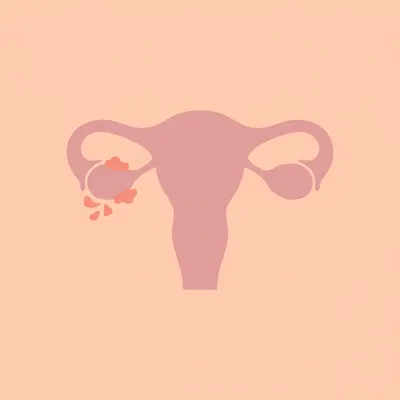
The endometrium is the lining inside your uterus. Each month it thickens, then sheds: that is your period. Endometriosis happens when similar tissue grows outside the uterus [1].
With parietal endometriosis, this tissue settles in the abdominal wall, the layers of skin, fat, and muscle of your belly, most often near a cesarean scar [2].
Even far from the uterus, this tissue keeps responding to your hormones. It swells, bleeds, and becomes inflamed with each cycle [3]. That is why the pain returns with your period.
One key difference from pelvic endometriosis (in the ovaries or peritoneum): it is not caused by retrograde menstruation, but by direct implantation of cells during surgery [4].
Sources (4)
- [1] Zondervan KT, Becker CM, Missmer SA. Endometriosis. N Engl J Med. 2020;382(13):1244-1256. doi:10.1056/NEJMra1810764
- [2] Horton JD, DeZee KJ, Ahnfeldt EP, Wagner M. Abdominal wall endometriosis: a surgeon's perspective and review of 445 cases. Am J Surg. 2008;196(2):207-212. doi:10.1016/j.amjsurg.2007.07.035
- [3] Carsote M, Terzea DC, Valea A, Gheorghisan-Galateanu AA. Abdominal wall endometriosis (a narrative review). Int J Med Sci. 2020;17(4):536-542. doi:10.7150/ijms.38679
- [4] Carsote M, Terzea DC, Valea A, Gheorghisan-Galateanu AA. Abdominal wall endometriosis (a narrative review). Int J Med Sci. 2020;17(4):536-542. doi:10.7150/ijms.38679
It is not your fault or a surgical error
During a cesarean, the surgeon cuts through the wall, then opens the uterus. In contact with the endometrium, tiny fragments of tissue can settle into the wall and grow there [4]. Doctors call this iatrogenic implantation: an unintended consequence of a medical procedure.
It is no one's fault. These cells are microscopic, and even the most careful technique cannot always prevent it.
The link with cesarean delivery is well established:
- of 65 affected women, 81.5% had a history of cesarean [5];
- cesarean delivery clearly raises the risk of this form of endometriosis [6];
- other surgeries on the uterus can also be involved [2].
Once settled, these cells keep their estrogen receptors and slowly build up scar tissue around them. That is why the lump hardens and the pain can intensify over time [4].
Sources (4)
- [4] Carsote M, Terzea DC, Valea A, Gheorghisan-Galateanu AA. Abdominal wall endometriosis (a narrative review). Int J Med Sci. 2020;17(4):536-542. doi:10.7150/ijms.38679
- [5] Ecker AM, Donnellan NM, Shepherd JP, Lee TTM. Abdominal wall endometriosis: 12 years of experience at a large academic institution. Am J Obstet Gynecol. 2014;211(4):363.e1-363.e5. doi:10.1016/j.ajog.2014.04.011
- [6] Nominato NS, Prates LFVS, Lauar I, Morais J, Maia L, Geber S. Caesarean section greatly increases risk of scar endometriosis. Eur J Obstet Gynecol Reprod Biol. 2010;152(1):83-85. doi:10.1016/j.ejogrb.2010.05.001
- [2] Horton JD, DeZee KJ, Ahnfeldt EP, Wagner M. Abdominal wall endometriosis: a surgeon's perspective and review of 445 cases. Am J Surg. 2008;196(2):207-212. doi:10.1016/j.amjsurg.2007.07.035
A lump that swells with your period is the clearest sign
Parietal endometriosis has a recognizable signature. The most telling sign is a lump under the skin, near the scar, which was palpable in 96% of patients in a review of 445 cases [2].
This lump often comes with cyclical pain, tied to your period [7]. It may swell before or during your period, then shrink. In a series of 12 women who had surgery, all had a painful mass [8].
Intensity varies a lot: a dull ache for some, sharp pain for others. Whatever it feels like, your pain is legitimate.
One tricky detail: symptoms often appear months, even years, after the cesarean [2]. That is why the link is not always made right away. Write down the location, the tie to your cycle, and how long it has lasted: these details will help your doctor.
Sources (3)
- [2] Horton JD, DeZee KJ, Ahnfeldt EP, Wagner M. Abdominal wall endometriosis: a surgeon's perspective and review of 445 cases. Am J Surg. 2008;196(2):207-212. doi:10.1016/j.amjsurg.2007.07.035
- [7] Khan Z, Zanfagnin V, El-Nashar SA, Famuyide AO, Daftary GS, Hopkins MR. Risk factors, clinical presentation, and outcomes for abdominal wall endometriosis. J Minim Invasive Gynecol. 2017;24(3):478-484. doi:10.1016/j.jmig.2017.01.005
- [8] Blanco RG, Parithivel VS, Shah AK, Gumbs MA, Schein M, Gerst PH. Abdominal wall endometriomas. Am J Surg. 2003;185(6):596-598. doi:10.1016/S0002-9610(03)00072-2
An ultrasound finds the lesion, surgery cures it
Diagnosis starts with your account: cyclical pain near the scar already points strongly to it. The first-line test is an ultrasound of the abdominal wall (painless), which located the lesion before surgery in 85.7% of cases in a series of 14 women [9].
If needed, an MRI (magnetic resonance imaging, which shows soft tissue well) reveals the depth of the lesion [4]. The diagnosis is confirmed under the microscope on the removed tissue [2].
Good news: this endometriosis responds well to treatment. The standard is surgical removal of the lesion (wide excision) [2]. Depending on depth, the procedure is simple when the lesion sits in the fat, or calls for reinforcing the wall with a mesh when the muscle is involved [2]. After complete removal, the recurrence rate is low, around 4.3% [2].
Hormonal treatment can ease pain while you wait, but it does not make the lump disappear: it is a complement, not an alternative to surgery [1] [2].
Three fears you can set aside:
- it is not cancer, but a benign lesion [2] [4];
- it does not mean you have endometriosis everywhere [5];
- your fertility is not at stake: neither the uterus nor the ovaries are affected [2].
Sources (5)
- [9] Tatli F, Gozeneli O, Uyanikoglu H, et al. The clinical characteristics and surgical approach of scar endometriosis: A case series of 14 women. Bosn J Basic Med Sci. 2018;18(3):275-278. doi:10.17305/bjbms.2018.2659
- [4] Carsote M, Terzea DC, Valea A, Gheorghisan-Galateanu AA. Abdominal wall endometriosis (a narrative review). Int J Med Sci. 2020;17(4):536-542. doi:10.7150/ijms.38679
- [2] Horton JD, DeZee KJ, Ahnfeldt EP, Wagner M. Abdominal wall endometriosis: a surgeon's perspective and review of 445 cases. Am J Surg. 2008;196(2):207-212. doi:10.1016/j.amjsurg.2007.07.035
- [1] Zondervan KT, Becker CM, Missmer SA. Endometriosis. N Engl J Med. 2020;382(13):1244-1256. doi:10.1056/NEJMra1810764
- [5] Ecker AM, Donnellan NM, Shepherd JP, Lee TTM. Abdominal wall endometriosis: 12 years of experience at a large academic institution. Am J Obstet Gynecol. 2014;211(4):363.e1-363.e5. doi:10.1016/j.ajog.2014.04.011
You came with pain that had no name. You leave with a word, parietal endometriosis, and concrete steps. Write down your symptoms and how they track with your cycle. Then ask for a targeted ultrasound of the abdominal wall: simply say you want to explore this possibility. You have the right to ask, and the right to be heard.
This article is for information only and does not replace the advice of a health professional. If a symptom worries you, talk to a doctor.