When sex hurts: dyspareunia linked to endometriosis
Your pain is real, your pleasure is legitimate, and the two can be reconciled.
4 min read
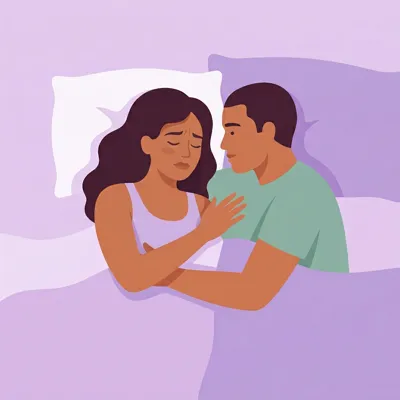
Clenching your teeth during sex, pretending everything is fine, eventually avoiding intimacy: if this sounds familiar, you are not alone. This pain has a name, dyspareunia. With endometriosis, it affects one in two women, sometimes more [1][2]. It is not rare, it is not in your head, and it is not your fault.
Your pain is real and physical, not imagined
You may have been told to "relax," or that "all women feel a little pain." These words are wrong, and they hurt as much as the pain itself.
Pain during sex is never normal. It is a clinical symptom, like a migraine. With endometriosis, it has precise physical causes documented by science [1][3]: inflammatory lesions, nerve damage, and muscle tension. Not a lack of desire.
Yet one in two women with endometriosis says this pain was never raised in a consultation [4]. Diagnosis takes about 7 years on average in France [5]. Seven years of silence, while the pain settles in and confidence erodes.
Here is the key point: your pain is real, physical, common, and it deserves care. It is not a personal flaw. It is a symptom of your disease.
Sources (4)
- [1] ESHRE. Guideline on Endometriosis. European Society of Human Reproduction and Embryology, 2022. https://www.eshre.eu/Guidelines-and-Legal/Guidelines/Endometriosis-Guideline
- [3] Stratton P, Berkley KJ. Chronic pelvic pain and endometriosis: translational evidence of the relationship and implications. Human Reproduction Update. 2011;17(3):327-346.
- [4] De Graaff AA, D'Hooghe TM, Dunselman GAJ, et al. The significant effect of endometriosis on physical, mental and social wellbeing: results from an international cross-sectional survey. Human Reproduction. 2013;28(10):2677-2685. Complété par : enquête EndoFrance-IPSOS, 2020.
- [5] Stratégie nationale de lutte contre l'endométriose. Ministère des Solidarités et de la Santé, France, 2022. Données INSERM / EndoFrance.
Why it hurts: lesions, hypersensitive nerves and guarded muscles
Understanding what is happening does not erase the pain, but it makes your body less frightening. Several mechanisms add up.
First, lesions grow on deep pelvic areas: the ligaments behind the uterus (the uterosacral ligaments) and the space between the vagina and the rectum (the rectovaginal septum) [2][6]. Deep penetration presses on these areas, like pressing on a bruise.
Next, these lesions grow their own pain nerve fibers (aberrant neurogenesis) [3], so the area turns hypersensitive. Over time, the nervous system itself misfires, like a fire alarm going off at the slightest draft: this is central sensitization [3][7]. It explains why pain can persist even after the lesions are treated.
Finally, the pelvic floor muscles tighten reflexively to protect the area (hypertonia) [8]. This tension worsens the pain. A cycle sets in: pain, fear, tension, pain. It is not psychological, it is neuromuscular, and it can be treated.
Sources (5)
- [2] Vercellini P, Frattaruolo MP, Somigliana E, et al. Surgical versus low-dose progestin treatment for endometriosis-associated severe deep dyspareunia II: effect on sexual functioning, psychological status and health-related quality of life. Fertility and Sterility. 2012;98(6):1559-1567.
- [6] Ferrero S, Esposito F, Abbamonte LH, et al. Quality of sex life in women with endometriosis and deep dyspareunia. Fertility and Sterility. 2005;83(3):573-579.
- [3] Stratton P, Berkley KJ. Chronic pelvic pain and endometriosis: translational evidence of the relationship and implications. Human Reproduction Update. 2011;17(3):327-346.
- [7] As-Sanie S, Harris RE, Napadow V, et al. Changes in regional gray matter volume in women with chronic pelvic pain: a voxel-based morphometry study. Pain. 2012;153(5):1006-1014. Note : cette étude illustre les modifications cérébrales structurelles associées à la douleur pelvienne chronique ; pour la sensibilisation centrale, voir principalement [3] (Stratton & Berkley, 2011).
- [8] ESHRE. Guideline on Endometriosis, recommandations sur la kinésithérapie pelvi-périnéale et les approches non médicamenteuses. 2022.
Pain affects your mood, but pleasure stays possible
Pain does not stay in the body. It seeps into self-esteem and relationships. Nearly 8 in 10 women living with this pain report significant sexual distress [9], and many cut the frequency of sex by half [10].
If you recognize yourself, these feelings are legitimate. Losing desire is not a failure, and avoidance is not cowardice. They are human responses to an unfair situation.
Here is an idea that changes everything: penetration is not sexuality, only one possible part of it. 70 to 80% of women do not reach orgasm through penetration alone [12][13]. The clitoris, the main organ of pleasure, responds mostly to external touch.
Widening the map of pleasure is not a plan B. Caresses, clitoral stimulation, sensuality, play: each is a full sexuality of its own. Couples who diversify report equal or greater satisfaction [15]. There is no single right way, there is your way.
Sources (6)
- [9] Fritzer N, Haas D, Oppelt P, et al. More than just bad sex: sexual dysfunction and distress in patients with endometriosis. Eur J Obstet Gynecol Reprod Biol. 2013;169(2):392-396. PMID: 23642970
- [10] De Graaff AA, D'Hooghe TM, Dunselman GAJ, et al. The significant effect of endometriosis on physical, mental and social wellbeing: results from an international cross-sectional survey (étude EndoCost). Human Reproduction. 2013;28(10):2677-2685.
- [12] Herbenick D, Fu TJ, Arter J, et al. Women's experiences with genital touching, sexual pleasure, and orgasm: results from a U.S. probability sample of women ages 18 to 94. Journal of Sex and Marital Therapy. 2018;44(2):201-212.
- [13] Lloyd E.A. The Case of the Female Orgasm: Bias in the Science of Evolution. Harvard University Press, 2005.
- [15] Kleinplatz PJ, Ménard AD, Paquet M-P, et al. The components of optimal sexuality: a portrait of 'great sex'. Canadian Journal of Human Sexuality. 2009;18(1-2):1-13.
- [14] Uloko M, Isabey EP, Peters BR. Clitoral nerve count. Présenté au congrès de la Sexual Medicine Society of North America (SMSNA), 2022.
Concrete options, and who to turn to
Nothing below is an obligation. These are doors you can open at your own pace.
For the body, several options exist:
- Positions where you guide the depth (you on top, spooning) limit pressure on the deep areas [1][8].
- Lubricant, water- or silicone-based, fragrance- and glycerin-free: a comfort measure, not an admission [8].
- Pelvic floor physiotherapy: a trained physiotherapist helps release pelvic floor tension [8].
On the medical side, hormonal treatments (progestins, continuous pill) reduce pain in 50 to 70% of patients [1][6]. Surgery on deep lesions improves dyspareunia in 60 to 80% of women at one year, but pain can persist through central sensitization [2][3]. Hence a combined approach works best: medical care, physiotherapy, and sexological support [1].
Talking about it matters too. Naming the pain to your partner ("it is not because of you, it is my disease") and setting your limits builds a safe intimacy. A sexologist trained in chronic pain can support you without judgment [1][11].
Sources (6)
- [1] ESHRE. Guideline on Endometriosis. European Society of Human Reproduction and Embryology, 2022. https://www.eshre.eu/Guidelines-and-Legal/Guidelines/Endometriosis-Guideline
- [8] ESHRE. Guideline on Endometriosis, recommandations sur la kinésithérapie pelvi-périnéale et les approches non médicamenteuses. 2022.
- [6] Ferrero S, Esposito F, Abbamonte LH, et al. Quality of sex life in women with endometriosis and deep dyspareunia. Fertility and Sterility. 2005;83(3):573-579.
- [2] Vercellini P, Frattaruolo MP, Somigliana E, et al. Surgical versus low-dose progestin treatment for endometriosis-associated severe deep dyspareunia II: effect on sexual functioning, psychological status and health-related quality of life. Fertility and Sterility. 2012;98(6):1559-1567.
- [3] Stratton P, Berkley KJ. Chronic pelvic pain and endometriosis: translational evidence of the relationship and implications. Human Reproduction Update. 2011;17(3):327-346.
- [11] Brotto LA, Bergeron S, Engel S, et al. A comparison of mindfulness-based cognitive therapy vs cognitive behavioral therapy for the treatment of provoked vestibulodynia in a hospital clinic setting. Journal of Sexual Medicine. 2019;16(6):909-923.
The path is not linear. Some days pleasure returns, other days pain takes over, and that is not a failure. Your sexuality belongs to you: you have the right to redefine it, to set limits without guilt, and to ask for help. Every step you take to listen to your body or name your pain is already a victory. Log your pain and when it happens in Endora: these markers help you talk about it concretely with your doctor.
This article is for information only and does not replace the advice of a health professional. If a symptom worries you, talk to a doctor.