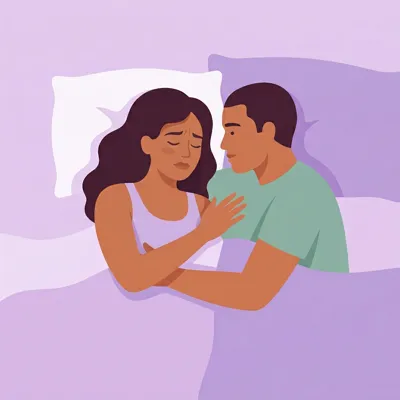
Why don't I want sex anymore?
Your libido is not an on/off switch. It responds to your hormones, your fatigue, your relationship, sometimes to pain.
3 min read
Desire fading, the urge disappearing: what you feel is real and common. Nearly one in three women reports low sexual desire [1]. You are neither broken nor abnormal. Your libido is not a switch, but a sensitive balance of hormones, emotions, fatigue, and relationship.
Desire can arise after arousal, not only before
Desire has long been described as an urge that shows up on its own, like hunger. In reality, for many women it arises in response to arousal, not before [2]. This is responsive desire, just as healthy as spontaneous desire.
So not feeling an urge "out of nowhere" is not a problem. Think of desire as a fire: it needs dry wood (a rested body), air (a safe emotional space), and a spark. If one condition is missing, the fire does not catch. It is not broken.
A lower libido only becomes an issue if it makes you suffer. About 39% of women report decreased desire, but only a minority feel real distress about it [3]. Not other people's standard: your own.
Sources (2)
- [2] Basson R. Women's sexual dysfunction: revised and expanded definitions. CMAJ. 2005;172(10):1327-1333.
- [3] Shifren JL, Monz BU, Russo PA, Segreti A, Johannes CB. Sexual problems and distress in United States women: prevalence and correlates. Obstet Gynecol. 2008;112(5):970-978.
Hormones, the pill, postpartum, menopause: when biochemistry shifts
Your brain balances "accelerator" molecules (dopamine) and "brake" molecules (serotonin, prolactin) [4]. Three hormones matter: estrogens maintain lubrication [5], progesterone slightly calms desire, and testosterone, which your body also makes, supports it [6]. This is why desire often peaks around ovulation [7].
Some life stages shift this balance more lastingly:
- The pill: combined contraceptives raise a protein (SHBG) that captures testosterone [7]. About 15 to 20% of users notice lower desire [8].
- Postpartum: after birth, hormones drop and breastfeeding keeps prolactin high, which inhibits desire [4]. One in two women is affected in the first months [10].
- Menopause: falling estrogens dry the tissues and can make sex painful [5]. About 40% of menopausal women report less desire [11].
Options exist: local estrogens for comfort, testosterone at physiological doses for desire, to discuss with a healthcare professional [6].
Sources (8)
- [4] Goldstein I, Kim NN, Clayton AH, DeRogatis LR, Giraldi A, Parish SJ, Pfaus J, Simon JA, Kingsberg SA, Meston C, Stahl SM, Wallen K, Worsley R. Hypoactive Sexual Desire Disorder: ISSWSH Expert Consensus Panel Review. Mayo Clin Proc. 2017;92(1):114-128.
- [5] Rosen RC, Barsky JL. Normal sexual response in women. Obstet Gynecol Clin North Am. 2006;33(4):515-526.
- [6] Davis SR, Baber R, Panay N, Bitzer J, Perez SC, Islam RM, Kaunitz AM, Kingsberg SA, Lambrinoudaki I, Liu J, Parish SJ, Pinkerton J, Rymer J, Simon JA, Vignozzi L, Wierman ME. Global Consensus Position Statement on the Use of Testosterone Therapy for Women. J Clin Endocrinol Metab. 2019;104(10):4660-4666.
- [7] Both S, Laan E, Schultz WW. Disorders in sexual desire and sexual arousal in women, a 2010 state of the art. J Psychosom Obstet Gynaecol. 2010;31(4):207-218.
- [8] Pastor Z, Holla K, Chmel R. The influence of combined oral contraceptives on female sexual desire: a systematic review. Eur J Contracept Reprod Health Care. 2013;18(1):27-43.
- [10] Abdool Z, Thakar R, Sultan AH. Postpartum female sexual function: a review. Eur J Obstet Gynecol Reprod Biol. 2009;145(2):133-137.
- [11] Nappi RE, Kokot-Kierepa M. Vaginal Health: Insights, Views & Attitudes (VIVA). Climacteric. 2012;15(1):36-44. PMID 22168244. doi:10.3109/13697137.2011.647840
- [9] Panzer C, Wise S, Fantini G, Kang D, Munarriz R, Guay A, Goldstein I. Impact of oral contraceptives on sex hormone-binding globulin and androgen levels: a retrospective study in women with sexual dysfunction. J Sex Med. 2006;3(1):104-113.
Stress, fatigue, and the relationship weigh as much as hormones
When stress is chronic, your body makes cortisol, which puts reproduction on hold and lowers estrogen and testosterone [4]. It is not a lack of wanting: it is a survival brake left on. Built-up fatigue does the same, because desire needs available energy.
Depression, even mild, can switch off desire, and some antidepressants add to it [4]. If your mood plays a part, that is worth exploring with a professional, without guilt. How you see your own body matters too: feeling desirable is a pillar of pleasure.
The bond with your partner counts as well. Desire feeds on emotional intimacy and safety [2]. Pressure ("will I feel like it this time?") breeds an anxiety that blocks everything. You have the right not to be in the mood, and desire often returns when that pressure eases.
Sources (2)
- [4] Goldstein I, Kim NN, Clayton AH, DeRogatis LR, Giraldi A, Parish SJ, Pfaus J, Simon JA, Kingsberg SA, Meston C, Stahl SM, Wallen K, Worsley R. Hypoactive Sexual Desire Disorder: ISSWSH Expert Consensus Panel Review. Mayo Clin Proc. 2017;92(1):114-128.
- [2] Basson R. Women's sexual dysfunction: revised and expanded definitions. CMAJ. 2005;172(10):1327-1333.
With endometriosis, painful sex shuts down desire
If your body links intimacy to pain, it is logical, even protective, for desire to withdraw. With endometriosis, about 50 to 70% of women report pain during sex, called deep dyspareunia (deep pain on penetration) [13]. This pain is physical: it comes from lesions, adhesions, and pelvic inflammation [14].
A vicious cycle sets in. The brain remembers the pain, anxiety rises before sex, the pelvic floor muscles tighten, and avoidance takes hold [14]. It is not "in your head," nor a lack of arousal.
This pain can be treated in several ways: pelvic floor physiotherapy, hormonal treatment of endometriosis, surgery for deep lesions, and sex therapy support [13][14]. Surgery improves dyspareunia in 60 to 70% of cases. If your doctor does not raise your sexuality, you have every right to.
Sources (3)
- [13] Ferrero S, Abbamonte LH, Giordano M, Ragni N, Remorgida V. Deep dyspareunia and sex life after laparoscopic excision of endometriosis. Hum Reprod. 2007;22(4):1142-1148. PMID 17182665. doi:10.1093/humrep/del465 / ESHRE Guideline on Endometriosis. 2022.
- [14] Barbara G, Facchin F, Buggio L, Somigliana E, Berlanda N, Kustermann A, Vercellini P. What is known and unknown about the association between endometriosis and sexual functioning: a systematic review of the literature. Reprod Sci. 2017;24(12):1566-1576.
- [12] Fritzer N, Haas D, Oppelt P, Gerstner GJ, Grill R, Ulrich D, Wenzl R. More than just bad sex: sexual dysfunction and distress in patients with endometriosis. Eur J Obstet Gynecol Reprod Biol. 2013;169(2):392-396. PMID 23642970. doi:10.1016/j.ejogrb.2013.04.001
Your desire measures neither your worth, your relationship, nor your femininity. What you feel is real, common, and it is not your fault. You can move at your own pace: talk to someone you trust, reconnect with your body without pressure, or seek care (gynecologist, sexologist, psychologist, pelvic floor physiotherapist). The first step is seeking to understand. You have just taken it.
This article is for information only and does not replace the advice of a health professional. If a symptom worries you, talk to a doctor.