Heavy periods: why standard period products aren't designed for you
Nearly one in three women lives with heavy periods, and solutions exist well beyond wearing a nighttime pad during the day.
4 min read
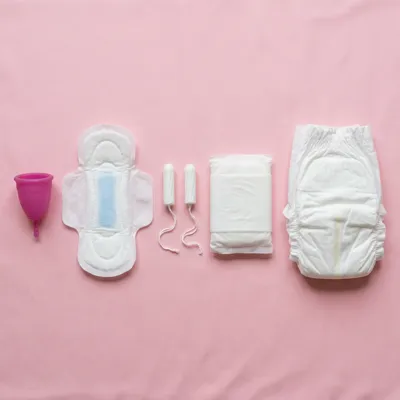
Changing protection every hour, doubling up, skipping an outing: if your period runs your days, what you're going through is real. In France, 27 to 30% of women of reproductive age have heavy periods [1]. Yet most products are designed for an average flow. You shouldn't have to just "deal with it" in silence.
Why your products can't keep up with your flow
A "super" tampon absorbs 9 to 12 ml of blood, a standard pad barely more. Yet some women lose 80 ml or more per cycle, the medical threshold for menorrhagia (abnormally heavy periods) [2]. When your flow exceeds the product's capacity, leaks aren't an accident: they're the logical result of protection that wasn't designed for you.
Manufacturers calibrate their products for an average flow, estimated at 30 to 40 ml per cycle. It's a bit like shoes only coming in one size. And when protection can't keep up, you carry the mental load: anticipating, checking, changing, cleaning.
This burden is not trivial. One in two women with very heavy periods reports a negative impact on her work life [5]. Over time, the risk of iron-deficiency anemia is high [4]. Common does not mean normal: women have too often been taught to stay quiet.
Sources (3)
- [2] Hallberg L, Högdahl AM, Nilsson L, Rybo G. Menstrual blood loss – a population study. Acta Obstetricia et Gynecologica Scandinavica. 1966;45(3):320-351.
- [5] Côté I, Jacobs P, Cumming D. Work loss associated with increased menstrual loss in the United States. Obstetrics & Gynecology. 2002;100(4):683-687.
- [4] NICE. Heavy menstrual bleeding: assessment and management. NICE guideline NG88. 2018 (mis à jour 2021) – Lien entre ménorragies et anémie ferriprive.
High-capacity products that change daily life
Good news: products suited to heavy flows exist, even if they're rarely front-of-shelf. The large menstrual cup (25 to 42 ml depending on the model) holds far more than a tampon. Worn internally and graduated, it also lets you measure your flow. A Lancet Public Health meta-analysis (43 studies, over 3,300 participants) found a leakage rate similar to or lower than tampons and pads [6]. The menstrual disc goes further, up to 50 to 70 ml.
High-capacity period underwear absorbs the equivalent of 3 to 5 tampons. Alone on moderate days, it becomes backup on heavy days alongside a cup or disc. Many women adopt this double protection on their own, and it makes sense [6]. Wearing a nighttime pad during the day stays simple and accessible: it's not a failure, it's an adaptation.
Capacity at a glance:
- Super tampon: 9 to 12 ml, change every 4 to 6 hours.
- Large cup: 25 to 42 ml, up to 8 to 12 hours.
- Menstrual disc: 50 to 70 ml, up to 12 hours.
- High-capacity underwear: equivalent of 3 to 5 tampons, washable and reusable.
- Double protection (cup or disc + underwear): the most reassuring on heavy days.
Sources (1)
- [6] van Eijk AM, Zulaika G, Lenchner M, et al. Menstrual cup use, leakage, acceptability, safety, and availability: a systematic review and meta-analysis. Lancet Public Health. 2019;4(8):e376-e393. doi:10.1016/S2468-2667(19)30111-2
Your periods turn "too" heavy above 80 ml per cycle
Flow naturally varies from one woman to the next, that's true. But there is a threshold: above 80 ml per cycle, it's called menorrhagia [2]. The problem is that nobody measures their loss with a graduated beaker.
That's why a simple tool exists: the Higham score, or PBAC (a visual chart for rating blood loss). Over one cycle, you record how many products you use, how saturated they are, and any clots [7]. A score above 100 signals menorrhagia, with reliability above 80% [7][8]. You can walk into your appointment with that number, and it changes the conversation.
Sources (3)
- [2] Hallberg L, Högdahl AM, Nilsson L, Rybo G. Menstrual blood loss – a population study. Acta Obstetricia et Gynecologica Scandinavica. 1966;45(3):320-351.
- [7] Higham JM, O'Brien PM, Shaw RW. Assessment of menstrual blood loss using a pictorial chart. British Journal of Obstetrics and Gynaecology. 1990;97(8):734-739.
- [8] Zakherah MS, Sayed GH, El-Nashar SA, Shaaban MM. Pictorial blood loss assessment chart in the evaluation of heavy menstrual bleeding: diagnostic accuracy compared to alkaline hematin. Gynecologic and Obstetric Investigation. 2011;71(4):281-284. doi:10.1159/000320336.
Half of heavy periods have a cause you can treat
Very heavy periods aren't always "just the way it is." In about half of cases, a treatable cause is found [1]. A diagnosis can then change everything.
Uterine fibroids (benign tumors of the uterine muscle) are the leading cause: they affect 40 to 80% of women before age 50, with 25 to 30% having symptoms [9]. Adenomyosis, where endometrial tissue (the lining that bleeds each month) grows into the uterine muscle, affects about 20% of women and often takes years to be recognized [10]. Polyps, some bleeding disorders, and endometriosis are other leads.
On treatment, the range goes well beyond the pill, and step by step:
- Tranexamic acid: non-hormonal, taken 2 to 4 days a month, cuts blood loss by 40 to 58% [1][11].
- Anti-inflammatories (ibuprofen, mefenamic acid): reduce flow by 20 to 40% and ease pain [1].
- Levonorgestrel IUD (Mirena), recommended first-line: reduces flow by 71 to 96% at one year [1][11].
- Endometrial ablation (a minimally invasive surgery that removes the lining, once pregnancy plans are complete): flow cut by more than 80% [11][12].
The choice is made with your doctor, based on your preferences, your pregnancy plans, and the identified cause. Hysterectomy (removal of the uterus) stays reserved for when other treatments fail. You have the right to know all your options.
Sources (5)
- [1] NICE. Heavy menstrual bleeding: assessment and management. NICE guideline NG88. 2018 (mis à jour 2021). https://www.nice.org.uk/guidance/ng88
- [9] Stewart EA. Uterine Fibroids. New England Journal of Medicine. 2015;372(17):1646-1655. doi:10.1056/NEJMcp1411029. PMID:25901428.
- [10] Chapron C, Vannuccini S, Santulli P, et al. Diagnosing adenomyosis: an integrated clinical and imaging approach. Human Reproduction Update. 2020;26(3):392-411. doi:10.1093/humupd/dmz049
- [11] CNGOF. Recommandations pour la pratique clinique – Prise en charge des ménorragies. 2022.
- [12] Lethaby A, Penninx J, Hickey M, Garry R, Marjoribanks J. Endometrial resection and ablation techniques for heavy menstrual bleeding. Cochrane Database Syst Rev. 2013;(8):CD001501. doi:10.1002/14651858.CD001501.pub4
What you're going through is not trivial, it's not "all in your head," and you don't have to build your life around your period. Three concrete steps: fill out a Higham score over your next cycle, logging your flow day by day in Endora; try a high-capacity product; and book an appointment with your doctor, midwife, or gynecologist. Come with your numbers. You deserve answers, and solutions.
This article is for information only and does not replace the advice of a health professional. If a symptom worries you, talk to a doctor.