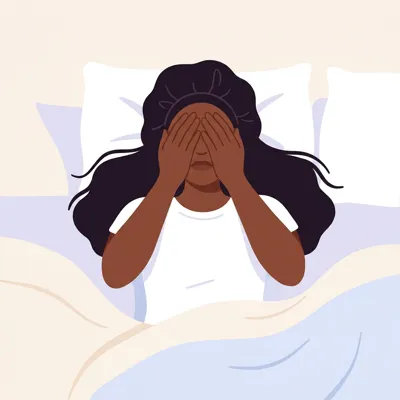
Why am I so exhausted at certain times of the month?
That fatigue that comes and goes is not in your head: it follows your hormones, and sometimes your iron stores.
4 min read
That fatigue that returns every month is real, and it has a physical cause. Your hormones shift across the cycle and affect your energy, your sleep, and your focus [1]. No, you are not lazy, and no, you are not making it up. Here is what is happening inside your body, and what you can do about it.
Your energy follows the rhythm of your hormones
Your energy fluctuates because two hormones take turns each month: oestrogens (mainly estradiol) and progesterone [1]. Their back-and-forth directly shapes your stamina, your sleep, and your mood.
One easy way to find your bearings is to picture four inner seasons. After your period, oestrogens rise: energy, motivation, and mental clarity return. Around ovulation, they peak and you often feel at the top of your game [1].
After ovulation, progesterone takes over and your body slows down. Then, just before and during your period, both hormones drop: this is often the most draining time of the cycle [2].
This pattern varies from woman to woman and cycle to cycle. But it gives you a reference point: once you know where you are, fatigue stops being a worrying mystery.
Sources (2)
- [1] Thiyagarajan DK, Basit H, Jeanmonod R. Physiology, Menstrual Cycle. StatPearls [Internet]. Treasure Island (FL): StatPearls Publishing; 2023. PMID: 29763196
- [2] Romans SE, Kreindler D, Einstein G, Laredo S, Petrovic MJ, Stanley J. Sleep quality and the menstrual cycle. Sleep Medicine. 2015;16(4):489-495. doi:10.1016/j.sleep.2014.12.001
The second half of your cycle slows you down, and it is biochemical
After ovulation, your body produces large amounts of progesterone. Your brain converts it into allopregnanolone (a molecule that acts on the same receptors as sleeping pills and anti-anxiety medicines) [3]. In other words, your body makes its own sedative.
This calming effect explains why you may feel drowsier and less sharp during these two weeks. It is not a lack of willpower; it is chemistry.
Then, two to three days before your period, progesterone and estradiol drop all at once [2]. Estradiol had been supporting your serotonin and dopamine, the messengers of stable mood and motivation. Their fall dims everything.
This drop also disrupts sleep: harder to fall asleep, night awakenings, shallower rest [2]. About 30% of women report sleep problems before their period [3]. Nearly one in two women lives with premenstrual syndrome, and fatigue is one of its common symptoms [5].
Sources (4)
- [3] Baker FC, Driver HS. Circadian rhythms, sleep, and the menstrual cycle. Sleep Medicine. 2007;8(6):613-622. doi:10.1016/j.sleep.2006.09.011
- [2] Romans SE, Kreindler D, Einstein G, Laredo S, Petrovic MJ, Stanley J. Sleep quality and the menstrual cycle. Sleep Medicine. 2015;16(4):489-495. doi:10.1016/j.sleep.2014.12.001
- [5] Direkvand-Moghadam A, Sayehmiri K, Delpisheh A, Satar Kaikhavandi S. Epidemiology of premenstrual syndrome (PMS) – A systematic review and meta-analysis study. Journal of Clinical and Diagnostic Research. 2014;8(2):106-109. doi:10.7860/JCDR/2014/8024.4021
- [1] Thiyagarajan DK, Basit H, Jeanmonod R. Physiology, Menstrual Cycle. StatPearls [Internet]. Treasure Island (FL): StatPearls Publishing; 2023. PMID: 29763196
Fatigue that lingers may hide low iron
During your period, fatigue turns more physical. The uterus releases prostaglandins (inflammatory molecules that trigger contractions) that also enter your bloodstream: fatigue, nausea, and headaches can follow [1].
Each cycle causes blood loss, and so iron loss. On average, a woman loses 30 to 40 mL per cycle, but some lose more than 80 mL [7]. Periods are the leading cause of low iron in women of childbearing age [4]. And iron carries oxygen in your blood.
Here is what matters: you can be low on iron without being anaemic. Your haemoglobin may look normal while your stores, measured by ferritin, are at rock bottom. This iron deficiency without anaemia already causes fatigue, trouble concentrating, and hair loss [8][9].
The signs to watch for:
- fatigue that does not lift with rest;
- breathlessness during easy efforts, like climbing stairs;
- unusual paleness, hair falling out, a constant feeling of being cold [8].
Sources (6)
- [1] Thiyagarajan DK, Basit H, Jeanmonod R. Physiology, Menstrual Cycle. StatPearls [Internet]. Treasure Island (FL): StatPearls Publishing; 2023. PMID: 29763196
- [7] National Institute for Health and Care Excellence (NICE). Heavy menstrual bleeding: assessment and management. NICE Guideline NG88. 2018. Disponible sur : https://www.nice.org.uk/guidance/ng88
- [4] Bruinvels G, Burden RJ, McGregor AJ, Ackerman KE, Dooley M, Richards T, Pedlar CR. Sport, exercise and the menstrual cycle: where is the research? British Journal of Sports Medicine. 2017;51(6):487-488. doi:10.1136/bjsports-2016-096279
- [8] Percy L, Mansour D, Fraser IS. Iron deficiency and iron deficiency anaemia in women. Best Practice & Research Clinical Obstetrics & Gynaecology. 2017;40:55-67. doi:10.1016/j.bpobgyn.2016.09.007
- [9] Étude nationale nutrition santé (ENNS). Santé publique France, 2006 ; Étude INCA 3. ANSES (Agence nationale de sécurité sanitaire de l'alimentation, de l'environnement et du travail), 2017
- [10] Hurrell R, Egli I. Iron bioavailability and dietary reference values. American Journal of Clinical Nutrition. 2010;91(5):1461S-1467S. doi:10.3945/ajcn.2010.28674F
Practical levers to work with your cycle
Understanding this is already a big step. From there, you can act at your own pace, with no rigid programme.
- Adapt your pace: place demanding tasks and intense workouts in the first half of your cycle, and gentler activities before your period [4].
- Boost iron: red meat is best absorbed; for plant-based iron (lentils, tofu), add vitamin C and keep tea or coffee away from meals [10].
- Protect your sleep: a cool room, regular hours, and 30 to 60 extra minutes of rest before your period if your body asks for it [3].
If fatigue is intense or persistent, a blood test is simple and useful. Ask for a ferritin test alongside the standard blood count: below 30 micrograms per litre, supplementation may be considered, even with normal haemoglobin [7].
To be heard, name exactly what you feel: "I have cyclical fatigue that returns every month and disrupts my daily life. I would like a ferritin test."
Sources (4)
- [4] Bruinvels G, Burden RJ, McGregor AJ, Ackerman KE, Dooley M, Richards T, Pedlar CR. Sport, exercise and the menstrual cycle: where is the research? British Journal of Sports Medicine. 2017;51(6):487-488. doi:10.1136/bjsports-2016-096279
- [10] Hurrell R, Egli I. Iron bioavailability and dietary reference values. American Journal of Clinical Nutrition. 2010;91(5):1461S-1467S. doi:10.3945/ajcn.2010.28674F
- [3] Baker FC, Driver HS. Circadian rhythms, sleep, and the menstrual cycle. Sleep Medicine. 2007;8(6):613-622. doi:10.1016/j.sleep.2006.09.011
- [7] National Institute for Health and Care Excellence (NICE). Heavy menstrual bleeding: assessment and management. NICE Guideline NG88. 2018. Disponible sur : https://www.nice.org.uk/guidance/ng88
Your energy is not linear: it follows a cycle nobody ever really taught you to read. Now that you know how it works, you can work with your body rather than against it. Not perfectly, not overnight, but with less guilt. You are not broken, you are cyclical. Tracking your energy day by day in Endora can help you spot your own rhythm.
This article is for information only and does not replace the advice of a health professional. If a symptom worries you, talk to a doctor.