Perimenopause: when to actually see a doctor, without hearing "it's just your age"
The signals that justify an appointment, who to see first, and how to arrive prepared enough to finally be heard.
3 min read
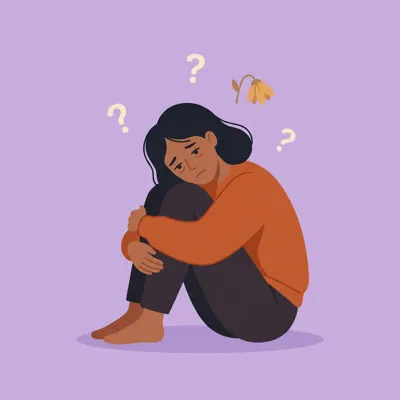
Your broken nights, your hot flashes, your cycles going haywire: these changes are real and they have a hormonal cause. You don't have to wait until you're at breaking point to see a doctor. Yet nearly one in two women has her symptoms brushed off at a visit. Your caution rests on real ground.
You don't need proof: your body has real reasons
Let's be clear: you don't have to prove it's "bad enough" to deserve an appointment. Waiting until you're at breaking point before daring to ask questions is exactly what keeps women stuck.
In perimenopause, your ovaries don't switch off gently. Your estrogen rises and falls unpredictably from one cycle to the next [2]. The transition lasts 4 to 8 years on average and often starts around 45 [1]. It's this hormonal rollercoaster, not just a "lack" of estrogen, that makes your body lurch.
Estrogen sets your brain's "thermostat." When levels drop, that thermostat overreacts and triggers hot flashes and night sweats [2]. Up to 4 in 5 women go through these vasomotor symptoms (flashes and sweats) [4]. The same swings can feed anxiety and low mood [6].
That's also why a blood test done on a random day can look "normal" and miss everything. A normal result doesn't close the conversation: your experience is still real.
Sources (4)
- [2] Santoro N, Roeca C, Peters BA, Neal-Perry G. The Menopause Transition: Signs, Symptoms, and Management Options. J Clin Endocrinol Metab. 2021;106(1):1-15.
- [1] National Institute for Health and Care Excellence (NICE). Menopause: diagnosis and management (NG23). NICE Guideline. Mise à jour 2024.
- [4] The North American Menopause Society (NAMS). Position Statement / Menopause guidance. 2022.
- [6] Maki PM, Kornstein SG, Joffe H, et al. Guidelines for the Evaluation and Treatment of Perimenopausal Depression. Menopause / J Womens Health. 2018.
The signals that truly justify an appointment
The right test isn't severity, it's impact. If a symptom wrecks your days, nights, or relationships for several weeks, that's enough.
Book an appointment when any of these takes hold:
- Your cycles change: their length varies by 7 days or more, or you skip periods for 60 days or more. That's a recognized medical marker [3].
- Hot flashes or night sweats that wake you or embarrass you in public.
- Shredded sleep: 40 to 60% of women in perimenopause sleep badly [9].
- Mood swings, new anxiety, or brain fog (you lose your words).
- Vaginal dryness, painful sex, more frequent urination [2].
One situation deserves extra care. Before 40, irregular or absent periods with menopause symptoms warrant a workup. A repeated FSH test (a hormone that spikes as the ovaries slow down) then checks for early ovarian insufficiency [10].
Sources (4)
- [3] Harlow SD, Gass M, Hall JE, et al. Executive summary of the Stages of Reproductive Aging Workshop +10 (STRAW+10). J Clin Endocrinol Metab. 2012;97(4):1159-1168.
- [9] Sleep Medicine Reviews / NAMS. Troubles du sommeil en transition ménopausique. 2021.
- [2] Santoro N, Roeca C, Peters BA, Neal-Perry G. The Menopause Transition: Signs, Symptoms, and Management Options. J Clin Endocrinol Metab. 2021;106(1):1-15.
- [10] Webber L, et al. ESHRE Guideline: Management of women with premature ovarian insufficiency. Hum Reprod. 2016;31(5):926-937.
The bleeding you should never ignore, without panic
Most bleeding during the transition is harmless: the hormonal chaos thickens the lining of the uterus and causes irregular periods [7]. But some bleeding needs a prompt review.
See a doctor quickly if you notice:
- Bleeding 12 full months after your last period (so after menopause). This is the most important signal.
- Bleeding between your periods, outside your usual cycle.
- Bleeding after sex.
- Periods that are unusually heavy or last far longer than usual.
Why the vigilance? Bleeding after menopause turns out to be endometrial cancer (cancer of the uterine lining) in about 9% of cases [8]. Caught early, it's very treatable. The exam, often an ultrasound (imaging with sound waves), is reassuring in the vast majority of cases [8].
Sources (2)
- [7] Davis SR, Lambrinoudaki I, Lumsden M, et al. Menopause. Nat Rev Dis Primers. 2015;1:15004.
- [8] American College of Obstetricians and Gynecologists (ACOG). The Role of Transvaginal Ultrasonography in Evaluating the Endometrium of Women With Postmenopausal Bleeding (Committee Opinion 734). Obstet Gynecol. 2018.
Who to see, how to arrive prepared, which options
For a first check or a workup, your GP is an excellent front door. After 45, diagnosis is clinical: it rests on your symptoms and your cycles, with no mandatory blood test [1][11]. A gynecologist takes over for abnormal bleeding or in-depth treatment advice. A menopause specialist steps in when symptoms resist.
Arriving prepared changes everything. In Endora, log your cycles, flashes, nights, and mood week by week, then pull up a clear recap. You turn a feeling into data, the objective marker described in the official classifications [3]. Hard, then, to answer you with "it's just your age."
There are real options worth discussing. Menopause hormone therapy (MHT) is the first-line treatment for hot flashes; the transdermal route (patch or gel) is often preferred, with a lower clot risk [1][4]. For intimate dryness, local estrogen; for mood and sleep, cognitive behavioral therapy is proven [4]. And if you're sent home without answers, you have the right to a second opinion [5].
Sources (5)
- [1] National Institute for Health and Care Excellence (NICE). Menopause: diagnosis and management (NG23). NICE Guideline. Mise à jour 2024.
- [11] Haute Autorité de Santé (HAS). Prise en charge de la ménopause et des troubles climatériques. Recommandations de bonne pratique. 2014.
- [3] Harlow SD, Gass M, Hall JE, et al. Executive summary of the Stages of Reproductive Aging Workshop +10 (STRAW+10). J Clin Endocrinol Metab. 2012;97(4):1159-1168.
- [4] The North American Menopause Society (NAMS). Position Statement / Menopause guidance. 2022.
- [5] Enquête IPSOS pour la ménopause, France. 2023.
You have nothing to prove to be heard. Track your cycles and symptoms for a few weeks, pull up a recap, pick three priorities and the right person to see. And if bleeding shows up between your periods, after sex, or 12 months after your last period, book quickly. You're not there to plead, but to decide together, with your data in hand.
This article is for information only and does not replace the advice of a health professional. If a symptom worries you, talk to a doctor.