No, you're not losing it. Your progesterone is.
Why you feel on edge, wired and foggy long before the first hot flush, and the hormone story nobody told you.
4 min read
It's 3am. You're exhausted but your mind won't stop. The next day you cry at an advert, then snap at someone over nothing. What you're feeling has a real hormonal cause. In perimenopause, one hormone drops before the others: progesterone. What looks like chaos actually follows a logic, and once you can read it, you get some power back.
What you're feeling has a name, and it's not in your head
The tears that don't match the trigger, the irritability from nowhere, the broken nights: this isn't a character flaw. These are recognised, documented symptoms of a real hormonal change [4].
That change has a name: perimenopause. It's the transition before your periods stop for good. It often begins around 45, sometimes in your late 30s, while your periods are still showing up [1]. It can last four to eight years [9].
Many people think it all starts with the first hot flush. That's wrong. Mood, sleep and focus problems often come first, before any heat at all [3].
And you're not overreacting. During this transition, the risk of depressive symptoms is two to four times higher than in the years before [4]. In fact, after 45, perimenopause can be diagnosed on your symptoms and changing periods, without a routine blood test [9]. Your experience counts as data.
Sources (4)
- [4] Bromberger JT, Kravitz HM, Chang YF, et al. Major depression during and after the menopausal transition: Study of Women's Health Across the Nation (SWAN). Psychol Med. 2011;41(9):1879-1888. doi:10.1017/S003329171100016X
- [1] Harlow SD, Gass M, Hall JE, et al. Executive summary of the Stages of Reproductive Aging Workshop +10: addressing the unfinished agenda of staging reproductive aging. J Clin Endocrinol Metab. 2012;97(4):1159-1168. doi:10.1210/jc.2011-3362
- [9] National Institute for Health and Care Excellence (NICE). Menopause: diagnosis and management (NG23). 2015 (updated 2024).
- [3] Santoro N, Roeca C, Peters BA, Neal-Perry G. The Menopause Transition: Signs, Symptoms, and Management Options. J Clin Endocrinol Metab. 2021;106(1):1-15. doi:10.1210/clinem/dgaa764
Progesterone drops first, before estrogen
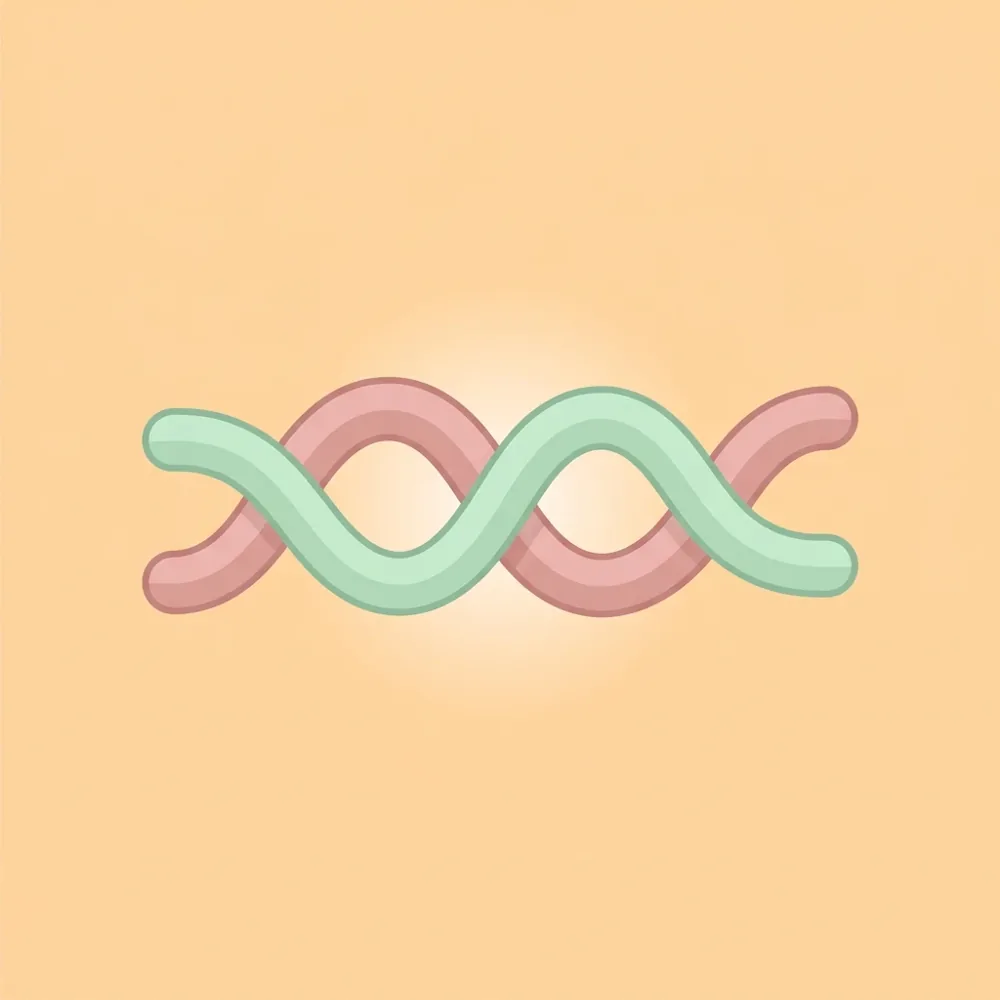
Picture your cycle as an orchestra. Each month two players perform: estrogen in the first half, progesterone in the second. But progesterone only appears after ovulation, when your ovary releases an egg.
In perimenopause, you stop ovulating every cycle. No ovulation, no progesterone. So progesterone starts dropping first, often years before estrogen does [2].
This is the missing piece. We long believed estrogen led the whole story. In reality, the first to leave the stage is progesterone, your calming hormone and natural sedative.
Meanwhile, estrogen doesn't fade gently. It swings up and down unpredictably [2]. And it's that rollercoaster, more than the level itself, that most destabilises your mood [8].
Your calming brake weakens while the accelerator surges in bursts. This has nothing to do with your willpower or your strength. It's a hormone ratio shifting, and that shift amplifies irritability, tension and heavier periods [2].
Sources (3)
- [2] Prior JC. Perimenopause: the complex endocrinology of the menopausal transition. Endocr Rev. 1998;19(4):397-428. doi:10.1210/edrv.19.4.0341
- [8] Joffe H, de Wit A, Coborn J, et al. Impact of Estradiol Variability and Progesterone on Mood in Perimenopausal Women With Depressive Symptoms. J Clin Endocrinol Metab. 2020;105(3):e642-e650. doi:10.1210/clinem/dgz181
- [5] Baker FC, de Zambotti M, Colrain IM, Bei B. Sleep problems during the menopausal transition: prevalence, impact, and management challenges. Nat Sci Sleep. 2018;10:73-95. doi:10.2147/NSS.S125807
Your PMS, your 3am, your fog: each symptom has a cause
Let's match each symptom to its mechanism.
- PMS turned up to eleven. With less progesterone to steady things, your premenstrual days hit harder [2]. You haven't become more fragile: you've lost a buffer that quietly protected you.
- The 3am wake-ups. Without progesterone's calming effect, you fall asleep fine but wake in the night with a racing mind, sometimes before any night sweat [5]. Around four to six in ten women report sleep problems in this phase [5].
- The brain fog. The word that won't come, the name that slips away. Estrogen supports the brain areas tied to memory, and its swings explain the fog [6]. For most women it's temporary and improves after the transition [6].
- The tears and anxiety out of nowhere. Estrogen shapes serotonin, your feel-good messenger. When it rollercoasters, your mood follows the curve [3].
Every piece fits together. You are not a mosaic of unexplained failures: your hormonal landscape is reorganising, with real, nameable effects.
Sources (4)
- [2] Prior JC. Perimenopause: the complex endocrinology of the menopausal transition. Endocr Rev. 1998;19(4):397-428. doi:10.1210/edrv.19.4.0341
- [5] Baker FC, de Zambotti M, Colrain IM, Bei B. Sleep problems during the menopausal transition: prevalence, impact, and management challenges. Nat Sci Sleep. 2018;10:73-95. doi:10.2147/NSS.S125807
- [6] Maki PM, Henderson VW. Cognition and the menopause transition. Menopause. 2016;23(7):803-805. doi:10.1097/GME.0000000000000681
- [3] Santoro N, Roeca C, Peters BA, Neal-Perry G. The Menopause Transition: Signs, Symptoms, and Management Options. J Clin Endocrinol Metab. 2021;106(1):1-15. doi:10.1210/clinem/dgaa764
Get your thyroid checked, and know your options
Before pinning everything on female hormones, one reflex can change everything.
Fatigue, anxiety and fog are classic in perimenopause. But the same signs can come from elsewhere, especially a thyroid disorder, the small gland at the base of your neck that sets your energy and mood [10]. Women are five to eight times more likely than men to develop one, often right around this age [10].
Other causes deserve ruling out too: low iron, depression, sleep apnoea. All are common in your 40s, and all are treatable. That's why a simple blood test is worth it [9].
If a doctor once told you you're "too young", you're allowed to go back. After 45, perimenopause is diagnosed on symptoms and changing periods, not on age [9].
And options exist, to discuss with your doctor. Menopause hormone therapy (MHT) is the first-line treatment for marked symptoms, often given through the skin [9][11]. Micronized progesterone in the evening can support sleep [5]. Cognitive behavioural therapy is proven for anxiety and insomnia, with no hormonal effect [7].
Sources (5)
- [10] American Thyroid Association. Thyroid Disease in Women. 2022.
- [9] National Institute for Health and Care Excellence (NICE). Menopause: diagnosis and management (NG23). 2015 (updated 2024).
- [11] The North American Menopause Society. The 2022 hormone therapy position statement of The North American Menopause Society. Menopause. 2022;29(7):767-794. doi:10.1097/GME.0000000000002028
- [5] Baker FC, de Zambotti M, Colrain IM, Bei B. Sleep problems during the menopausal transition: prevalence, impact, and management challenges. Nat Sci Sleep. 2018;10:73-95. doi:10.2147/NSS.S125807
- [7] Maki PM, Kornstein SG, Joffe H, et al. Guidelines for the Evaluation and Treatment of Perimenopausal Depression: Summary and Recommendations. J Womens Health (Larchmt). 2018;27(6):688-697. doi:10.1089/jwh.2018.27099
You're not losing your mind. You're finally understanding what your body has been telling you for months. Progesterone drops first, estrogen swings: that's the logic behind the chaos, and it was never your imagination or your weakness. Starting tonight, log how you feel, your mood, sleep and energy, and note where you are in your cycle. Day by day, the patterns emerge with Endora. You move from "I'm just enduring this" to "I can see it and decide", and you walk into your doctor's office with concrete data instead of a vague feeling.
This article is for information only and does not replace the advice of a health professional. If a symptom worries you, talk to a doctor.