You're not melting away: how to keep your strength after 50
Why the protein-plus-resistance combo, not the scale, is your real tool against muscle loss.
4 min read
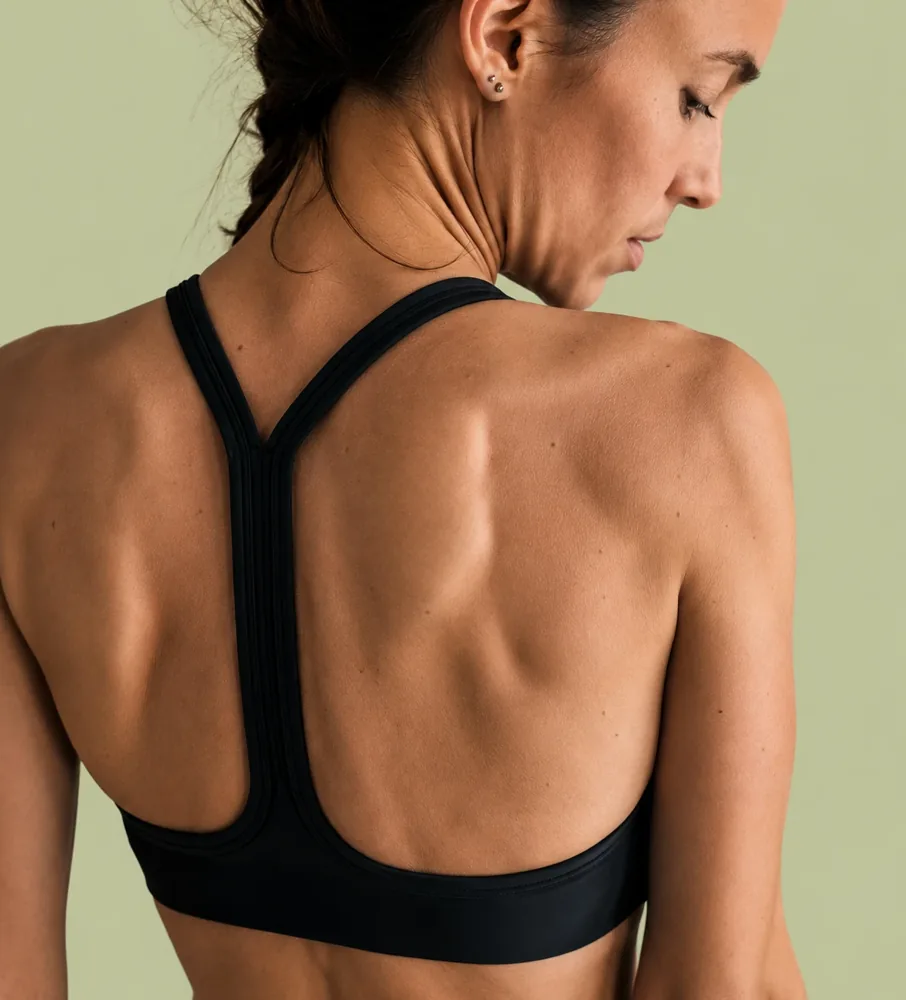
You pull on your jeans and something's off. Not a pound more on the scale, yet there's a belly settling in and arms that feel softer. You're being careful, maybe more than before, and the result is the opposite of what you hoped. That fear of "fading" is valid. It also has a precise biological cause, and real, concrete levers.
You're not melting: your hormones changed the rules
What you're feeling is real, and it has a precise biological cause. Age-related muscle loss has a name: sarcopenia (the gradual loss of muscle). After 50 you can lose 1 to 2% of your muscle a year, and menopause speeds it up [1].
Why? Your muscle goes a little "deaf" to the signal that says "build muscle." You can eat and move the way you always did, and your body responds less. You didn't give up; the settings changed.
Your shape shifts too. Estrogen used to steer fat toward your hips and thighs. As it falls, fat migrates to your belly, around your organs: visceral fat [2][3]. Across the menopause transition it can rise by around 44% [2].
Here's the part that changes everything. This process is real, but it is not permanent. Resistance training and enough protein rebuild muscle and shrink that fat, at any age [4]. Learning this at 50 or 55 is exactly the right moment to take back control.
Sources (4)
- [1] Cruz-Jentoft AJ, Bahat G, Bauer J, et al. Sarcopenia: revised European consensus on definition and diagnosis (EWGSOP2). Age and Ageing. 2019;48(1):16-31. doi:10.1093/ageing/afy169
- [2] Greendale GA, Sternfeld B, Huang M, et al. Changes in body composition and weight during the menopause transition. JCI Insight. 2019;4(5):e124865. doi:10.1172/jci.insight.124865
- [3] Lovejoy JC, Champagne CM, de Jonge L, et al. Increased visceral fat and decreased energy expenditure during the menopausal transition. Int J Obes (Lond). 2008;32(6):949-958. doi:10.1038/ijo.2008.25
- [4] Villareal DT, Aguirre L, Gurney AB, et al. Aerobic or Resistance Exercise, or Both, in Dieting Obese Older Adults. N Engl J Med. 2017;376(20):1943-1955. doi:10.1056/NEJMoa1616338
The combo that works: protein plus resistance
Two levers, and they work together. Resistance training is the most effective thing against muscle loss, and it's safe after 50. And no, lifting won't make you bulky: women have very little testosterone [6][7].
It also protects your bones. At menopause you can lose up to 10% of your bone mass in five years [5]. When muscle pulls on bone, the bone rebuilds stronger.
To build, your muscle needs a trigger: protein. After 50, aim for 1.0 to 1.2 grams per kilo of body weight a day, split into 25 to 30 grams per meal [8].
At each meal, aim for a palm-sized portion:
- a piece of chicken or fish
- two eggs, Greek yogurt, or cottage cheese
- tofu or lentils
For movement, 2 to 3 sessions a week is enough [9]. Squats, standing up from a chair, wall push-ups, lifting water bottles then light weights. Eat the bricks and give the order to build: that's the combo [7].
Sources (5)
- [6] Fragala MS, Cadore EL, Dorgo S, et al. Resistance Training for Older Adults: Position Statement From the National Strength and Conditioning Association. J Strength Cond Res. 2019;33(8):2019-2052. doi:10.1519/JSC.0000000000003230
- [7] Beckwee D, Delaere A, Aelbrecht S, et al. Exercise Interventions for the Prevention and Treatment of Sarcopenia. A Systematic Umbrella Review. J Nutr Health Aging. 2019;23(6):494-502. doi:10.1007/s12603-019-1196-8
- [5] International Osteoporosis Foundation. Facts and Statistics. 2022.
- [8] Bauer J, Biolo G, Cederholm T, et al. Evidence-Based Recommendations for Optimal Dietary Protein Intake in Older People: A Position Paper From the PROT-AGE Study Group. JAMDA. 2013;14(8):542-559. doi:10.1016/j.jamda.2013.05.021
- [9] Watson SL, Weeks BK, Weis LJ, et al. High-Intensity Resistance and Impact Training Improves Bone Mineral Density and Physical Function in Postmenopausal Women With Osteopenia and Osteoporosis: The LIFTMOR Randomized Controlled Trial. J Bone Miner Res. 2018;33(2):211-220. doi:10.1002/jbmr.3284
Track your strength, not the scale
The scale shows one total. It never tells muscle from fat [10]. You can gain muscle and lose fat while the number barely moves, even as your body genuinely improves.
The real marker is your strength. Doctors even changed the definition of sarcopenia: it's now strength, not muscle bulk, that serves as the main criterion [1]. Grip strength predicts longevity [11].
Two tests you can do tonight:
- The chair test: sit with arms crossed over your chest, then stand up and sit down as many times as you can in 30 seconds, and count.
- Grip: a hand dynamometer (a small device that measures squeeze strength) gives a number, or notice how easily you open a jar or carry your bags.
Write the numbers down and repeat the test in six weeks. This is where an app earns its place: tracking your strength instead of a weight that says nothing about how solid you are.
Sources (3)
- [10] Cheng FW, Gao X, Mitchell DC, et al. Body mass index and all-cause mortality among older adults. Obesity (Silver Spring). 2016;24(10):2232-2239. doi:10.1002/oby.21612
- [1] Cruz-Jentoft AJ, Bahat G, Bauer J, et al. Sarcopenia: revised European consensus on definition and diagnosis (EWGSOP2). Age and Ageing. 2019;48(1):16-31. doi:10.1093/ageing/afy169
- [11] Leong DP, Teo KK, Rangarajan S, et al. Prognostic value of grip strength: findings from the Prospective Urban Rural Epidemiology (PURE) study. The Lancet. 2015;386(9990):266-273. doi:10.1016/S0140-6736(14)62000-6
On Ozempic or Wegovy? Protein and lifting are non-negotiable
If you take a GLP-1 drug like Ozempic or Wegovy, or you're thinking about it, this part is for you, without alarmism.
These drugs cut appetite and drive weight loss: about 15% on average with semaglutide [12]. But when you eat far less, your body draws not only on fat, it draws on muscle too.
Analyses suggest 25 to 40% of the weight lost on a GLP-1 can be lean mass, meaning muscle [13]. You can get lighter and, without noticing, get weaker.
The takeaway is simple. On a GLP-1, protein and resistance are no longer optional [13]. Because you eat less, hitting your protein target takes intention [8]: put protein first at every meal.
Above all, make this a conversation with your doctor. Ask to track your strength and body composition, not just your weight. Successful weight loss is fat lost while you stay strong.
Sources (3)
- [12] Wilding JPH, Batterham RL, Calanna S, et al. Once-Weekly Semaglutide in Adults with Overweight or Obesity (STEP 1). N Engl J Med. 2021;384(11):989-1002. doi:10.1056/NEJMoa2032183
- [13] Prado CM, Phillips SM, Gonzalez MC, Heymsfield SB. Muscle mass loss with GLP-1 receptor agonists: implications and mitigation strategies. Lancet Diabetes Endocrinol. 2024. doi:10.1016/S2213-8587(24)00272-9
- [8] Bauer J, Biolo G, Cederholm T, et al. Evidence-Based Recommendations for Optimal Dietary Protein Intake in Older People: A Position Paper From the PROT-AGE Study Group. JAMDA. 2013;14(8):542-559. doi:10.1016/j.jamda.2013.05.021
You came in afraid of fading. The mechanism was real: falling estrogen, muscle that renews less well, fat that migrates to the belly. None of it was a lack of willpower. But you leave with a concrete lever. Start tonight with one move: the chair test, five timed stands, the number written down. Add a protein portion at breakfast, and book two short resistance slots this week. Your result won't be measured in pounds lost, but in strength gained.
This article is for information only and does not replace the advice of a health professional. If a symptom worries you, talk to a doctor.