When sex hurts after 50: why it tears, why it feels closed, and what actually helps
The pain is real, it's physical, and it's fixable. Here's how to break the cycle of pain, dread and avoidance, without forcing anything and without blaming yourself.
4 min read
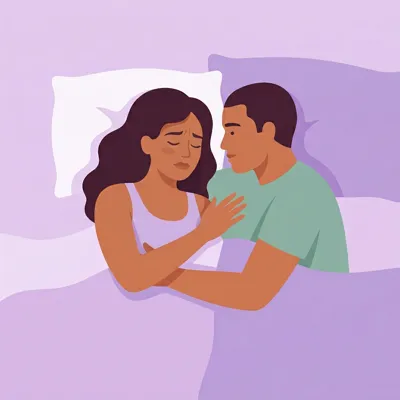
What you're describing, that it tears, it burns, it feels closed up, has a medical name, affects up to half of women after menopause, and it's treatable [3]. You're not exaggerating, and no, it isn't just your age. Painful sex builds a dread that pushes you to avoid intimacy altogether. Here's why your body reacts this way, and the concrete levers to find comfort again, without pain and without blaming yourself.
Falling oestrogen thinned the tissue, and it is not in your head
Your pain is real and it has a physical cause. Before menopause, oestrogen kept the vaginal wall thick, supple and naturally moist. As it falls, the lining (the inner wall of the vagina) becomes thinner, drier and less elastic [2].
The tissue stretches less, so penetration catches instead of gliding. That's exactly the feeling that it tears or it's closed up. Arousal also triggers less lubrication, and more slowly: the desire can be there and the moisture still lag behind [2].
There's a third change: the vagina's pH rises and its protective barrier weakens, which adds burning and irritation [2]. All of this has one name, genitourinary syndrome of menopause, and it affects up to half of women after menopause [1][3][6]. One point deserves your attention: after menopause, any bleeding during or after sex always warrants a medical check [9].
That name matters because it tells you what to fix. You're not repairing a feeling or a relationship: you're rehydrating tissue. This is not a failing, not in your head, and not something to just live with.
Sources (5)
- [2] Sarmento ACA, Costa APF, Vieira-Baptista P, et al. Genitourinary Syndrome of Menopause: Epidemiology, Physiopathology, Clinical Manifestation and Diagnostic. Front Reprod Health. 2021;3:779398.
- [1] Nappi RE, Kokot-Kierepa M. Vaginal Health: Insights, Views & Attitudes (VIVA) - results from an international survey. Climacteric. 2012;15(1):36-44.
- [3] Portman DJ, Gass ML; Vulvovaginal Atrophy Terminology Consensus Conference Panel. Genitourinary syndrome of menopause: new terminology for vulvovaginal atrophy. Menopause. 2014;21(10):1063-1068.
- [6] The 2020 Genitourinary Syndrome of Menopause Position Statement of The North American Menopause Society. Menopause. 2020;27(9):976-992.
- [9] American College of Obstetricians and Gynecologists. Committee Opinion: The Role of Transvaginal Ultrasonography in Evaluating the Endometrium of Women With Postmenopausal Bleeding. 2018.
Pain builds a dread that tightens muscles and drives avoidance
Often the worst part isn't the pain itself, it's the dread that settles in afterward. Sex hurt once, and your body, which is smart, files that away.
The next time intimacy gets close, the pelvic floor muscles (the muscular hammock that supports the lower belly) tense up on their own, a protective reflex [4]. That tensing makes penetration harder, so more painful. The fear is confirmed, and you avoid it more.
This reflex isn't a choice. It's the same kind of reaction as your eyelid snapping shut when something nears your eye. That's why 'just relax' doesn't work: you can't relax a reflex on command.
This loop is common. Up to one in four women who have this pain reduce or stop sex altogether [8]. If you've quietly closed that door, you are far from alone. The good news: once the pain eases and the pressure lifts, those muscles can finally let go, and the loop loosens.
Sources (2)
- [4] Faubion SS, Sood R, Kapoor E. Genitourinary Syndrome of Menopause: Management Strategies for the Clinician. Mayo Clin Proc. 2017;92(12):1842-1849.
- [8] Kingsberg SA, Wysocki S, Magnus L, Krychman ML. Vulvar and vaginal atrophy in postmenopausal women: findings from the REVIVE survey. J Sex Med. 2013;10(7):1790-1799.
Three real levers: lubricant, moisturiser, local oestrogen
Good news: there's a ladder of options, and you start on the lowest rung.
Lubricant is for the moment. You apply it right before or during sex to cut friction straight away [5]. Choose a water- or silicone-based one, fragrance-free, with a pH close to the vagina's own: an overly concentrated product can instead irritate already-fragile tissue [5].
A moisturiser is the background care. Used two to three times a week, apart from sex, it rehydrates the lining and restores some elasticity [5]. Think of daily cream for very dry skin. The two work together and are recommended as first-line care [6].
Local oestrogen is for when the tissue is too thin. Low-dose vaginal creams, tablets or pessaries rebuild thickness and moisture where the lack of oestrogen thinned everything [7]. Let's clear up a myth: very little is absorbed into the body, this is not systemic hormone therapy, and the safety profile stays favourable even long term [6][7]. Prasterone (a DHEA pessary that converts to hormones on site) or ospemifene (a tablet) are other options [4][6]. You have every right to ask for this treatment.
Sources (5)
- [5] Edwards D, Panay N. Treating vulvovaginal atrophy/genitourinary syndrome of menopause: how important is vaginal lubricant and moisturizer composition? Climacteric. 2016;19(2):151-161.
- [6] The 2020 Genitourinary Syndrome of Menopause Position Statement of The North American Menopause Society. Menopause. 2020;27(9):976-992.
- [7] Lethaby A, Ayeleke RO, Roberts H. Local oestrogen for vaginal atrophy in postmenopausal women. Cochrane Database Syst Rev. 2016;(8):CD001500.
- [4] Faubion SS, Sood R, Kapoor E. Genitourinary Syndrome of Menopause: Management Strategies for the Clinician. Mayo Clin Proc. 2017;92(12):1842-1849.
- [8] Kingsberg SA, Wysocki S, Magnus L, Krychman ML. Vulvar and vaginal atrophy in postmenopausal women: findings from the REVIVE survey. J Sex Med. 2013;10(7):1790-1799.
Intimacy is relearned without pressure, and named in plain words
Treating the tissue is half the road. The other half is relearning an intimacy where your body is no longer on alert. That starts by taking penetration out of the center for a while, long enough to rebuild trust.
Sex isn't only penetration [4]. Slower foreplay gives arousal time to build the lubrication you still make, and your muscles time to release. You move out of 'performance' mode into 'sensation' mode. When you feel ready, pelvic floor physiotherapy with a specialist can help release that protective tension [4].
Then the hardest part: the words. In silence, your partner may read rejection where there is pain [8]. Saying it lifts the blame from everyone. A few sentences are enough: 'I want you, but my body changed with menopause and sex hurts. It's not you. I'd love for us to find solutions together, at my pace.'
Saying 'I want you, but it hurts' turns a supposed rejection into a shared problem.
Sources (2)
- [4] Faubion SS, Sood R, Kapoor E. Genitourinary Syndrome of Menopause: Management Strategies for the Clinician. Mayo Clin Proc. 2017;92(12):1842-1849.
- [8] Kingsberg SA, Wysocki S, Magnus L, Krychman ML. Vulvar and vaginal atrophy in postmenopausal women: findings from the REVIVE survey. J Sex Med. 2013;10(7):1790-1799.
The pain you feel is not a verdict on your body or your relationship. It's a physiological signal: a lining that changed for lack of oestrogen, and that can be repaired. This week, you can try a moisturiser, keep a fragrance-free lubricant within reach, and log in the app the days you feel more comfortable. Book an appointment if the pain persists, or at any bleeding. You don't have to choose between hurting and pretending.
This article is for information only and does not replace the advice of a health professional. If a symptom worries you, talk to a doctor.