Am I pregnant? Decoding your body's signals
Why your symptoms look so much like PMS, and the one reliable way to know for sure.
4 min read
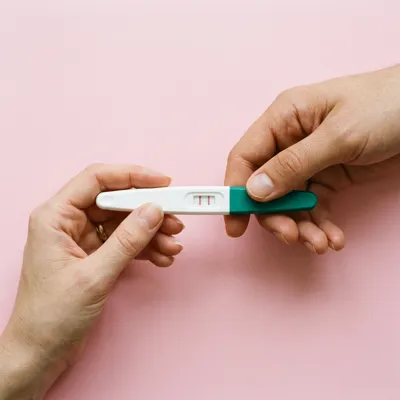
Sudden fatigue, nausea, sore breasts, a late period: your body is sending signals, and a small voice keeps asking, "what if?" This waiting can feel intense, and your questions are valid. Here is the truth: no single symptom proves a pregnancy on its own. Only one tool truly settles it, a test taken at the right time.
No single symptom proves a pregnancy on its own
Every body reacts differently. Some women feel several signs very early, others none for weeks. A missing symptom does not mean anything is wrong.
The most common signals in very early pregnancy:
- Missed period: the most reliable cue to test. Progesterone stays high and prevents the usual bleeding [1].
- Nausea: between the 4th and 6th week, driven by rising pregnancy hormone (beta-hCG) and estrogen [2] [3]. It affects 70 to 80% of pregnant women, at any hour despite its name [2] [4].
- Intense fatigue: progesterone has a strong sedative effect [1].
- Tender or swollen breasts: the mammary glands start preparing in the first weeks [1].
Other, lesser-known signals are just as real: frequent urination (kidneys filter about 50% more blood) [13], a sharper sense of smell (hyperosmia) [3], a metallic taste (dysgeusia) [3], and mood swings [1]. It is not "all in your head": it is a real biological response.
Sources (5)
- [1] Cunningham FG, Leveno KJ, Dashe JS, Hoffman BL, Spong CY, Casey BM. Williams Obstetrics. 26th ed. McGraw-Hill Education; 2022.
- [2] Lacroix R, Eason E, Melzack R. Nausea and vomiting during pregnancy: A prospective study of its frequency, intensity, and patterns of change. Am J Obstet Gynecol. 2000;182(4):931-937.
- [3] Niebyl JR. Clinical Practice: Nausea and Vomiting in Pregnancy. N Engl J Med. 2010;363(16):1544-1550. doi:10.1056/NEJMcp1003896
- [4] ACOG Practice Bulletin No. 189. Nausea and Vomiting of Pregnancy. Obstet Gynecol. 2018;131(1):e15-e30.
- [13] Cheung KL, Lafayette RA. Renal Physiology of Pregnancy. Adv Chronic Kidney Dis. 2013;20(3):209-214.
PMS or pregnancy: the same hormone blurs the picture
Let's be honest: most early signs look exactly like premenstrual syndrome (PMS). Breast tenderness, fatigue, bloating, mood swings, mild cramps. It is not your imagination, it is biology.
The reason: it is the same hormone, progesterone, in both cases [1]. After ovulation, your body makes it to prepare the uterus. In pregnancy, the pregnancy hormone (beta-hCG) takes over and amplifies everything. Otherwise, progesterone drops and your period arrives. During the wait, the symptoms are nearly indistinguishable [1].
Another source of doubt: implantation spotting (light bleeding as the embryo settles in, 6 to 12 days after fertilization) [5]. About one in four women notice it, often pink or brown, more subtle than a period [6]. It can appear before the expected date and be mistaken for an early period.
A few differences exist, with nausea and a sharper sense of smell being more specific to pregnancy [3], but none is reliable enough to decide. Only a test can.
Sources (4)
- [1] Cunningham FG, Leveno KJ, Dashe JS, Hoffman BL, Spong CY, Casey BM. Williams Obstetrics. 26th ed. McGraw-Hill Education; 2022.
- [5] Wilcox AJ, Baird DD, Weinberg CR. Time of Implantation of the Conceptus and Loss of Pregnancy. N Engl J Med. 1999;340(23):1796-1799. doi:10.1056/NEJM199906103402304
- [6] Hasan R, Baird DD, Herring AH, Olshan AF, Jonsson Funk ML, Hartmann KE. Patterns and predictors of vaginal bleeding in the first trimester of pregnancy. Ann Epidemiol. 2010;20(7):524-531. doi:10.1016/j.annepidem.2010.02.006
- [3] Niebyl JR. Clinical Practice: Nausea and Vomiting in Pregnancy. N Engl J Med. 2010;363(16):1544-1550. doi:10.1056/NEJMcp1003896
A test at the right time gives a reliable answer
Here is how to get a sure answer, step by step.
The urine test is the most accessible (pharmacy, supermarket, online). It detects the pregnancy hormone (beta-hCG) in your urine. Taken from the first day of a missed period, it is about 99% reliable [8] [9]. Use your first morning urine, the most concentrated.
The trap: testing too early. Before your expected period date, the hormone level may be too low, and a false negative is common [8]. The hormone becomes detectable only about 12 to 14 days after fertilization. If the test is negative but your period does not come, retest 3 to 5 days later [8].
The blood test (a serum beta-hCG measurement) is the gold standard. Prescribed by a doctor or midwife, it detects a pregnancy as early as 10 days after fertilization and gives a precise number [9]. In some countries, such as France, it is covered when prescribed.
Sources (3)
- [8] Gnoth C, Johnson S. Strips of Hope: Accuracy of Home Pregnancy Tests and New Developments. Geburtshilfe Frauenheilkd. 2014;74(7):661-669. doi:10.1055/s-0034-1368589
- [9] HAS (Haute Autorité de Santé). Suivi et orientation des femmes enceintes en fonction des situations à risque identifiées. Recommandations de bonne pratique. 2016.
- [10] Cole LA. The utility of six over-the-counter (home) pregnancy tests. Clin Chem Lab Med. 2011;49(8):1317-1322.
A positive test: your first steps, no rush
Two lines, a "+", the word "pregnant": take a moment to breathe first. Joy, surprise, worry, or all at once, every emotion is valid. Nothing has to be done the same day.
The concrete steps, at your own pace:
- Book an appointment with a doctor or midwife. In France, the first prenatal visit is recommended before the end of the 3rd month [9]. The first ultrasound, the dating scan, takes place between 11 and 14 weeks [11].
- Start folic acid (vitamin B9), 0.4 mg per day, from a pharmacy with or without a prescription [11] [12]. It cuts the risk of certain nervous system malformations by 50 to 70%, ideally started early [12].
- File your pregnancy declaration, before the end of the 14th week (16 weeks of amenorrhea) with your health insurance and family benefits office [9].
You have the right to take time to process it, to talk about it or not. Taking care of yourself starts with honoring what you need right now.
Sources (3)
- [9] HAS (Haute Autorité de Santé). Suivi et orientation des femmes enceintes en fonction des situations à risque identifiées. Recommandations de bonne pratique. 2016.
- [11] NICE (National Institute for Health and Care Excellence). Antenatal care. NICE Guideline NG201. 2021.
- [12] HAS. Projet de grossesse : informations, messages de prévention, examens à proposer. Recommandations de bonne pratique. 2009 (mise à jour).
You came with questions and leave with landmarks. No symptom proves a pregnancy on its own: only a test, taken at the right time, truly settles it. Whatever your situation, what you feel is valid. If you have any doubt or worrying bleeding, a doctor or midwife is there for you, without judgment, at your own pace.
This article is for information only and does not replace the advice of a health professional. If a symptom worries you, talk to a doctor.