Mood swings before your period: why, and what helps
Your emotions follow real brain chemistry. How to tell PMS from PMDD, and which practical steps to try.
4 min read
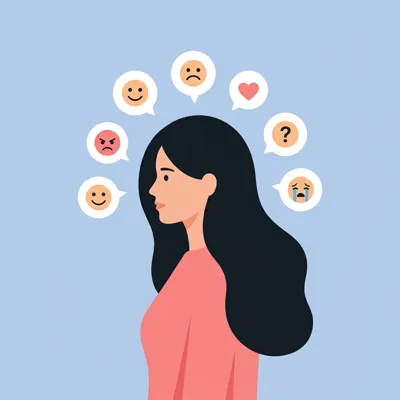
That moment when everything irritates you, then tears well up for no reason, followed by anger at yourself. What you're feeling is real: it's not a lack of willpower, it's biochemistry. Every month, your brain goes through genuine chemical shifts that change your mood. Here's why, and what can help you.
Your emotions follow a chemical tide, not your willpower
Every month, two hormones rise and fall like the tide: estrogen and progesterone. Your brain is wired directly into that movement.
Estrogen stimulates serotonin, the chemical messenger that regulates mood, sleep, and appetite. A few days before your period, estradiol drops sharply [1][2]. Serotonin follows, and your brain loses part of its emotional shock absorber.
At the same time, progesterone converts into allopregnanolone, a molecule that activates GABA receptors (your brain's braking and calming system). When progesterone drops before your period, it's like suddenly removing a natural tranquilizer [2].
The result: within a few days, your brain loses both its well-being messenger and its calming brake. This chemical storm, temporary but very real, explains the irritability, easy tears, and anxiety. It's not a character flaw.
Sources (2)
- [1] Halbreich U. The etiology, biology, and evolving pathology of premenstrual syndromes. Psychoneuroendocrinology. 2003;28 Suppl 3:55-99. doi:10.1016/s0306-4530(03)00097-0
- [2] Rapkin AJ, Akopians AL. Pathophysiology of premenstrual syndrome and premenstrual dysphoric disorder. Menopause International. 2012;18(2):52-59.
PMS or PMDD: a spectrum, and PMDD is a recognized disorder
There's a severity spectrum. PMS (premenstrual syndrome) affects 20 to 40% of women of reproductive age, with moderate to severe symptoms [3]. Irritability, fatigue, bloating, emotional sensitivity: uncomfortable, but without stopping you from functioning.
PMDD (premenstrual dysphoric disorder) affects 2 to 5% of women [4], and up to 8% by broader estimates [5]. It has been listed in the DSM-5, the standard reference manual in psychiatry, since 2013 [4]. What sets it apart is the impact: anger, despair, or anxiety that jeopardize work and relationships [6].
A key point: with PMDD, hormone levels are normal. It's the brain that reacts to them differently [5]. The amygdala (the brain's fear and emotion center) becomes hyperreactive, while the prefrontal cortex, which regulates emotions, loses efficiency [5]. These changes are comparable to those in recognized anxiety disorders [12]. No, it's not "all in your head."
With endometriosis, this burden is real and biological too. Chronic pain keeps the stress system on alert, and inflammation disrupts serotonin [11]. The risk of depression or anxiety is 1.5 to 2 times higher [11]. In France, endometriosis affects about one in ten women [10].
Sources (8)
- [3] Yonkers KA, O'Brien PM, Eriksson E. Premenstrual syndrome. The Lancet. 2008;371(9619):1200-1210.
- [4] Epperson CN, Steiner M, Hartlage SA, et al. Premenstrual Dysphoric Disorder: Evidence for a New Category for DSM-5. American Journal of Psychiatry. 2012;169(5):465-475.
- [5] Hantsoo L, Epperson CN. Premenstrual Dysphoric Disorder: Epidemiology and Treatment. Current Psychiatry Reports. 2015;17(11):87.
- [6] Heinemann LAJ et al. Explorative evaluation of the impact of premenstrual disorder on daily functioning and quality of life. Patient. 2010;3(2):125-132 ; Borenstein J et al. Journal of Occupational and Environmental Medicine. 2005. PMID: 15643156
- [12] Baller EB, Wei SM, Kohn PD, et al. Abnormalities of dorsolateral prefrontal function in women with premenstrual dysphoric disorder: a multimodal neuroimaging study. American Journal of Psychiatry. 2013;170(3):305-314.
- [11] Laganà AS, La Rosa VL, Rapisarda AMC, et al. Anxiety and depression in patients with endometriosis: impact and management challenges. International Journal of Women's Health. 2017;9:323-330.
- [10] INSERM, dossier Endométriose ; Stratégie nationale de lutte contre l'endométriose, Ministère de la Santé, 2022.
- [7] American College of Obstetricians and Gynecologists (ACOG). Clinical Practice Guideline No. 7: Management of Premenstrual Disorders. 2023.
Practical tools, at your own pace
No one is asking you to change everything at once. You'll choose the keys that speak to you, at your own pace.
- Move: 30 minutes of walking, swimming, or cycling, 3 to 5 times a week, raise serotonin and BDNF, a protein that nourishes your neurons [8].
- Feed your brain: tryptophan (eggs, turkey, banana, dark chocolate) helps make serotonin; magnesium and vitamin B6 support this conversion and ease irritability [9].
- Protect your sleep: a regular schedule and fewer screens in the evening make a real difference.
- Soothe your emotions: slow breathing (inhale for 4 counts, exhale for 6), journaling, and self-compassion are research-backed tools [13].
Cognitive behavioral therapy (CBT), a short, practical form of talk therapy, also helps you spot the thoughts that intensify before your period [5]. Ask your doctor or pharmacist before any supplement, and don't exceed 100 mg of vitamin B6 per day long-term, due to a risk to the nerves.
Sources (4)
- [8] Daley A. Exercise and premenstrual symptomatology: a comprehensive review. Journal of Women's Health. 2009;18(6):895-899.
- [9] Whelan AM, Jurgens TM, Naylor H. Herbs, vitamins and minerals in the treatment of premenstrual syndrome: a systematic review. Canadian Journal of Clinical Pharmacology. 2009;16(3):e407-e429.
- [13] Neff KD. Self-Compassion: An Alternative Conceptualization of a Healthy Attitude Toward Oneself. Self and Identity. 2003;2(2):85-101.
- [5] Hantsoo L, Epperson CN. Premenstrual Dysphoric Disorder: Epidemiology and Treatment. Current Psychiatry Reports. 2015;17(11):87.
Seeking help is self-care: PMDD is treatable
Asking for help is not weakness. If your emotional symptoms stop you from working or maintaining your relationships, talk to your doctor.
PMDD responds well to treatment. SSRIs (antidepressants that raise serotonin), taken continuously or only during the luteal phase, reduce symptoms in 60 to 75% of patients [5]. A specific pill (drospirenone/ethinylestradiol, on a 24 active days / 4 inactive days regimen) is approved for PMDD [5].
Sometimes PMDD and depression overlap. If your mood stays low throughout the whole cycle, not just before your period, a healthcare professional can help you tell the two apart.
To raise it in a consultation: "My mood changes dramatically before my period, and it's affecting my life." Or: "I've tracked my symptoms over two cycles, could you look at them with me?" You deserve to be heard.
Sources (1)
- [5] Hantsoo L, Epperson CN. Premenstrual Dysphoric Disorder: Epidemiology and Treatment. Current Psychiatry Reports. 2015;17(11):87.
The next time your mood wavers, you'll know why: your brain is temporarily losing two chemical allies. This is not a flaw, it's a reality shared by millions of women. Tools exist, and so do treatments. Tracking your emotions over two cycles can help both you and your doctor. You are not defined by your cycle, and asking for help is a right.
This article is for information only and does not replace the advice of a health professional. If a symptom worries you, talk to a doctor.